
CAR T cell therapy and stem cell transplant are among the most advanced treatment options for blood cancers such as leukemia, lymphoma and multiple myeloma. At City of Hope Orange County, decades of pioneering research and clinical expertise continue to expand access to these innovative therapies, bringing new hope to patients across the region and beyond.

“Both stem cell transplant and CAR T cell therapy represent major advances in how we treat blood cancers, but they work in very different ways and are used at different points in a patient’s journey,” says Tanya Siddiqi, M.D., the medical director of lymphoma for City of Hope Orange County and the director of the chronic lymphocytic leukemia program for the Toni Stephenson Lymphoma Center at City of Hope.
“In many cases, these therapies are not competing choices, but complementary tools we use thoughtfully over time,” says Dr. Siddiqi. “Our role is to help patients understand these options in the context of their specific diagnosis, prior treatments and overall health, so we can recommend the approach most likely to lead to the best possible outcome.”
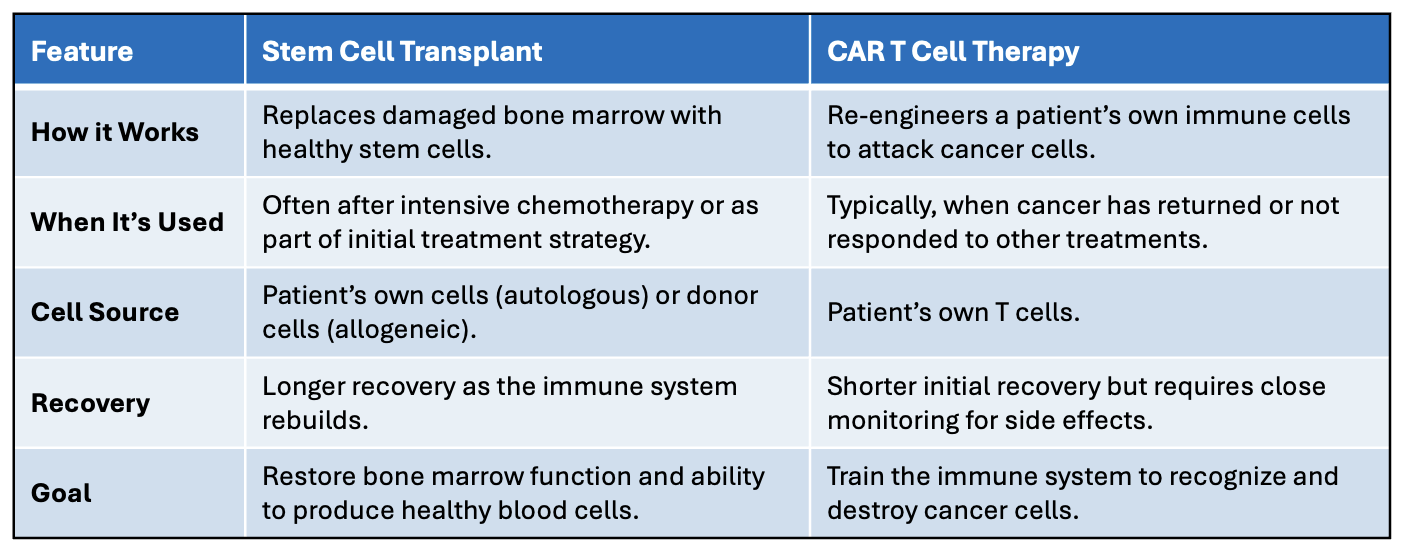
Quick comparison: CAR T vs. stem cell transplant
- What is a stem cell transplant?
The goal of stem cell transplantation is to restore healthy blood-forming cells after intensive cancer treatment.
In an autologous transplant, doctors collect and store a patient’s own stem cells before treatment, then return them to help rebuild the bone marrow and immune system. In an allogeneic transplant, stem cells come from a donor, replacing diseased cells with healthy ones.
City of Hope has performed more than 20,000 bone marrow and stem cell transplants since 1976, reflecting decades of highly specialized expertise in researching and treating complex blood cancers.
“With City of Hope, I got hope and a second chance at life,” says Laguna Beach resident Arash Rounaghi, who successfully received a stem cell transplant at City of Hope for leukemia, utilizing healthy cells donated by his son. “Having City of Hope in our community changes everything for patients like me.”
- What is CAR T cell therapy?
CAR T cell therapy is a type of immunotherapy that uses a patient’s own immune system to fight cancer.
Doctors collect T cells from the patient’s blood and modify them in a laboratory so they can better recognize and attack cancer cells. These enhanced cells are then returned to the body to target the disease.
CAR T cell therapy may be an option for certain blood cancers, especially when other treatments have stopped working or the cancer has returned.
At City of Hope Orange County, physician-scientists are studying how CAR T and other cellular therapies may expand into treating additional types of cancer, including solid tumors.
Huntington Beach resident Kathy Miller Wilahan is grateful to be back doing the things she loves following successful CAR T therapy at City of Hope for non-Hodgkin’s lymphoma. “Thanks to City of Hope, I can enjoy my family, especially my new great-grandson, travel and pickleball,” she says.
What cancers can stem cell transplant and CAR T cell therapy treat?
Both stem cell transplant and CAR T cell therapy are used to treat blood cancers, though they play different roles depending on the patient’s individual condition.These treatments may be considered for:
CAR T cell therapy is currently approved for select types of non-Hodgkin lymphoma, acute lymphoblastic leukemia and multiple myeloma. Stem cell transplant, by contrast, has been a foundational treatment for decades across a broad range of blood cancers and bone marrow disorders.
How do doctors decide which treatment is right?
Treatment decisions are highly individualized. Doctors consider multiple factors, including:- The type and stage of cancer
- Whether the disease has returned
- How aggressive it is
- The patient’s overall health
- Treatment goals and preferences
City of Hope Orange County’s multidisciplinary teams collaborate closely to design personalized treatment plans for patients with cancer. These plans address not only the cancer itself, but also side effects, recovery, quality of life and long-term survivorship.
Can patients receive both CAR T and stem cell transplant?
Yes, in certain cases. These therapies are not always “either-or.”
Some patients may receive both treatments at different points in their care. For example, CAR T cell therapy may be used before or after a stem cell transplant, depending on how the disease responds and the patient’s overall health.
What are the side effects and recovery differences?
Stem cell transplant and CAR T cell therapy involve different treatment experiences.
Stem cell transplant typically:- Requires intensive chemotherapy beforehand
- Involves a longer recovery period
- Requires time for the immune system to rebuild
CAR T cell therapy:
- Uses engineered immune cells rather than chemotherapy alone
- May cause temporary but potentially serious side effects such as fever, fatigue, low blood pressure or neurologic symptoms
- Requires close monitoring, especially in the early phase
Recovery varies from patient to patient. At City of Hope, specialized teams closely monitor patients throughout treatment and recovery, helping manage side effects and supporting long-term follow-up care.
Are these treatments curative?
In some cases, stem cell transplant or CAR T cell therapy may lead to long-term remission. For certain patients, these treatments can offer durable control of their cancer.
Outcomes can vary depending on:- The type of blood cancer
- How advanced it is
- Prior treatments
- Overall health
Ongoing research at City of Hope continues to advance these therapies and explore how they can be used earlier or in combination to improve outcomes for more patients.
The next chapter of hope is here
City of Hope Orange County’s network of care is built with a single purpose: saving lives. It includes an outpatient cancer center and Orange County’s only dedicated cancer specialty hospital, located on the organization’s 72-acre academic research campus in Irvine, along with the region’s largest network of advanced cancer care.
Patients have access to more cancer-focused clinical trials than anywhere else in California, including first-in-human studies and trials requiring specialized inpatient care.
Also read:
A Living Promise of Hope
For Patients with Blood Cancer, A Promise Fulfilled
Clinical trials: How City of Hope Orange County fuels discoveries for patients with cancer