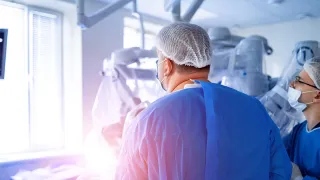
City of Hope Orange County, part of one of the largest and most advanced cancer research and treatment organizations in the U.S., has performed Orange County’s first single-port robotic colorectal surgeries, placing it among the first centers in Southern California to bring the leading-edge, minimally invasive approach to patients with colorectal cancer.

The only surgeon in Orange County currently conducting these procedures, City of Hope Orange County colorectal surgeon Amir Esparza, M.D., has performed three single-port robotically assisted surgeries: two right hemicolectomies, which remove the right side of the colon, and one complex total colectomy, which removes the entire colon.
Esparza is among a handful of colorectal surgeons nationally breaking new ground in single-port robotic surgery, as innovations in the high-precision technology expand its use for increasingly complex procedures.
“Single-port surgery is opening possibilities in colorectal cancer care that simply weren’t available to us before,” Esparza said. “For patients, a minimally invasive approach typically means less postoperative pain, a shorter hospital stay, fewer complications and less scarring. Being able to have just one incision only magnifies these advantages. We need more experience and data to fully understand the benefits, but I believe this approach is going to be adopted quickly as the technology continues to evolve.”
Conventional robotic colorectal surgery typically requires several small incisions for a camera and robotic instruments. Using the da Vinci SP surgical system, Esparza can introduce a flexible camera and three robotic instruments through a single incision of about an inch. The instruments move independently inside the body, providing the high precision and maneuverability needed for complex procedures.
Esparza’s first single-port colorectal patient successfully underwent a robotic single-port right hemicolectomy and went home the next day. At her one-week follow-up, “she was recovering remarkably well with little outward sign of having undergone major abdominal surgery,” Esparza said. Pathology following surgery showed no evidence of remaining cancer.
Single-port surgery may also offer options for patients who are challenging candidates for conventional robotic surgery, including those with scar tissue from previous abdominal procedures that can make multiple surgical access points more difficult to utilize.
Single-port technology could also expand options for transanal surgery. For certain colorectal tumors and lesions, the system can be introduced through the body’s natural anatomy, potentially eliminating the need for an abdominal incision altogether. For select patients, it could also provide an alternative to advanced endoscopic procedures that can take several hours. Esparza said some could potentially be completed in a fraction of that time using a single-port robotic approach.
“This changes the way we can think about accessing the colon and rectum,” Esparza said. “We are still learning what the limits of this technology are and what may be possible for patients with cancer.”
Esparza was introduced to single-port robotic surgery in 2019, when its colorectal applications were limited. As advances in instrumentation made more complex procedures possible, he pursued additional training and consulted with early adopters around the country. After he shared video of his first case, more than 15 surgeons contacted him to learn more about his approach.
The achievement builds on City of Hope’s leadership in robotic and minimally invasive cancer surgery. The organization’s Irvine academic research campus recently expanded those capabilities with the opening of Orange County’s only cancer specialty hospital, doubling surgical capacity and bringing lifesaving cancer care closer to patients in the region.
Ending cancer starts with Hope. To make an appointment at any of City of Hope’s Orange County locations, call 888-333-HOPE (4673).
Talking Hope: How liquid biopsies are reshaping colon cancer detection and treatment
A Living Promise of Hope
Gastrointestinal Cancer Care in Orange County