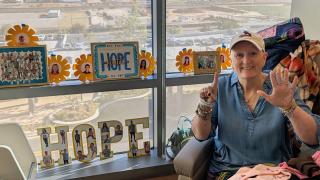
Nan Magdits is from Missouri, where she says, “There's something to be said for looking a problem squarely in the eye, figuring out what's needed and getting on with it.”
So when gynecologic cancer upended her life and timely access to advanced care became a concern, Nancy and her family looked beyond her own backyard. She found the answers she needed at City of Hope Orange County, where a multidisciplinary team offered specialized, cancer-focused expertise and something just as important: hope.
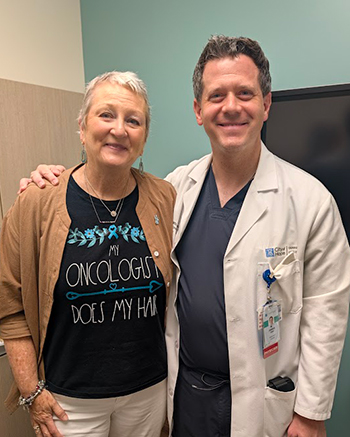
When Magdits felt overwhelmed by her cancer diagnosis, she drew confidence knowing the care team that was there for her. She met with Joshua G. Cohen, M.D., the medical director of gynecologic oncology at City of Hope Orange County and an associate clinical professor at City of Hope, who laid out a personalized treatment plan: chemotherapy, surgery, more chemotherapy and maintenance treatment to follow.
The clarity of that plan and access to the expertise and resources of one of the most advanced cancer and treatment and research organizations in the U.S. reassured Magdits that she was in good hands. “I feel like he and the entire team at City of Hope saved my life,” says Magdits.
When waiting wasn’t an option
Magdits's cancer journey began in February 2025 with persistent stomach pain. A CT scan ordered by a hematologist-oncologist she was already seeing for an unrelated issue revealed suspicious areas and led to further testing.
An MRI near her Missouri home could take six weeks. Her family found a way to have it done sooner, but when the results led to a recommendation for a biopsy, Magdits learned that could take as long as eight weeks.
Knowing that cancer doesn’t wait, and that specialized cancer care at advanced cancer centers saves lives, she and her husband decided they needed to travel the 1,700 miles from rural Missouri to Orange County, California. At City of Hope’s academic research campus in Irvine, Magdits underwent testing and met with Dr. Cohen and teams of cancer-focused experts. The pathology confirmed high-grade serous carcinoma — cancer that had originated in a fallopian tube and spread to her abdomen.
“I think that if I had had to wait the eight weeks to get the biopsy, we would be talking about a different story,” Magdits says. “Instead, by eight weeks, I was here at City of Hope and had started chemo.”
Magdits and her husband of 45 years, Lou, found an apartment near her care team and settled in for an extended stay. From the beginning, she had a patient navigator and a care team she could call with questions — invaluable resources, she says. Magdits came to appreciate the personal attention she received. “You're not a number at City of Hope,” she says. “You're a face they remember.”
At the core of her support network was her family. Along with her husband
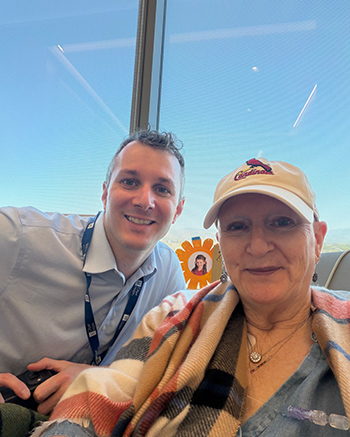
was sister Trisha, daughter Jordan and her husband Nathan, son Ian and his wife Annie, and son Louis and his wife Anne, along with seven grandchildren. Louis is a City of Hope leader who serves as the vice president of ambulatory services at City of Hope Orange County and the chief operating officer for City of Hope Medical Foundation. For Louis, experiencing City of Hope as the loved one of a patient was moving. He recounts that no matter who accompanied his mother to an appointment, he noticed that the team's attention remained on her. “They're looking at my mom,” Louis says. “They want to know how she feels, what she's thinking. That meant a lot to us.
Life Saving Surgery
Dr. Cohen had described the next step as “a big surgery,” says Magdits.
It was.
The complex operation lasted seven hours, and Magdits spent 10 days in the hospital, including Christmas.
“It's one of those things where you know you have to do it,” she says. “It's not elective. ‘If you want to live, you have to have it done, I told myself.’ What carried me through was my family and the skill and compassion of everyone at City of Hope who cared for me.”
Magdits returned to the apartment on Dec. 26 and focused on rebuilding her strength. In March 2026, after successfully completing three more rounds of chemotherapy, she rang the bell at the infusion center surrounded by family and members of her care team.
“It was a wonderful feeling,” she says.
A community she never expected to need
Cancer also introduced Magdits to what she calls “a whole community that I never thought that I would be a member of, need or want. I didn't realize how much I needed it until it became part of my life. From fellow patients to staff and volunteers, the caring, commitment and compassion shown is the crowning attribute of City of Hope.”
Reflecting on advice she might offer to other patients, Magdits says: “You have to be your own advocate or have advocates that work for you,” she says. “I couldn't have done it without my husband, my children, my sister and friends. Everybody is working toward the same goal. They are with me through every step of this journey.”
Taking hope home
Magdits looks forward to returning to Missouri when she completes treatment, but her time on the West Coast has brought unexpected blessings. Louis and his parents had not lived in the same town since 2008. Now they’re minutes apart, sharing meals and simply spending time together in a way distance rarely allowed before.
“You don't think anything good can come out of this, but nothing can replace the family time we have been able to share together,” Magdits says.
When Magdits returns to Missouri, she’ll be bringing a unique keepsake: a holiday tree her family put up for her during treatment. Friends from around the country began sending Christmas ornaments, each chosen because it meant something to Magdits or reminded her of the person who sent it. “For me, the tree is a symbol of hope. City of Hope made my hope a reality. And hope goes everywhere with me,” Magdits says.
Ending Cancer Starts with Hope. To make an appointment at any of City of Hope’s Orange County locations, call 888-333-HOPE (4673).
Talking Hope: What every woman should know about gynecologic cancers
City of Hope Orange County physician-scientists advance clinical research in gynecologic oncology