Linda Malkas, Ph.D., never dreamed that a 2005 newspaper interview about her leukemia research would lead her to develop a powerful cancer-fighting drug.
During the interview, Indiana Star photographer Steve Healey shared that his 8-year-old daughter was in a five-year battle against neuroblastoma, a rare cancer that springs from immature nerve cells. His openness inspired Dr. Malkas, then the Vera Bradley chair of oncology at Indiana University School of Medicine, to share details of her current research. At the time, she was studying how DNA replication — the process of how DNA makes copies of itself — works differently in cancer cells.
“I knew there was very little I could do for this man. But I gave him the only thing in this world that is truly mine — my data,” she says. “For two hours, I showed him graphs and tables of numbers and explained how DNA replication isn’t the same in cancer cells.”
Dr. Malkas kept tabs on Steve’s daughter Anna until she died less than a year later. She didn’t expect to hear from Steve again. Then, he called one day and asked to see her at her lab. During that visit, Steve and his wife explained that on her last trip to the hospital, Anna had expressed a wish for more cancer research.
“That’s when he handed me a check for $25,000. These are not rich people, but they changed my life,” Dr. Malkas says. “At that point, I knew I wanted to do something bold in the name of their little girl.”
That moment launched Dr. Malkas’s journey to creating AOH1996, the cancer-killing drug named after Anna Olivia Healey and her birth year.
Discovering a Valuable Target
Shortly before joining City of Hope 2011 as the associate director for basic science, Dr. Malkas determined that a protein linked to DNA replication and repair could hold the key to destroying cancer cells.
This protein, called proliferating cell nuclear antigen (PCNA), binds to 200 other proteins and is required for accurate DNA replication in every cell. But in cancer cells, PCNA is corrupted and continues to make copies of damaged DNA.
Dr. Malkas, now City of Hope dean of translational science and external affairs, says she saw this discovery as an opportunity to apply the Healeys’ gift.
“With the check in my hand, I told my husband if we could make a drug against this corrupted protein, it could potentially attack only cancer cells,” she says. “It would leave normal cells alone and be much less toxic or, perhaps, not toxic at all.”
There was just one problem to overcome. PCNA has only protein-binding activity. It can’t respond to therapeutic drugs.
Developing a Powerful Cancer-Fighting Drug
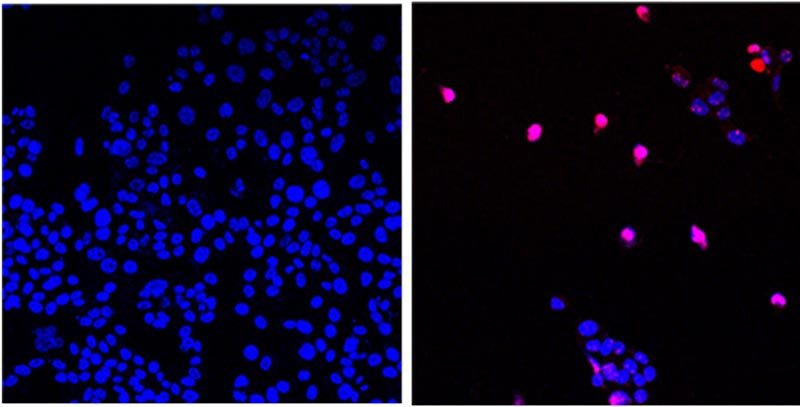
Dr. Malkas found the solution to this dilemma in AOH1996. This oral drug works like a molecular glue that prevents corrupted PCNA from binding to other proteins linked to DNA replication. In many ways, she says AOH1996 is like a snowstorm that shutters a major airport.
“Think of PCNA as an airport terminal with 200 jetways. When AOH1996 comes in, it blankets every point of connection,” she says. “This drug accomplishes a major shutdown — it stops corrupted PCNA from replicating damaged DNA, destroying the cancer cells.”
AOH1996 holds extraordinary promise as a cancer-killing drug. In partnership with the PRISM Lab at the Broad Institute of Harvard University and Massachusetts Institute of Technology, Dr. Malkas has examined 900 different cell lines across a wide variety of cancers. Corrupted PCNA exists in every type of cancer her team has studied.
“So, when it comes to using AOH1996 to fight disease — if it’s cancer, we’ve got it,” she says.
Improving Existing Cancer Treatments
The first patient received AOH1996 as part of a clinical trial in 2022. Since then, Dr. Malkas has partnered with several investigators nationwide to test how well the drug performs against multiple types of solid tumors. These initial efforts have produced encouraging results, including:
- A 50% decrease in the size of liver tumors metastasized from pancreatic cancer
- A 50% reduction in doses of cisplatin, a highly toxic platinum-based therapy for cervical cancer
Now, Dr. Malkas is looking to add AOH1996 to treatments for “liquid cancers,” (cancers of the blood) including multiple myeloma and acute myeloid leukemia (AML). She recently launched a clinical trial focused on AML with City of Hope hematologist Amanda Blackmon, D.O. Initial results show that AOH1996 enhances the effectiveness of venetoclax and cytosine, two drugs used in standard-of-care medication cocktails for AML.
Dr. Malkas says these outcomes could open the door for AOH1996 to strengthen newer, more personalized cancer therapies even further.
“Today, we understand much more about the genetics behind each patient’s tumor. We can almost make an individualized cocktail of cancer drugs to treat them,” she says. “By adding AOH1996 to the mix, we can decrease the amount of toxic medication without lowering the effectiveness of cancer therapy. So, I believe AOH1996 is going to be the olive in everyone’s cancer cocktail.”
Plus, because AOH1996 only attacks cancer cells and leaves healthy cells with uncorrupted PCNA alone, patients can receive high doses without experiencing negative side effects, such as extreme fatigue or nausea.
“I’m doing two things,” Dr. Malkas says. “I’m helping wipe out cancer, and I’m also helping to potentially improve the quality of life for patients.”
The Power of Donor Support
Dr. Malkas says City of Hope’s unique research- and donor-based model makes much of her work possible. By connecting interested donors with innovative, forward-thinking investigators, the institution ensures new, life-changing discoveries make their way into the clinic.
The Kal and Lucille Rudman Foundation recently offered this kind of support to Dr. Malkas with a $220,000 donation. Mitch Rudman, son of the late Kal and Lucille Rudman and director of the family foundation, was intrigued when he first started reading about the progress Dr. Malkas and her team were making with AOH1996. A scientist and inventor in his own right, Rudman had been following the field of cancer drug development for years.
“What got me excited was the extraordinary target…the idea that you could find one thing that all cancer cells have in common—everyone had given up on this idea but then Dr. Malkas found it,” he says.
Rudman met with Dr. Malkas to discuss her research and hear her story. Her persistence over two decades in the face of skepticism made an impression on him: “The important thing is when people tell you what can’t be done, don’t believe them. And Dr. Malkas did not believe them. She kept working on this. She just didn’t give up.”
The Rudman funds will bolster her efforts to collect the clinical trial data about safety, complications and contraindications that the Food & Drug Administration needs for drug approval.
“I am extremely grateful for donors like the Rudman Foundation who take these enormous risks. This is where the magic happens,” Dr. Malkas says. “They take a big bet on our brains as researchers to help us get the data that can take our science and discoveries to the next level.”
Ultimately, Dr. Malkas says her career took a different path than she expected. She appreciates each opportunity she’s had to gather data and explore the impact AOH1996 can have on cancer treatment.
“At the beginning of my career, I thought I would study DNA replication and repair forever,” she says. “I never anticipated that my work would blossom into a drug that has such potential as a cancer-fighting tool. I’m grateful every day for the support I receive to work with my clinical and basic science colleagues. The synergy leads to amazing results that go far in benefiting patients.”