Breast Biopsy
April 10, 2025
This page was reviewed under our medical and editorial policy by Susan Yost, Ph.D., staff scientist, Department of Medical Oncology & Therapeutics Research, City of Hope® Cancer Center Duarte
When breast symptoms or imaging tests like mammograms suggest a possible concern, doctors often recommend a breast biopsy. Having this procedure does not automatically mean breast cancer is present. In fact, most biopsy results are benign, meaning they are not cancerous.
However, a biopsy is the only way to determine for sure if there is anything to be concerned about. This important step helps the care team understand what is happening inside the breast and plan the next steps accordingly.
What Is a Breast Biopsy?
A breast biopsy is a procedure in which a doctor removes a small piece of breast tissue or tumor, called a sample, to check for cancer cells. This process helps doctors understand if a suspicious area in the breast is cancerous or not. There are different types of breast biopsies, and the method used depends on various factors, such as:
- How suspicious the area looks or feels
- Its size
- Its location
- If there are multiple areas of concern or just one
Most breast biopsies are performed by inserting a hollow needle into the breast to take the sample. In some cases, a surgical biopsy might be necessary, where the doctor makes a small cut in the skin to remove a sample.
It is always a good idea to ask the doctor about the type of biopsy being performed and why, and what to expect during and after the procedure.
The doctor may also place a breast biopsy clip (or breast biopsy marker). This clip is a small metal object placed in the breast during a biopsy to mark the spot where the tissue sample was taken. The clip helps identify the area on future imaging tests or if surgery is needed. The clip is tiny, does not cause pain or harm, and may safely remain in the breast. If the abnormal area is later removed during surgery, the surgeon will usually remove the clip along with it.
Once the biopsy is completed, the samples are sent to a laboratory, where an expert called a pathologist examines them under a microscope.
What Percentage of Breast Biopsies Are Cancer?
Each year, more than 1 million women in the United States undergo breast biopsies, often after noticing symptoms or finding something unusual during a mammogram or breast self-exam. Only about 20% of these biopsies result in a cancer diagnosis, according to the Agency for Healthcare Research and Quality.
This means that most biopsies — about 80% — do not show cancer. While waiting for results may be stressful, it is helpful to know that the majority of biopsies reveal noncancerous conditions. These conditions are still important to address, but typically they are not life-threatening.
Types of Breast Biopsy
There are several types of breast biopsies, each tailored to different situations. The type of biopsy a patient has depends on factors such as the size and location of the suspicious area, as well as the patient’s overall health and preferences.
Core Needle Breast Biopsy
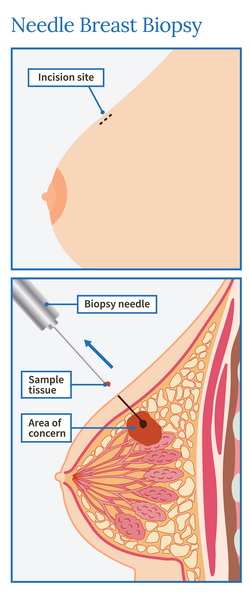
A core needle biopsy is a procedure in which a doctor uses a hollow needle to remove small pieces of tissue from a suspicious area in the breast. The needle is often attached to a tool that moves it quickly in and out of the tissue or a suction device that helps collect the tissue (known as a vacuum-assisted core biopsy). Several small tissue samples, called cores, are usually taken during the procedure.
To ensure accuracy, doctors typically use imaging tests like a mammogram, breast ultrasound or magnetic resonance imaging (breast MRI) to guide the needle to the appropriate spot.
Fine Needle Aspiration
A fine needle aspiration (FNA) is a procedure in which a very thin, hollow needle attached to a syringe is used to obtain a sample of tissue or fluid from a suspicious site in the breast. FNA is often used when a lump is likely to be a cyst, which is a fluid-filled sac. Removing the fluid might relieve discomfort and confirm whether the lump is a cyst or a solid mass.
If the area is easy to feel, the doctor may guide the needle by touch. If not, the doctor may use an ultrasound to guide the needle to the appropriate spot. The sample is then quickly examined for cancer cells. Since FNA collects only a small amount of tissue, additional samples may be needed.
Excisional Breast Biopsy
An excisional biopsy is a surgical procedure in which a surgeon removes the entire suspicious area or tumor from the breast to check for cancer cells.
This type of biopsy is often recommended when results from a needle biopsy, such as a core needle biopsy or fine needle aspiration, are not conclusive. A small margin of normal tissue around the abnormal area is also removed in some cases.
If the breast lump is able to be felt, the surgeon might use touch to guide the biopsy. However, if the area is hard to find, imaging tests like mammography or ultrasound may be used to place a marker, helping the surgeon locate the exact spot.
Preparing for the Breast Biopsy Procedure
Before a breast biopsy, patients should follow their provider’s instructions to ensure the procedure goes smoothly. Patients who take blood thinners, including aspirin, may be advised to stop them several days before the biopsy to reduce the risk of bleeding. Patients should discuss any medications or supplements they take with their provider and mention any allergies, especially to the anesthesia team.
For procedures involving general anesthesia, fasting for several hours beforehand is usually required. Since general anesthesia or sedatives might cause grogginess after the procedure, patients need to arrange for someone to drive them home.
On the day of the biopsy, wearing loose, comfortable clothing is recommended. Patients may need to remove clothing and jewelry from the area being examined and might be asked to change into a gown. Having someone accompany the patient may also provide support and ease any stress.
How Long Does a Breast Biopsy Take?
A breast biopsy typically takes about an hour to complete. Most are performed on an outpatient basis, meaning patients go home the same day.
The doctor numbs the area with a local anesthetic to minimize discomfort. Depending on the type of biopsy, the doctor may use an ultrasound or another imaging test to guide the needle to the appropriate spot.
After taking the necessary tissue samples, the doctor removes the needle, applies pressure to stop any bleeding and covers the site with a dressing. No stitches are needed, and patients may usually return to their normal activities shortly after.
How Painful Is a Breast Biopsy?
During a breast biopsy, patients typically experience little discomfort. A local anesthetic is used to numb the area, which may cause a brief pinprick and mild stinging.
Once the area is numb, patients usually feel some pressure when the biopsy needle is inserted and during tissue sampling, but it should not be painful. Hearing clicks or buzzing sounds from the biopsy tool is normal.
After the procedure, some swelling and bruising may occur, which may be managed with over-the-counter pain relievers and cold packs. Most patients report little pain and no scarring on the breast.
How Long Do Breast Biopsy Results Take?
After a breast biopsy, the results typically take several days to a week to come back.
Once the tissue sample is collected, a pathologist examines it under a microscope to make a final diagnosis. The pathologist looks for any signs of cancer or abnormal cells, then prepares a report containing detailed information about the findings. This report is then sent to the health care provider who ordered the biopsy. The health care provider reviews the pathology report and explains the results to the patient. The report will fall into one of several categories, as listed below.
Normal: No cancer or abnormal cells are found.
Abnormal but noncancerous changes: There are changes in the breast tissue that are not cancerous and do not increase the risk of breast cancer. Some conditions may resolve on their own, while others might need treatment.
Abnormal changes with increased cancer risk: These cells are not cancerous but may increase the patient’s risk of developing breast cancer. If this is found, the provider may recommend a surgical biopsy to remove the abnormal tissue.
Breast cancer: If cancer cells are present, the report will include details about how aggressive the cancer is and how much the cancer cells differ from normal cells. This information helps guide the treatment plan.
In some cases, even if cancer is not found, surgery may still be recommended if the biopsy results do not match the findings from imaging tests. Follow-up exams may also be necessary to monitor changes or evaluate treatment progress.
Benefits, Risks and Limitations
A needle biopsy offers several benefits but also carries some risks and limitations. The procedure is less invasive than a surgical biopsy, usually takes less than an hour and leaves little to no scarring. It allows doctors to obtain tissue samples that help determine if a breast lump is benign (noncancerous) or malignant (cancerous).
Ultrasound-guided biopsies are particularly useful because they do not involve radiation, and the doctor is able to monitor the needle’s movement in real-time. This method also evaluates hard-to-reach areas, such as lumps near the chest wall or under the arm. Additionally, patients often return to normal activities shortly after the procedure.
However, like any medical procedure, a breast biopsy carries some risks. With a needle biopsy, there is a small chance of bleeding or developing a hematoma (a collection of blood at the biopsy site), but this risk is less than 1%, according to the Radiological Society of North America. Some patients may experience discomfort, which is usually managed with over-the-counter pain relievers.
For excisional biopsies, patients may experience bruising, bleeding or swelling. These typically go away on their own over time. Patients may have a scar or a change in breast shape depending on how much tissue is removed.
With any biopsy, there is also a slight risk of infection, but this is rare and may be treated with antibiotics if it occurs. In very rare cases, a biopsy needle may pass through the chest wall and cause air to enter the area around the lung, potentially leading to lung collapse (pneumothorax).
Another limitation is that the biopsy may not always provide a definitive answer, which could require further testing or procedures. Despite these risks, complications are uncommon, and the benefits of obtaining a clear diagnosis often outweigh these potential issues.
American Cancer Society. Breast biopsy, February 27, 2024.
https://www.cancer.org/cancer/types/breast-cancer/screening-tests-and-early-detection/breast-biopsy.htmlNational Cancer Institute. Breast health: follow-up after an abnormal mammogram, March 2, 2023.
https://www.cancer.gov/types/breast/breast-changesAgency for Healthcare Research and Quality. Core-needle biopsy for breast abnormalities, May 26, 2016.
https://effectivehealthcare.ahrq.gov/products/breast-biopsy-update/clinicianAmerican Cancer Society. Core needle biopsy of the breast, January 14, 2022.
https://www.cancer.org/cancer/types/breast-cancer/screening-tests-and-early-detection/breast-biopsy/core-needle-biopsy-of-the-breast.htmlAmerican Cancer Society. Fine needle aspiration (FNA) of the breast, January 14, 2022.
https://www.cancer.org/cancer/types/breast-cancer/screening-tests-and-early-detection/breast-biopsy/fine-needle-aspiration-biopsy-of-the-breast.htmlAmerican Cancer Society. Surgical breast biopsy, January 14, 2022.
https://www.cancer.org/cancer/types/breast-cancer/screening-tests-and-early-detection/breast-biopsy/surgical-breast-biopsy.htmlMedlinePlus. Breast biopsy, September 28, 2022.
https://medlineplus.gov/lab-tests/breast-biopsy/Radiological Society of North America. Ultrasound-guided breast biopsy, May 1, 2023.
https://www.radiologyinfo.org/en/info/breastbius