How to Perform a Breast Self-Exam
April 10, 2025
This page was reviewed under our medical and editorial policy by Leah Naghi, M.D., assistant clinical professor, and Susan Yost, Ph.D., staff scientist, Department of Medical Oncology & Therapeutics Research, City of Hope® Cancer Center Duarte
A breast self-exam (BSE) is one of the tools that women may use to help detect breast cancer, in addition to physical exams and mammogram screenings with their doctor. Self-examination allows women to become more familiar with their breasts — including the normal changes that may occur during their lifetime and the potentially abnormal changes that they should report to the doctor right away.
What Is a Breast Self-Exam?
A breast self-exam is when a woman feels her own breasts to find any changes that are not typical, such as lumps or masses; nipple discharge that is not breast milk; or skin redness, itching, dimples, puckering, darkening or swelling.
While the American Cancer Society does not recommend breast self-exams for women who are at average risk for developing breast cancer, if atypical changes occur, they should be reported to the patient’s medical care team right away. Sometimes these breast changes are due to medication or other health issues, and the doctor may run further tests to determine the cause.
Detecting breast changes, along with mammograms and doctor visits, may help with early breast cancer detection. Finding breast cancer in early stages is associated with an increased chance of longer survival.
How to Do a Breast Self-Exam
After deciding to perform a breast self-exam, there are a few techniques to learn. The exam may be performed while lying down or standing up. In either case, it is important to try to choose a relaxing spot that is free from interruptions.
Each of the breast self-exam methods are described below.
Steps to Take When Standing
To examine the breast for unusual firmness or lumps while standing:
- Remove any clothing covering the breasts, like a shirt, dress or bra.
- Stand and place the arm that is on the side of the breast to be examined behind the head.
- Take the other hand and, with fingertips pressed together, firmly press down on a spot on the opposite breast (especially with the middle finger) while rotating the fingers in a small circle.
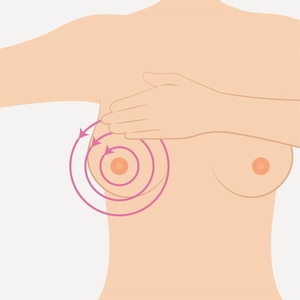
- Use varying degrees of pressure in each spot before moving on to the next.
- Move the fingers around to the next spot using a series of circles so that the outermost tissue, middle and inner tissues (closest to the nipple) are all examined.
- Squeeze the nipple gently to check for discharge (other than breast milk).
- Repeat these steps on the opposite breast.
Some people may prefer to use their fingers to examine the breast from top to bottom and back up again, rather than in a series of circles. Another option is to move the fingers in a series of straight lines that run from the outermost tissue to the nipple until all the breast tissue has been checked. Whichever option is chosen, it is important to examine all areas of the breast for unusual features.
After examining the tissue of the breast, remain standing or sit to examine lymph nodes under the armpit. Note whether any nodes are enlarged, movable or fixed. Repeat this on the other armpit and also on the lymph nodes that are located above and below the collarbone.
In addition to feeling the breast tissue, a standing breast self-exam includes a visual inspection of the breast in a mirror from different angles and positions. Women may follow these steps to look for changes:
- Begin by removing any clothes covering the breasts and stand directly facing a mirror in a well-lit room with arms by the side.
- Check the skin of the breasts for any redness, breast rashes, swelling, darkening, inflammation, indentations (dimples), small folds or wrinkles (puckering), or texture changes that resemble an orange peel.
- Look for changes in the breasts’ size and shape, including any new asymmetries between the two (when one breast is larger than the other) that was not seen before.
- Look to see if the nipple is (newly) inverted (turned inward), inflamed or has discharge or swelling.
- Repeat these steps by turning the body for a right profile and then a left profile, with arms still by the side for each.
- Next, repeat these steps from a front, left and right profile with arms raised above the head (women may bend forward in this position or stand upright, depending on what provides the most optimal view).
- Finally, repeat these steps from a front, left and right profile with hands on the hips and the body hunched over (bending forward).
Steps to Take When Lying Down
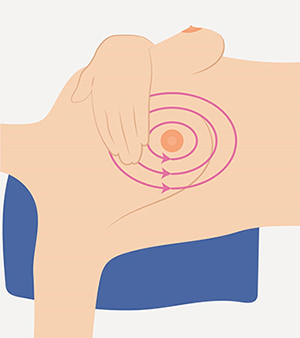
Checking the breast tissue while lying down may increase the chances of finding abnormalities because this position causes breast tissues to thin out by spreading it more evenly across the chest wall. To examine the breast for unusual firmness or lumps while lying down:
- Remove any clothing covering the breasts, like a shirt, dress or bra.
- Lie on the back and place one hand behind the head.
- Take the other hand and, with fingertips pressed together, firmly press down on a spot on the opposite breast (especially with the middle finger) while rotating the fingers in a small circle.
- Use varying degrees of pressure in each spot before moving on to the next.
- Move the fingers around to the next spots using a series of circles so that the outermost tissue, middle and inner tissues (closest to the nipple) are all examined.
- Squeeze the nipple gently to check for discharge (other than breast milk).
- Repeat on the opposite breast.
As with a standing breast exam, some people may prefer to examine the breast tissue from top to bottom and back up again or by moving the fingers along a series of straight lines that run from the outermost tissue to the nipple.
How Often Should a Breast Self-Exam Be Performed?
National guidelines for performing a breast self-exam vary by organization. Since there is no clinical evidence of the benefits of breast self-exams, organizations may recommend against them or provide general guidelines on breast awareness.
According to a 2021 review from the American Academy of Family Physicians:
- The American Cancer Society (ACS) encourages breast self-awareness (knowing how the breasts normally look and feel), but does not recommend routine breast self-exams.
- The National Comprehensive Cancer Network (NCCN) encourages breast self-awareness.
- The U.S. Preventive Services Task Force (USPSTF) and American Academy of Family Physicians (AAFP) recommend against teaching people about breast self-exams.
- The American College of Obstetricians & Gynecologists (ACOG) encourages breast self-awareness.
For women who choose to perform breast exams, it is ideal to perform them on the same day each month. This makes it easier to remember and, for women who are still having periods, helps ensure that any noticeable changes are not due to hormone shifts that may make the breasts look or feel different at different points in the menstrual cycle. It is recommended that exams be performed about three to five days after menstruation begins or right after it ends.
In addition to self-exams, the patient’s doctor may schedule clinical breast exams, alongside mammograms. Clinical breast exams are similar to self breast exams, except they are conducted by trained medical professionals. Both the ACOG and the NCCN suggest that women have a clinical breast exam every one to three years between the ages of 25 and 39, and then annually after that.
When to Contact a Doctor About Self-Exam Findings
The National Cancer Institute notes that even if a woman is not due for a mammogram, she should still follow up with her doctor about any breast changes, whether they are found during a breast self-exam or while doing normal activities like showering and dressing.
The more familiar a woman is with the look and feel of her breasts, the greater the likelihood she will discover new features like a lump or change in breast size or shape.
If unusual changes are found, they should be reported to the doctor right away to ensure that any necessary treatments may be started as soon as possible.
Breast cancer that is detected and treated during its early stages has significantly better survival outcomes than that found in advanced stages.
City of Hope® offers advanced screening options for women to help detect breast cancer, including clinical breast exams, mammograms including 3D mammography (breast tomosynthesis) and nipple discharge exams. In addition, the City of Hope’s High-Risk Breast Clinics house multidisciplinary medical teams made up of experts in surveillance and risk-reduction strategies for women at elevated risk of developing the disease.
American Cancer Society. American Cancer Society recommendations for the early detection of breast cancer, December 19, 2023.
https://www.cancer.org/cancer/types/breast-cancer/screening-tests-and-early-detection/american-cancer-society-recommendations-for-the-early-detection-of-breast-cancer.htmlStatPearls [Internet]. Breast self-examination, August 17, 2023.
https://www.ncbi.nlm.nih.gov/books/NBK565846/National Cancer Institute. Understanding breast changes and conditions: a health guide, October 2022.
https://www.cancer.gov/types/breast/breast-changes/understanding-breast-changes.pdfNational Cancer Institute, NCI Dictionary of Cancer Terms. Breast self-exam.
https://www.cancer.gov/publications/dictionaries/cancer-terms/def/breast-self-examPractice Bulletin Number 179: Breast cancer risk assessment and screening in average-risk women. Obstetrics & Gynecology, July 2017.
PMID: 28644335U.S. Department of Health and Human Services Office on Women’s Health. 99 percent survival rate for breast cancer caught early, October 6, 2022.
https://www.womenshealth.gov/blog/99-percent-survival-rate-breast-cancer-caught-earlyMedlinePlus. Breast self-exam, March 11, 2023.
https://medlineplus.gov/ency/article/001993.htmThe Ohio State University. A woman’s shower guide to breast self-examination (BSE).
https://cancer.osu.edu/-/media/files/cancer/cancer-specialties/breast-self-exam.pdfMissouri Department of Health and Senior Services. Breast self-exam: how to perform monthly exams.
https://health.mo.gov/living/healthcondiseases/chronic/showmehealthywomen/pdf/BSEbrochure.pdfAlabama Public Health. Breast self-exam (BSE), July 2015.
https://www.alabamapublichealth.gov/familyplanning/assets/fhs2082015.pdfKhan M, Chollet A. Breast cancer screening: Common questions and answers. American Family Physician, January 2021.
PMID: 33382554StatPearls [Internet]. Breast examination techniques, January 16, 2023.
https://www.ncbi.nlm.nih.gov/books/NBK459179/