Peyronie's Disease Treatment
January 21, 2026
This page was reviewed under our medical and editorial policy by Humberto Villarreal, M.D., assistant clinical professor, Division of Urology and Urologic Oncology, Department of Surgery, City of Hope® Cancer Center Duarte.
Peyronie’s disease treatment plans are tailored to the severity of the curvature, whether the curvature is stable and whether the patient is able to get strong erections despite the disease.
The care team will make specific recommendations tailored to each patient, for a singular treatment or a combination of options based on these factors and the newest therapies available.
Can Peyronie’s Disease Heal Itself?
Not everyone with Peyronie’s disease requires treatment. Some men find that the condition subsides without intervention. Peyronie’s disease heals on its own about 13% of the time.
Treating Acute Peyronie’s Disease
During the acute phase, when the disease is first noticed, the patient may experience excessive pain and worsening penile curvature. The acute phase may last up to 12 months.
If there are no changes to the curve and it is no longer painful, the patient has likely entered the stable, or chronic, phase.
During the acute phase, the care team may recommend the treatment options listed below.
Medications and Injections
Many oral, topical and injection therapies have been tested for use in the acute phase of Peyronie’s, but none of these have been widely accepted. Some studies indicate that injections combining collagenase Clostridium histolyticum (Xiaflex®) and interferon-a2b (Intron A®) are effective, but more research is needed to confirm whether this combination is useful in the long term.
Peyronie’s Disease Penile Traction
In some cases, the care team may recommend mechanical traction or a vacuum erection device to treat Peyronie’s disease. These devices cause the penis to bend or stretch, reducing the curvature. They may also be beneficial in restoring some of the acquired penile shortening as a result of Peyronie’s disease.
Treating Chronic Peyronie’s Disease
During the chronic phase, the care team may recommend the treatment options listed below.
Collagenase Injections
Collagenase injections are the main treatment for chronic Peyronie’s disease in men with penile curvature of more than 30 degrees.
Collagenase is an enzyme that targets a certain part of the scar tissue found in Peyronie’s disease and breaks it down The injection t is given over four cycles, each involving an injection of Xiaflex into the plaque, another injection after one to three days, followed by penile modeling one to three days after that.
Penile modeling involves manipulating the penis by hand to apply pressure in areas with plaque, which may help reduce the bend. The patient is then asked to do this penile modeling at home for six weeks before returning to the office for the next treatment cycle.
For the most part, collagenase is a well-tolerated medication. Some pain and soreness are possible at the injection site, and blood may build up under the skin (hematoma). In rare cases, the erect penis can crack and cause significant bleeding (penile fracture). To avoid this, patients are instructed to refrain from intercourse for two weeks after the injection.
Peyronie’s Surgery
The care team may recommend surgery in certain cases of Peyronie’s disease.
Penile Plication Surgery
During plication surgery, involves suturing or “hemming” the tunica albuginea from the side of the penis opposite from where the plaques are located as a way to straighten it. The tunica albuginea, a dense elastic covering on the penis, is typically where Peyronie’s-causing plaque builds up.
The goal of a plication is to “pull” the penis into a straight line. If the scar is on the top of the penis, the plication is performed at the bottom of the penis to pull it into a straight position, leaving the scar itself in place. This may be a good option when the curve is less than 60 degrees and there is no hourglass deformity or instability of the erection.
Plication can result in loss of penile length. The scar has already caused the penis to lose length so when the penis is straightened, the length lost is more apparent. For each 30 degrees of curvature, the patient may anticipate one centimeter of length loss. Other side effects may include penile pain, edema and infections.
The advantage of this approach is that it has relatively little impact on erectile function. Most cases of plication can also be performed through small incisions.
Penile Plaque Excision and Grafting
In this type of repair, the plaque is either cut into or removed entirely, then replaced with a patch. The patch may be composed of collagen fleece or cadaveric pericardium (tutoplast).
The graft technique is best for curves over 60 degrees, in those with an hourglass deformity or patients experiencing any degree of penile instability with erection.
In this approach, some penile length that was lost is restored, but it’s not a good option for men with erectile dysfunction (ED), since it can worsen their condition.
All penile surgeries run the risk of pain, bleeding, infection and hematoma. With plaque incision/excision and grafting, there’s a 20%chance that erectile function will worsen after the operation. That’s why it’s important to know how strong the patient’s erections were before the operation. This type of treatment should be avoided if the patient has any issues achieving an erection.
If the plaque is on top of the penis and the curve is upward, the nerves that control the sensation at the top of the penis have to be delicately separated from the tunica to expose the plaque. In some cases, this procedure may injure the nerves, causing numbness to the head of the penis. Numbness immediately after surgery isn’t common, but if it does occur, it should improve within a few months.
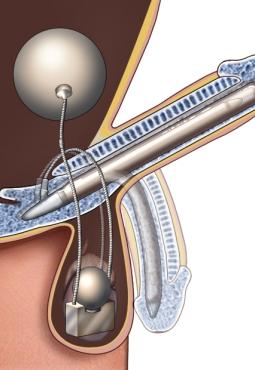
Penile Implant
The best treatment for Peyronie’s disease and significant ED is a penile implant. During the operation, the surgeon may use one of several techniques to straighten the penis. The penis will also straighten itself over time after the implant.
Side effects of penile implant may include infection, device failure, device erosion, penile pain and bleeding.
- Brimley S, Yafi F, et al. Sexual Medicine Reviews. Review of management options for active-phase Peyronie’s disease. April 7, 2019.
https://pubmed.ncbi.nlm.nih.gov/30503796/ - National Institute of Diabetes and Digestive and Kidney Diseases. Penile curvature (Peyronie’s disease), August 2019.
https://www.niddk.nih.gov/health-information/urologic-diseases/penile-curvature-peyronies-disease - Al-Thankafi, S and Al-Hathal, N. Translational Andrology and Urology. June 5, 2016. Peyronie’s disease: a literature review on epidemiology, genetics, pathophysiology, diagnosis and work-up. https://pmc.ncbi.nlm.nih.gov/articles/PMC4893516/