Sebastian "Diego" Serna is a happy, healthy 17-year-old with big plans.“I want to finish high school,” he says, “then go to college, study criminal justice and go into law enforcement. Maybe the FBI,
......
Every type of cancer damages and destroys your cells in some way. Ironically, the primary cancer treatments used to fight your disease — chemotherapy and radiation — can be equally destructive. As they kill cancer cells, they also harm healthy tissue. City of Hope investigators are changing that reality with immunotherapy.
Immunotherapy is a biological therapy that works with a person’s own immune system to boost its natural defenses. The biological substances in immunotherapy medicines may come from a person’s own body or a laboratory. Once in the body, these medicines help to train the immune system to do a better job at destroying cancer.
Immunotherapy typically produces fewer side effects than standard chemotherapy. Investing in immunotherapy is part of the growing push to de-escalate cancer treatments.
Chimeric antigen receptor (CAR) T cell therapy is a powerful type of immunotherapy.
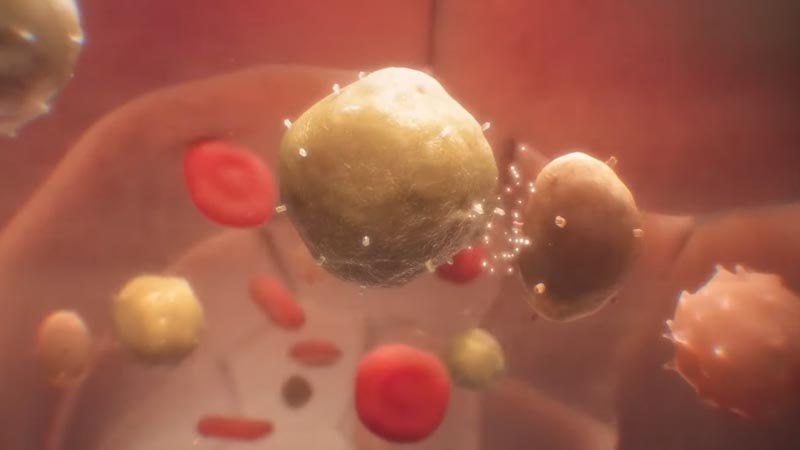
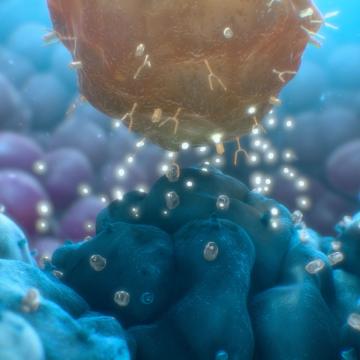
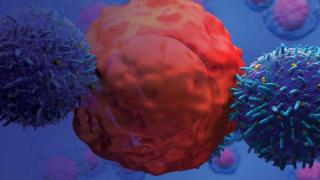
CAR T cell therapy lets doctors target specific cancer cells. It uses genetic engineering to reprogram a patient’s T cells (immune cells), activating these special receptors. CARs can detect and fight specific proteins found in cancer cells. Today, City of Hope researchers focus much of their efforts on advancing this new, non-toxic, effective immunotherapy.
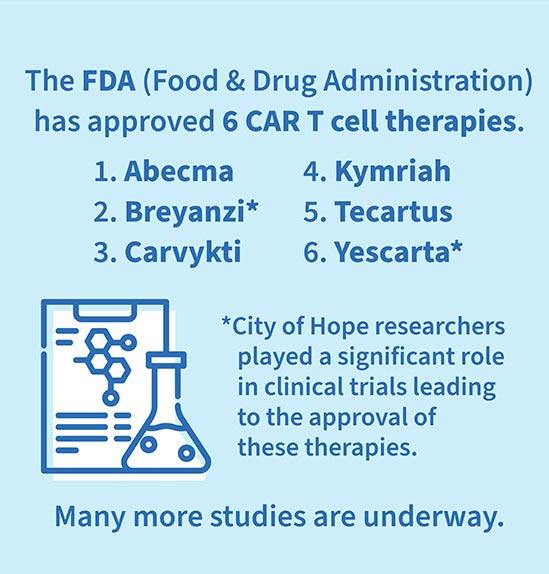
City of Hope has been a global leader in CAR T cell therapy for 25 years; it has one of the largest and most advanced clinical research programs focused on CAR T in the world. City of Hope researchers were some of the first investigators to develop this technology that re-engineers a patient’s own T cells against cancer. As a group, trailblazing researchers at City of Hope are using this technology to make substantial advances against some of the hardest-to-treat cancers.
CAR T cell therapy is a fine-tuned approach to cancer treatment. It’s already shown promise against many difficult-to-treat cancers, including brain and aggressive blood cancers. Currently, though, CAR T cell therapy is only available to certain patients, often those with relapsed disease or disease that has not responded well to other treatments. More research is needed. To save time and lives City of Hope investigators aim to advance CAR T cell therapy so it can become a first-line treatment.
City of Hope is leading the field in transitioning cell therapy treatments to the outpatient setting. We’re currently the only organization of our kind conducting outpatient CAR T cell therapy at a significant scale.
Our outpatient infrastructure has achieved a level where it is now the default for patients who are receiving CAR T therapy.
Moving CAR T therapy to the outpatient setting is a significant milestone as it escalates CAR T being used in earlier lines of treatment and in patients who are not transplant eligible.
City of Hope investigators are at the forefront of CAR T cell research. Its investigators were some of the first to use CAR T cell therapy in acute myeloid leukemia and glioblastoma trials. These researchers are exploring how CAR T cell therapy impacts several blood and solid tumor cancers such as leukemia, multiple myeloma, lymphoma and HER2-positive breast cancer that has spread to the brain.
For example, Elizabeth Budde, M.D., Ph.D., associate professor in the Division of Lymphoma and executive medical director of the Enterprise Immune Effector Cell Therapy Program, and Larry Kwak, M.D., Ph.D., deputy director of City of Hope’s comprehensive cancer center and the Dr. Michael Friedman Professor in Translational Medicine, worked together to create a CAR T treatment for patients who relapse after certain types of lymphoma or leukemia. They use CAR T cells programmed to fight recurrent malignant B cells to help patients like Howard Chew — who experienced a non-Hodgkin lymphoma relapse after a different, initial CAR T treatment — achieve remission after one infusion.
In addition, Christine Brown, Ph.D., Heritage Provider Network Professor in Immunotherapy and deputy director of City of Hope’s T Cell Therapeutics Research Laboratories, uses CAR T cell therapy to target and treat glioblastomas (an aggressive type of brain tumor) and cancer cells in the cerebrospinal fluid. To reach this goal, her team combines different CARs to target several proteins. They also use genetic engineering to strengthen T cells. This improves their survival rate in a toxic tumor environment.
One of the biggest obstacles to treating glioblastoma is getting cancer treatments across the blood-brain barrier. In a recent trial, Dr. Brown’s team showed they can overcome this challenge by administering CAR T cells engineered to target a protein receptor that is overexpressed in these brain tumors. After two months of CAR T therapy, 29 of 58 people with recurrent high-grade brain tumors were stabilized, and one person achieved complete remission.
In 2022, the Ted Schwartz Family made a $15 million gift to accelerate CAR T cell therapy research at City of Hope. Doctors diagnosed Schwartz with lymphoma in 2004. He received chemotherapy and radiation, but his cancer turned aggressive in 2019. That's when he received CAR T cell therapy at City of Hope. Today, he is cancer-free.
For Schwartz, his gift is a way to ensure other patients receive the same life-affirming care that finally defeated his cancer after 16 years. He says he made the gift in honor of his City of Hope physician, Steven Rosen, M.D., and to help other patients avoid some of the hardships and side effects that come with more traditional cancer treatments.
Cancer touches nearly 2 million people annually. Every person and family affected by cancer deserves the most advanced, innovative treatment options available. Developing and providing these therapies requires significant resources.
Let’s work together to make hope happen. Support our mission to defeat cancer for all — forever.
Sebastian "Diego" Serna is a happy, healthy 17-year-old with big plans.“I want to finish high school,” he says, “then go to college, study criminal justice and go into law enforcement. Maybe the FBI,
......
Jacob Flores, M.D., has met Mother Teresa.He’s fond of quoting famous people: Thomas Paine, John F. Kennedy, Winston Churchill, among others.And he makes house calls.The 70-year-old son of Mexican
......Leading national cancer research and treatment organization foresees significantly shorter treatments, tests to help stop the surge in under-50 cancers, training AI to advance more equitable cancer
......
Howard Chew had no idea he was sick.Living in Pomona, California, with family since the start of the COVID-19 pandemic, the 54-year-old Bay Area waiter’s heart condition was his only medical concern.
......
Treating prostate cancer with immunotherapy is currently difficult to do. But preliminary results from a first in-human phase 1 trial using a chimeric antigen receptor (CAR) T cell therapy developed
......