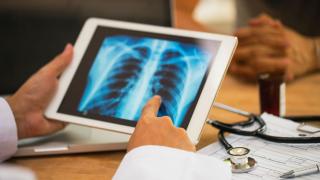
Lung cancer is the second most common cancer in the United States, with more than 200,000 new diagnoses every year. Screening for lung cancer usually involves imaging technology like a computed tomography (CT) scan. However, these scans may also detect lung nodules — small lesions that may look like a shadow or spot on the lung.
Most lung nodules are not cancerous. But one challenge for lung cancer surgeons who treat and remove nodules is determining whether a lung nodule is cancerous or not by simply by looking at it. A new drug called Cytalux® may help tackle this problem by using fluorescent dye to make lung nodules essentially glow in the dark.
“Cytalux® helps us visualize nodules on the lung that may not be otherwise be visible, enabling us to find small lesions and determine whether they are cancerous or not,” says Peter Baik, D.O., F.A.C.O.S., F.A.C.S., a thoracic surgeon and lung cancer expert at City of Hope® Cancer Centers Chicago and Phoenix.
This article explains more about Cytalux® and how it is being used to better detect and treat lung nodules, including:
- What lung nodules look like
- What is Cytalux®?
- Advantages during lung cancer surgery
- Side effects and complications
If you or a loved one has been diagnosed with lung cancer or would like to learn more and would like to schedule an appointment or get a second opinion, call us 24/7 at 877-460-4673.
What Lung Nodules Look Like
Lung nodules are small lesions that may be found in or on the lung. The vast majority of lung nodules seen on a scan are not cancer. However, many people undergo surgery to remove certain kinds of nodules. Lung nodules are usually round or oval in shape and less than 3 centimeters (cm) in size. They may be referred to as:
- Solid lung nodules, which have the same solid consistency throughout the nodule
- Ground-glass nodules, which may have a hazy appearance on a scan because they are not the same consistency the whole way through
- Part-solid nodules, which share the characteristics of both solid and ground-glass lung nodules
Although some visual characteristics may make it more likely that a lung nodule is cancerous, it is not always possible for a lung cancer surgeon to tell the difference between a benign and a malignant nodule during a surgical procedure.
What Is Cytalux®?
Cytalux® is the brand name for a drug called pafolacianine. It is a type of imaging agent, which means that it is used in combination with imaging technologies to help detect and locate tumors.
Cytalux® is a drug that combines folate, the chemical name for vitamin B9, and a type of fluorescent dye. The drug is injected into a patient’s body between one and 24 hours before he or she is scheduled to undergo lung nodule surgery.
Because cancer cells produce more folate receptors (cells that bind to folate) than healthy cells, Cytalux® binds to the cancer cells in the patient’s body. During surgery, doctors use a special camera with an almost-infrared light on it to make the fluorescent dye in the Cytalux® glow in the dark. This helps lung cancer surgeons locate nodules or tumors so that they may be removed or biopsied.
The drug is approved by the U.S. Food and Drug Administration (FDA) to help find lung cancer and ovarian cancer tumors, explains Dr. Baik.
“Its use is also expanding, so we should eventually have more data to determine whether Cytalux® may be beneficial in detecting other tumor types,” he says.
Advantages During Lung Cancer Surgery
Cytalux® makes it easier for surgeons to find and remove lung nodules using less invasive surgical techniques.
“Instead of making a larger incision, which is needed to find a lung nodule using direct palpation, we can use the Cytalux® technology to perform minimally invasive or robotic surgeries,” says Dr. Baik.
Some of the key advantages to minimally invasive surgical options include smaller incisions, faster recovery times and less scarring for patients.
Side Effects and Complications
In general, Cytalux® does not have many serious side effects . According to FDA studies, the most common are:
- Nausea or vomiting
- Pain in the abdomen
- Red flush on the skin
- Reactions to an intravenous infusion, such as a fever, chills, headache, itching and hives
If you or a loved one has been diagnosed with lung cancer or would like to learn more and would like to schedule an appointment or get a second opinion, call us 24/7 at 877-460-4673.