
One of the most delicate moments in a Whipple procedure comes after the tumor is out. Deep in the abdomen, the surgeon stitches a pancreatic duct that can be just a few millimeters wide to the small intestine. That connection allows digestive juices to reach the intestine, where they help break down food.
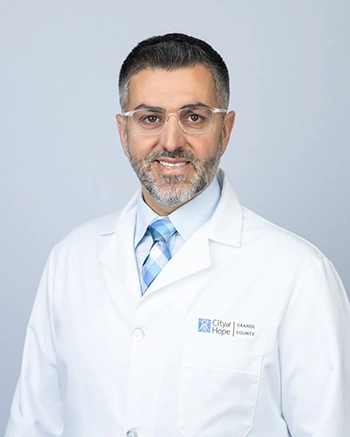
Traditionally, surgeons did this work through a large abdominal incision. Today, Ahmad Abou Abbass, M.D., the director of gastrointestinal robotics at City of Hope Orange County and an associate clinical professor of surgical oncology at City of Hope, combines extensive expertise in pancreatic surgery and advanced robotics to perform complex robotic Whipple procedures (pancreaticoduodenectomy) involving tiny keyhole ports instead of a single cut, offering a range of meaningful advantages over open surgery.
“With advanced robotic technology, I can see each tiny duct clearly and angle the needle to place every stitch exactly where it needs to go. That precision matters baecause patients at City of Hope are trusting us with their lives during one of the most difficult times they may ever face,” says Dr. Abbass. “Our goal is not only to remove the cancer safely, but also to reduce the physical impact of surgery and help patients recover sooner.”
Dr. Abbass has performed one of the highest volumes of robotic Whipple procedures in California and ranks among the highest-volume robotic Whipple surgeons in the United States.
Beyond his clinical practice, Dr. Abbass is dedicated to advancing robotic surgery through education, mentorship, and international collaboration. He travels extensively throughout the United States to train and mentor surgeons in advanced robotic pancreatic techniques and serves as an instructor for specialized hands-on training programs. He also leads monthly robotic Whipple training courses, providing surgeons with practical experience using cadaveric and animal models.
His expertise is sought internationally, where he performs complex robotic pancreatic procedures, trains surgical teams, and helps expand access to advanced minimally invasive pancreatic surgery worldwide.
In this article, you’ll learn:
- What a Whipple procedure involves
- What makes the robotic Whipple an advance
- What the robotic approach can mean for your recovery
- How City of Hope Orange County’s surgical oncology team plans your care
What does a Whipple procedure involve?
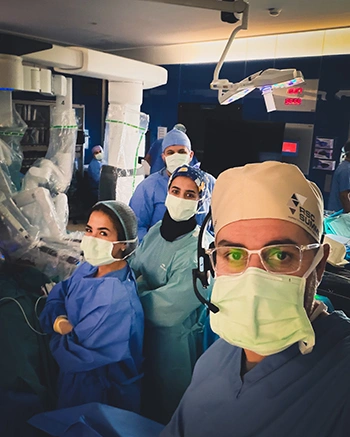
Whipple surgery is commonly utilized to treat cancer in the head of the pancreas, where the organ sits close to major blood vessels. The surgeon typically removes the head of the pancreas, the first part of the small intestine, the gallbladder and part of the bile duct. In some cases, part of the stomach is removed as well.
The surgeon then reconnects the remaining organs so food, bile and pancreatic fluids can move through the digestive tract. For patients whose pancreatic cancer can be removed, surgery offers a chance for long-term survival and potentially a cure. Chemotherapy is usually part of the treatment plan.
In a robotic Whipple surgery, advanced technology gives the surgeon a magnified, three-dimensional view of the area around the pancreas and helps guide the surgeon’s skilled hands. The surgeon controls instruments that bend and rotate at their tips, making it possible to work at angles that are harder to reach with straight instruments.
How can the robotic approach benefit patient recovery?
Minimally invasive techniques like robotic Whipple surgery are less physically impactful than open surgery. The benefits to patients include less postoperative pain, reduced blood loss, a lower risk of complications, a shorter hospital stay, and a quicker return to daily life and follow-up treatment.
In a randomized trial at experienced pancreatic surgery centers, patients who had a robotic Whipple met the trial’s criteria for early recovery about four days sooner than those who had open surgery. Those milestones included walking, eating solid food and managing pain with medication taken by mouth. Patients in the robotic group also spent a median of three fewer days in the hospital. The trial found comparable rates of clear surgical margins, meaning no cancer cells were found at the edges of the removed tissue.
What makes City of Hope Orange County’s surgical oncology care different?
City of Hope offers patients a level of surgical oncology expertise that only a nationally ranked cancer research and treatment organization can provide. In Orange County, City of Hope Orange County Cancer Specialty Hospital and City of Hope Orange County Lennar Foundation Cancer Center bring inpatient surgery and outpatient cancer care together on one 72-acre academic research campus. In addition to benefiting from the full power of innovation and groundbreaking technology, patients have seamless access to the full continuum of cancer care — from prevention through survivorship and including both outpatient and inpatient surgery in a single location.
“Cancer surgery can feel overwhelming, so I take time to help patients and their families understand what to expect during the operation and in the weeks that follow," says Dr. Abbass. "At City of Hope, we make that plan together before surgery, surrounding each patient with multidisciplinary expertise, individualized rehabilitation, integrative oncology and supportive care throughout the entire treatment journey.”
Ending cancer starts with Hope. To make an appointment at any of City of Hope’s Orange County locations, call 888-333-HOPE (4673).
Emerging Pancreatic Cancer Therapy Opens a New Door for This Grateful Patient
City of Hope Performs Orange County’s First Single-Port Robotic Surgeries for Colorectal Cancer
Pancreatic Cysts: What Happens After a Cyst Is Found on a Scan?