Lumpectomy
April 10, 2025
This page was reviewed under our medical and editorial policy by Susan Yost, Ph.D., staff scientist, Department of Medical Oncology & Therapeutics Research, City of Hope® Cancer Center Duarte
Lumpectomy is a common surgical treatment option for women diagnosed with breast cancer.
The majority of breast cancer patients have either a lumpectomy or mastectomy to remove cancer that forms in breast tissue. Doctors typically recommend a lumpectomy if the breast cancer is in its early stages — including the earliest stage, known as ductal carcinoma in situ (DCIS).
What Is a Lumpectomy?
While a mastectomy removes the entire breast, a lumpectomy is surgery to remove just part of the breast. It includes taking out the tissue that contains the cancer, surrounding healthy tissue and sometimes the lymph nodes under the arm. A portion of the chest wall lining may also be removed.
Doctors sometimes use other names for lumpectomy procedures, including:
- Breast-conserving surgery
- Partial mastectomy
- Segmental mastectomy
- Quadrantectomy
- Breast-sparing surgery
The goal of the surgery is to preserve the breast so it looks as close to its presurgery form as possible, while also removing the entire area of cancerous tissue.
Women who undergo a lumpectomy will often have whole breast or partial breast radiation therapy after the surgery to ensure that all the cancer cells are destroyed and the remaining breast tissue is healthy.
Lumpectomy may be an option for women:
- If their cancer tumor is small (less than 2 inches)
- If the cancer is located in only one quadrant (segment) of the breast
- If they have had no previous radiation treatments on the area or a prior lumpectomy
Lumpectomy Surgery
Breast lumpectomy surgery is usually performed as an outpatient procedure and takes about an hour.
If the surgeon does not feel the tumor (lump) by doing a physical exam, prior to the surgery he or she will:
- Use an imaging scan like an ultrasound or mammogram to pinpoint where the cancer is located
- Guide a wire or wires through a hollow needle into the area(s) to mark the cancer location(s)
Once any necessary wires are in place, patients are given general anesthesia to put them to sleep or local anesthesia to numb the area of the breast where the incision (cut) will be made.
Here are the steps of lumpectomy surgery:
- The surgeon makes a small cut on the area of the breast where tissue will be removed.
- The cancerous tissue and surrounding healthy tissue are removed.
- One or more lymph nodes under the arm may also be removed.
- A pathologist who is trained to find cancerous cells examines the tissue sample under a microscope to ensure all the cancer has been removed (known as clear margins).
- A metal clip or clips may be placed in the area(s) where the tissue was removed to make it easier in the future to check the area using imaging scans and to help guide the radiologist who gives follow-up radiation therapy.
- Any wires used to mark the cancer are removed before the procedure ends.
- The surgeon closes the incision with stitches.
- Sometimes (though rarely) a drainage tube is placed to reduce the risk of lymphedema (swelling caused by a buildup of lymph fluids under fatty tissue).
- The tissue is sent to the pathology lab for further testing, such as to determine the grade of the cancer.
Although the aim of a lumpectomy is to preserve the breast, some women who have the procedure may also choose breast reconstruction surgery to help reshape it.
For women who are thinking about reconstruction, it is important to talk with the doctor before the lumpectomy about how much tissue will be removed, the different reconstruction options available and the main concerns to be addressed (such as better-fitting clothes or feeling better about body shape). This collaborative approach helps provide the doctor with the information needed to optimize surgical results.
Procedure Recovery
After lumpectomy surgery, patients typically go home the same day and are able to perform basic functions. The care team will provide instructions on wound care and emptying the drainage tube (if one was inserted). A tube typically needs to be emptied once or twice daily.
Patients will also need to watch for signs of infection, such as redness, swelling and incision-site drainage. It is important to contact the doctor right away if these or other side effects arise.
The skin at the wound (incision) site should fully heal after about a month, and patients are advised to wear a comfortable bra (like a sports bra) during the lumpectomy recovery process. Women may also be provided with a postsurgical bra, such as a compression bra or one with a front closure if there is a drain in place. Typically, patients may remove their surgical bra to shower after about 48 hours.
Recovery time off work and away from normal daily activities like driving, exercising and heavy lifting varies from about one to two weeks after a lumpectomy. Patients are encouraged to check with their doctor prior to surgery to find out when they might expect to return to their regular activities.
Does Breast Tissue Grow Back After Lumpectomy?
Women’s breasts usually stop growing by the time they reach age 18, and older adults will not likely experience breast tissue regrowth after lumpectomy surgery. The breast’s appearance should not change much (if at all) for women who have lumpectomy surgery, although it may be smaller if a large amount of tissue is removed. The nipple, areola and breast will also likely still have the same feelings or sensations that they had before the procedure.
Sometimes women experience dimpling, hardened tissue at the surgical site and a scar or numbness where the cut was made. Specially-trained doctors may be able to provide a more pleasing cosmetic look by making the incision in a location that is more difficult to see so the scar is hidden from view.
Lumpectomy Side Effects
Patients sometimes experience shooting pain in the breast after lumpectomy. Other painful side effects may include:
- Shoulder, arm, armpit, chest wall and surgical scar pain
- Numbness or intense itching
- Tingling in the arm, armpit or chest wall
In time, pain after surgery often goes away on its own. If the pain does not go away, the condition is known as PMPS, or post-mastectomy pain syndrome (even though it sometimes occurs after lumpectomy surgery). The doctor may provide a number of treatment options for women dealing with PMPS, including physical therapy, pain medications like Gralise® (gabapentin) and Effexor® XR (venlafaxine), and follow-up surgery to treat scar tissue or other factors that may be causing the pain.
The following post-lumpectomy side effects may also occur:
- Temporary breast swelling
- Bleeding
- Medication reactions, such as to general anesthesia
- Seroma (fluid collection in the breast that may be drained)
- Lymphedema if lymph nodes are removed from under the arm
- Infection
- Blood clots that may lead to heart attack or stroke
Watching for signs of infection after lumpectomy is one key to proper healing. People with an infection at the wound site may experience wound seepage, inflammation and redness. Washing the wound regularly with soap and water may help reduce infection risk. Patients should also reach out to the doctor or clinic as soon as possible if they experience signs of infection or other side effects after their surgery so that treatments may be started to address the issues before they progress.
Who Shouldn’t Have a Lumpectomy?
The care team will go over the risks and benefits of lumpectomy surgery and advise patients whether they are a candidate for the procedure. A mastectomy may be recommended over a lumpectomy if a woman:
- Has advanced-stage breast cancer
- Has a tumor or tumors larger than 2 inches each
- Has a large tumor relative to breast size
- Has cancer in more than one segment (quadrant) of the breast
- Has inflammatory breast cancer (a rare type of breast cancer that tends to spread quickly)
- Has genetic risk factors for a second cancer, such as the BRCA or ATM genes
- Will not undergo radiation therapy after the procedure for personal or medical reasons (including pregnancy and connective tissue diseases like lupus or scleroderma)
- Had a previous lumpectomy and the pathologist found cancer in the tissue surrounding the tumor (positive margins)
- Had previous radiation therapy on the breast
- Chooses a mastectomy over a lumpectomy
Lumpectomy Versus Mastectomy
The chart below compares lumpectomy to mastectomy. Depending on the number of tumors and their sizes and shapes, women may be able to choose lumpectomy with radiation therapy over mastectomy.
The two types of surgery have some similarities. For instance, cancer recurrence (return) rates are the same for both when radiation therapy is given after the lumpectomy, as are overall survival rates.
The main benefit of lumpectomy over mastectomy is that it leaves part of the breast in place. Another potential benefit is that it may offer a higher quality of life than mastectomy for some women.
One possible lumpectomy drawback is that the patient will likely need to have radiation treatment after surgery, which requires a commitment to follow-up care at a hospital or clinic. Radiation therapy may also come with additional side effects, such as hair loss, low blood cell counts, fatigue and skin problems. While radiation therapy is sometimes used after mastectomy surgery, it is not as common.
LUMPECTOMY WITH RADIATION THERAPY VERSUS MASTECTOMY | ||
|---|---|---|
SURGERY FEATURES | LUMPECTOMY WITH RADIATION THERAPY | MASTECTOMY |
Surgery Type | Outpatient procedure under general or local anesthesia | In-hospital surgery under general anesthesia |
Early-stage cancer treatment successfulness against recurrence (cancer returning) | As successful as mastectomy | As successful as lumpectomy with radiation therapy |
Length of Surgery | About one hour | About two to three hours |
Tissue Removed | A portion of the breast | The entire breast |
Radiation Therapy | Yes | May or may not be necessary |
Side Effects | From both surgery and radiation therapy | From surgery only and sometimes radiation therapy |
Length of Hospital or Clinic Stay | Same-day release from clinic | 24-48 hour hospital stay |
Length of Recovery | One to two weeks | Four weeks |
Cosmetic Appearance | Similar to before surgery, with potential dimpling and smaller breast size and a small scar where the tissue was removed | Different than before surgery, with a flat chest and a scar where the entire breast was removed |
Survival | Same as for mastectomy | Same as for lumpectomy with radiation therapy |
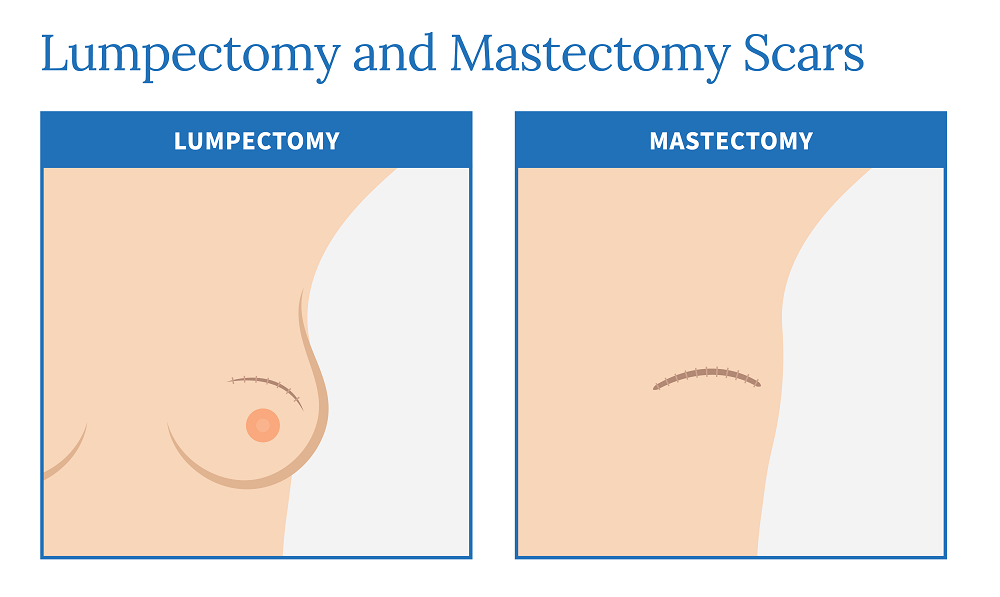
What Do Lumpectomy and Mastectomy Scars Look Like?
Lumpectomy scars differ in size and location from mastectomy scars.
Lumpectomy: With traditional surgical methods, there will likely be a small scar line where the cancer was removed, which varies in length depending on the size of the incision the surgeon made.
Mastectomy: For go-flat mastectomies, there will be a scar that typically runs horizontally across the breast area, with some variation of curved or straight lines. The scar will be longer for larger breasts and shorter for smaller breasts. For women undergoing nipple-sparing mastectomy, there may be smaller and fewer visible scars because much of the healthy outer skin is left intact.
Mastectomy with breast reconstruction: Scars may show where stitching occurred to reshape the breast or around the breast if tissue-flap reconstruction was performed. Other places on the body where tissue, fat or skin were removed to reconstruct the breast for a tissue-flap reconstruction may also have scars.
Lymph node removal: With traditional surgical methods, the area under the arm will have a scar that may run vertically along the armpit.
Newer, advanced surgical techniques are available that aim to camouflage and reduce scarring from breast surgery, as listed below.
Scar-sparing surgeries. These procedures typically involve a surgeon removing the cancer through an incision made under the breast or underarm, so that the scar is hidden from view.
Oncoplastic surgeries: These combine cancer surgery with plastic surgery advances, such as small endoscopic entry into the skin and robot-assisted surgery methods that leave very small scars, which may also be hidden from view.
Every patient is different and, for some women, having scar-sparing breast cancer surgery may help improve their emotional, physical, social and mental health.
Breast Cancer Care at City of Hope
City of Hope is guiding advances in breast-sparing surgery. This includes opening the first multicenter clinical trial in the nation to evaluate minimally-invasive robotic mastectomy surgery that leaves a small, hidden scar. Holistic patient care is another main focus of the cancer center’s Breast Cancer Program, which includes screenings, assessments, prevention resources, multidisciplinary breast cancer treatments and a follow-up program aimed at minimizing cancer recurrence.
National Cancer Institute. Breast cancer treatment (PDQ®) — patient version, May 28, 2024.
https://www.cancer.gov/types/breast/patient/breast-treatment-pdq#_185
American Cancer Society. Breast conserving surgery (lumpectomy), October 27, 2021.
https://www.cancer.org/cancer/types/breast-cancer/treatment/surgery-for-breast-cancer/breast-conserving-surgery-lumpectomy.htmlAmerican Cancer Society. Your breast pathology report: ductal carcinoma in situ (DCIS), July 7, 2023.
https://www.cancer.org/cancer/diagnosis-staging/tests/biopsy-and-cytology-tests/understanding-your-pathology-report/breast-pathology/ductal-carcinoma-in-situ.htmlAmerican Cancer Society. Treatment of ductal carcinoma in situ (DCIS), October 27, 2021.
https://www.cancer.org/cancer/types/breast-cancer/treatment/treatment-of-breast-cancer-by-stage/treatment-of-ductal-carcinoma-in-situ-dcis.htmlNational Cancer Institute. Surgery choices for women with DCIS or breast cancer, January 21, 2022.
https://www.cancer.gov/types/breast/surgery-choices#think-about-what-is-important-to-youNational Cancer Institute, NCI Dictionary of Cancer Terms. Lumpectomy.
https://www.cancer.gov/publications/dictionaries/cancer-terms/def/lumpectomyMedlinePlus. Breast lump removal, October 10, 2022.
https://medlineplus.gov/ency/article/002918.htmAcree P, Kapadia A, Mahatme R, Zhang L, Patel D, Almoney C, Park G, Kofsky M, Matin S, Habibi M. Review of current accepted practices in identification of the breast lumpectomy tumor bed. Adv Radiat Oncol, January 27, 2022.
PMID: 36148372American Cancer Society. Radiation for breast cancer, October 27, 2021.
https://www.cancer.org/cancer/types/breast-cancer/treatment/radiation-for-breast-cancer.htmlNational Cancer Institute, NCI Dictionary of Cancer Terms. Needle localization.
https://www.cancer.gov/publications/dictionaries/cancer-terms/def/needle-localizationAmerican Cancer Society. Lymphedema, April 9, 2024.
https://www.cancer.org/cancer/managing-cancer/side-effects/swelling/lymphedema.htmlAmerican Cancer Society. Your breast pathology report: breast cancer, July 7, 2023.
https://www.cancer.org/cancer/diagnosis-staging/tests/biopsy-and-cytology-tests/understanding-your-pathology-report/breast-pathology/breast-cancer-pathology.htmlAmerican Cancer Society. Breast reconstruction options, October 20, 2021.
https://www.cancer.org/cancer/types/breast-cancer/reconstruction-surgery/breast-reconstruction-options.htmlAmerican Cancer Society. Should I get breast reconstruction surgery? September 19, 2022.
https://www.cancer.org/cancer/types/breast-cancer/reconstruction-surgery/should-i-get-breast-reconstruction-surgery.htmlAmerican College of Surgeons. Breast cancer surgery: after your operation, your recovery, and discharge, 2024.
https://www.facs.org/for-patients/the-day-of-your-surgery/breast-cancer-surgery/after-your-operation/MedlinePlus. Adolescent development, January 24, 2023.
https://medlineplus.gov/ency/article/002003.htmUniversity of Utah Health. Benefits of breast reduction surgery, 2024.
https://healthcare.utah.edu/plastic-surgery/breast/reductionUCSF Fresno. Breast cancer surgery saves lives and hides scars, October 4, 2019.
https://fresno.ucsf.edu/news/breast-cancer-surgery-saves-lives-and-hides-scarsAmerican Cancer Society. Post-mastectomy pain syndrome, March 29, 2014.
https://www.cancer.org/cancer/managing-cancer/side-effects/pain/post-mastectomy-pain-syndrome.htmlMedlinePlus. Gabapentin, May 15, 2020.
https://medlineplus.gov/druginfo/meds/a694007.html#brand-name-1MedlinePlus. Venlafaxine, January 15, 2022.
https://medlineplus.gov/druginfo/meds/a694020.html#brand-name-1National Cancer Institute. Heart attack, stroke risk may be elevated following cancer diagnosis, August 25, 2017.
https://www.cancer.gov/news-events/cancer-currents-blog/2017/heart-attack-stroke-risk-cancerAmerican Cancer Society. Risks of cancer surgery, October 2, 2019.
https://www.cancer.org/cancer/managing-cancer/treatment-types/surgery/risks-of-cancer-surgery.htmlAmerican Cancer Society. Mastectomy, December 20, 2023.
https://www.cancer.org/cancer/types/breast-cancer/treatment/surgery-for-breast-cancer/mastectomy.htmlAmerican Cancer Society. Inflammatory breast cancer, March 1, 2023.
https://www.cancer.org/cancer/types/breast-cancer/about/types-of-breast-cancer/inflammatory-breast-cancer.htmlAdmoun C, Mayrovitz H. Choosing mastectomy vs. lumpectomy-with-radiation: experiences of breast cancer survivors. Cureus, October 2, 2021.
PMID: 34729260StatPearls [Internet]. Breast cancer surgery, February 8, 2023.
https://www.ncbi.nlm.nih.gov/books/NBK553076/American Cancer Society. Radiation therapy side effects, December 10, 2020.
https://www.cancer.org/cancer/managing-cancer/treatment-types/radiation/effects-on-different-parts-of-body.htmlMedlinePlus. Mastectomy, March 11, 2023.
https://pubmed.ncbi.nlm.nih.gov/32816201/Everaars KE, Welbie M, Hummelink S, Tjin EPM, de Laat EH, Ulrich DJO. The impact of scars on health-related quality of life after breast surgery: a qualitative exploration. Journal of Cancer Survivorship, April 2021.
PMID: 32816201Lotan AM, Tongson KC, Police AM, Dec W. Mastectomy incision design to optimize aesthetic outcomes in breast reconstruction. Plast Reconstr Surg Glob Open, September 24, 2020.
PMID: 33133941Yang JD, Lee J, Lee JS, Kim EK, Park CS, Park HY. Aesthetic Scar-Less Mastectomy and Breast Reconstruction. J Breast Cancer, February 2021.
PMID: 33634618