Lymph Node Removal Surgery for Breast Cancer
April 10, 2025
This page was reviewed under our medical and editorial policy by Susan Yost, Ph.D., staff scientist, Department of Medical Oncology & Therapeutics Research, City of Hope® Cancer Center Duarte
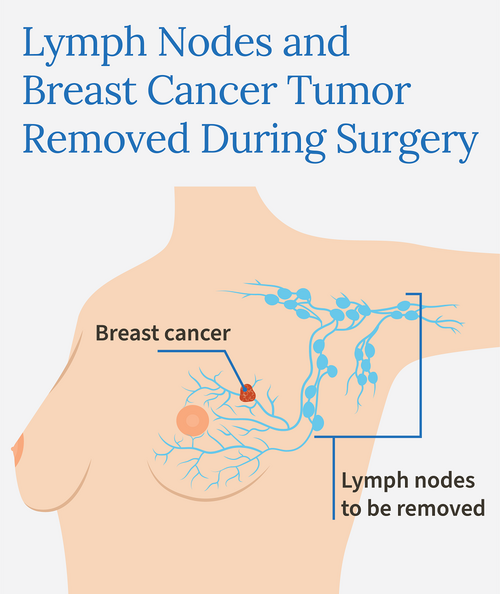
When breast cancer is diagnosed, it is essential to find out if the cancer has spread (metastasized) from the original tumor in the breast to other breast tissue or nearby tissue and lymph nodes. When cancer spreads to surrounding tissue (called invasive breast cancer), it typically spreads to the lymph nodes under the arm (axilla) or in the chest area first.
Checking for cancer or removing cancer in these nearby lymph nodes is a key step in many types of breast cancer.
Surgically removing lymph nodes near the breast tumor for examination under a microscope, called lymphadenectomy, is often performed during breast cancer surgery, such as lumpectomy (some breast tissue is removed) or mastectomy (entire breast is removed). It may also be performed as a separate procedure.
Lymph node surgery, along with other tests, helps the care team stage the cancer, a crucial step in determining treatment options and a path to recovery.
When breast cancer metastasizes further, it may spread to other areas of the body far away from the original tumor. This may be referred to as infiltrating breast cancer.
What Are the Lymph Nodes?
The lymph nodes are a key part of the body’s immune system. These little bean-shaped structures work as filters for the fluid in the lymphatic system. They contain white blood cells, which fight infections and diseases, like cancer. They are found throughout the body, connected by channels that allow the lymphatic fluid to flow.
Breast cancer becomes metastatic when it spreads through the lymphatic system or blood to other areas of the body.
Breast cancer usually spreads first to the lymph nodes closest to the affected breast, most commonly in the area under the arm, known as the axilla. Cancer cells may also affect lymph nodes under the breastbone and collarbone. Groups of lymph nodes appear in the axilla, neck, chest, abdomen and groin.
Lymph Node Surgery Types
A lymphadenectomy (lymph node removal) helps stage and remove cancer. The two lymph node removal surgeries commonly performed for breast cancer are sentinel lymph node biopsy and axillary lymph node dissection, as detailed below.
Sentinel lymph node biopsy (SLNB): This removes a small number of lymph nodes closest to the breast tumor. It is most often performed in early-stage breast cancer to see if cancerous cells are in the lymph nodes.
Axillary lymph node dissection (ALND): This is a more involved surgery that removes several lymph nodes in the armpit area. It may be performed in advanced cancer (such as large tumors) and after several positive sentinel lymph node biopsy results.
Sentinel Lymph Node Biopsy (SLNB)
Lymph nodes that have a path to the primary tumor are called sentinel lymph nodes. If they spread, breast cancer cells most often spread to the lymph nodes in the axilla next to the breast. Breast cancer located closer to the center of the chest may spread to lymph nodes under the breastbone before spreading to the axilla. A sentinel lymph node biopsy is commonly used for newly diagnosed patients to help stage their breast cancer.
The procedure involves the following steps.
Locating the tumor: A radioactive substance, a blue dye or both is injected near the breast tumor. The surgeon then uses a device to detect the radioactivity or blue dye in the lymph nodes.
Removal of the sentinel node: Through a small incision in the skin, the surgeon removes the first node(s) to take up the injected material.
Examination: A doctor trained in identifying diseases, known as a pathologist, uses a microscope to look for cancer in the removed sentinel lymph node(s).
A negative result means cancer has not spread to nearby lymph nodes or other organs
A positive result means cancer was found in the lymph node(s), and it may have spread to other lymph nodes or organs
The SLNB is usually done when the primary breast cancer tumor is removed with a lumpectomy or mastectomy. If the SLNB finds cancer, additional lymph nodes may be removed during the same procedure or at a follow-up surgery. In Stage 3 breast cancer and inflammatory breast cancer, SLNB is usually not an option. A more extensive axillary lymph node dissection is the alternative procedure.
Axillary Lymph Node Dissection (ALND)
The axillary lymph node dissection removes many lymph nodes from the armpit region. A surgeon may elect to perform an ALND if cancer cells are found in the sentinel nodes. The ALND may occur immediately after the sentinel lymph node biopsy if the pathologist examines the sentinel nodes during the procedure. When nodes are checked by the pathologist after the SLNB, the surgeon may schedule an ALND for a later time. ALND may be recommended when:
- The SLNB finds cancer in three or more axillary lymph nodes
- Lymph nodes in the axilla or under the collarbone are enlarged
- Cancer has grown beyond the borders of the lymph nodes
- SLNB continues to show cancer cells after chemotherapy
In the past, the ALND was a standard treatment for metastatic breast cancer. However, more recent research shows that it may be safe in some cases to leave the axillary lymph nodes intact even if the SLNB finds cancer cells.
According to the American Cancer Society, based on risks and benefits, avoiding an ALND may be recommended for patients:
- Whose breast tumors are no more than 2 inches (5 centimeters) in size with fewer than three positive sentinel lymph nodes, who are receiving radiation therapy for breast cancer after breast-conserving surgery, and who did not receive chemotherapy before their breast surgery
- Whose cancer is very small, less than 2 millimeters, and who will have surgery to remove all or part of the breast
Lymph Node Surgery Side Effects
Surgery may have harmful side effects. However, patients tend to have fewer and less severe side effects with the removal of smaller numbers of lymph nodes.
Lymphedema is a backup of lymph fluid inside tissue. It causes swelling in the arm or chest. Lymphedema occurs when the lymph vessels or nodes become damaged, affecting the flow of lymph fluid. This may occur during surgery or with other cancer treatments, such as radiation therapy. Lymphedema is more common following ALND than after SLNB. It is also more common following surgery and in patients who are obese.
Lymphedema may cause discomfort, and the skin may become thick or hard. Swelling may last just a few weeks, but some patients have long-term or chronic swelling. Patients experiencing swelling or tightness after lymph node surgery should notify their care team.
Additional side effects of lymph node removal for breast cancer surgery may include:
- Numbness or tingling at the surgical site
- Limited movement of the arm and/or shoulder
- Seroma, a mass or lump from a buildup of fluid at the surgical site
- Allergic reaction to the blue dye used in SLNB
National Cancer Institute, NCI Dictionary of Cancer Terms. Invasive breast cancer.
https://www.cancer.gov/publications/dictionaries/cancer-terms/def/invasive-breast-cancerNational Cancer Institute, NCI Dictionary of Cancer Terms. Metastasize.
https://www.cancer.gov/publications/dictionaries/cancer-terms/def/metastasizeAmerican Cancer Society. Lymph node surgery for breast cancer, January 3, 2023.
https://www.cancer.org/cancer/types/breast-cancer/treatment/surgery-for-breast-cancer/lymph-node-surgery-for-breast-cancer.htmlNational Cancer Institute, NCI Dictionary of Cancer Terms. Staging.
https://www.cancer.gov/publications/dictionaries/cancer-terms/def/stagingNational Cancer Institute, NCI Dictionary of Cancer Terms. Lymphadenectomy.
https://www.cancer.gov/publications/dictionaries/cancer-terms/def/lymphadenectomyAmerican Cancer Society. Breast-conserving surgery (lumpectomy), October 27, 2021.
https://www.cancer.org/cancer/types/breast-cancer/treatment/surgery-for-breast-cancer/breast-conserving-surgery-lumpectomy.htmlAmerican Cancer Society. Mastectomy, December 20, 2023.
https://www.cancer.org/cancer/types/breast-cancer/treatment/surgery-for-breast-cancer/mastectomy.htmlNational Cancer Institute, NCI Dictionary of Cancer Terms. Lymph node.
https://www.cancer.gov/publications/dictionaries/cancer-terms/def/lymph-nodeNational Cancer Institute, NCI Dictionary of Cancer Terms. Lymphadenectomy.
https://www.cancer.gov/publications/dictionaries/cancer-terms/def/lymphadenectomyNational Cancer Institute. Sentinel lymph node biopsy, June 25, 2019.
https://www.cancer.gov/about-cancer/diagnosis-staging/staging/sentinel-node-biopsy-fact-sheetNational Cancer Institute, NCI Dictionary of Cancer Terms. Pathologist.
https://www.cancer.gov/publications/dictionaries/cancer-terms/def/pathologistAmerican Cancer Society. Treatment of breast cancer stages I-III, April 12, 2022.
https://www.cancer.org/cancer/types/breast-cancer/treatment/treatment-of-breast-cancer-by-stage/treatment-of-breast-cancer-stages-i-iii.htmlSosa A, Lei X, Woodward WA, Chavez Mac Gregor M, Lucci A, Giordano SH, Nead KT. Trends in sentinel lymph node biopsies in patients with inflammatory breast cancer in the US. JAMA Netw Open, February 2022.
PMID: 35147686National Cancer Institute. Extensive lymph node removal doesn't improve survival in some women with early-stage breast cancer, October 10, 2017.
https://www.cancer.gov/news-events/cancer-currents-blog/2017/breast-cancer-lymph-node-removal