Squamous Cell Carcinoma
April 10, 2026
This page was reviewed under our medical and editorial policy by Gaurav Singh, M.D., M.P.H., F.A.C.M.S., Mohs Micrographic Surgeon and Dermatologist, City of Hope® Cancer Center Chicago.
Squamous cell carcinoma is the second most commonly diagnosed type of skin cancer, after basal cell carcinoma. Together, basal cell and squamous cell carcinomas affect about 3.3 million Americans every year. Squamous cell carcinoma accounts for around 20% of new nonmelanoma skin cancer diagnoses annually.
What Are Squamous Cells?
Squamous cell carcinoma occurs in the squamous cells, which are among the main types of cells that make up the outermost layer of the skin, which is called the epidermis. Squamous cells are found close to the surface of the skin. As old squamous cells die, they shed from the skin and are replaced with new squamous cells.
What Is Squamous Cell Carcinoma?
Squamous cell carcinoma is a type of cancer that begins in the squamous cells. When squamous cell carcinoma affects the skin, it is usually the result of exposure to ultraviolet (UV) light from the sun or from artificial UV sources like a tanning bed. UV light causes the DNA in the cells to change, leading to the development of a cancerous lesion.
Squamous cell carcinoma is sometimes referred to as squamous cell skin cancer, squamous cell cancer or cutaneous squamous cell cancer. When a patient is diagnosed with squamous cell carcinoma, it may be described as:
- Invasive squamous cell carcinoma, which means the cancer has spread into deeper layers of the skin and is not only confined to the uppermost layer (but does not mean it has spread to other parts of the body)
- Well-differentiated squamous cell carcinoma, which refers to cancer that is more slow-growing and likely to require only one form of treatment
- Poorly differentiated squamous cell carcinoma, which refers to cancer that is slightly faster-growing, may be more likely to spread and may require more than one treatment
- Aggressive squamous cell carcinoma, which means that the cancer has certain properties that make it more likely it may come back after treatment or spread more quickly
“After a squamous cell carcinoma diagnosis, the first question patients almost universally ask is, ‘Is it serious? Did we catch it in time?’” says Gaurav Singh, M.D., M.P.H., F.A.C.M.S., Mohs micrographic surgeon and dermatologist at City of Hope® Cancer Center Chicago. “As a Mohs surgeon, I can respond with details of the individual case. I tend to explain that the vast majority of cutaneous squamous cell carcinomas are detected at an early, localized stage and carry an excellent prognosis when treated appropriately.”
Squamous Cell Carcinoma vs. Basal Cell Carcinoma
Squamous cell carcinoma and basal cell carcinoma are the two most common skin cancer types, accounting for about 3.3 million new diagnoses in the United States every year. However, squamous cell carcinoma is the less common of the two, making up 20% of these diagnoses. There are some differences between these two types of skin cancer, as noted below.
Squamous cell carcinoma: This cancer develops in the squamous cells, which are flat cells closer to the surface of the skin. Squamous cell carcinoma is more likely than basal cell carcinoma to spread deeper into the skin or to other parts of the body.
Basal cell carcinoma: This develops in the basal cells, which are mostly in the bottom layer of the skin. Basal cell carcinoma rarely spreads to other parts of the body, but it may come back in the same place after treatment.
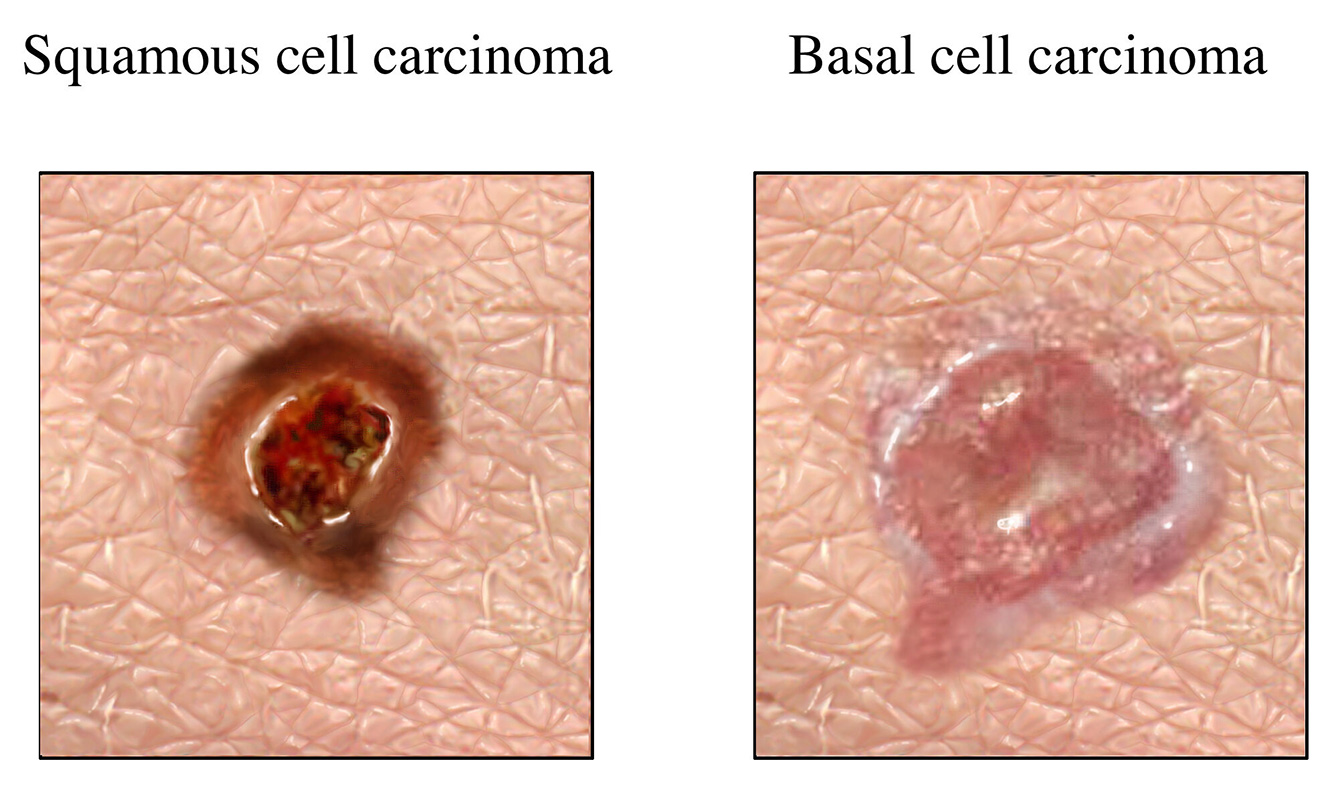
Comparison of what basal and squamous cell carcinoma look like.
Squamous Cell Carcinoma vs. Melanoma
Squamous cell carcinoma and melanoma are different kinds of skin cancer. While squamous cell carcinoma is fairly common, melanoma is much rarer, accounting for only 1% of the total number of new skin cancer diagnoses each year. However, melanoma is also much more aggressive, meaning it is more likely to spread to other parts of the body and often requires multiple forms of treatment.
Squamous Cell Carcinoma Versus Actinic Keratosis
While squamous cell carcinoma is a type of skin cancer, actinic keratosis is the term for a kind of precancerous skin lesion. Actinic keratosis is not cancer, though it can develop into squamous cell carcinoma. It often appears as a thick, rough or scaly patch of skin.
What Causes Squamous Cell Carcinoma?
Squamous cell carcinoma shares most of the same risk factors as other types of skin cancer. The main cause of squamous cell carcinoma is exposure over time to UV light or radiation. The most common source of UV light is natural sunlight, however, it is also used in artificial tanning salons.
Where Does Squamous Cell Carcinoma Form?
In most cases, squamous cell carcinoma forms on parts of the skin that are more frequently exposed to the sun, such as the arms, face and neck, scalp or shoulders. However, it may also occur in other areas, for instance, on the feet or around the genitals.
Squamous Cell Carcinoma Symptoms
The most common symptoms of squamous cell carcinoma are changes to the appearance or texture of the skin. These changes may look cause:
- Rough or scaly patches that are red or dark in color
- A sore that doesn’t heal properly, bleeds or ulcerates
- A wart that is rough, thick or horn-like in shape
- A round, firm bump or growth
- A sore that is surrounded by raised skin
Squamous Cell Carcinoma Stages
Staging cancer is the process of determining the extent of a patient’s cancer using the results of exams and tests.
Doctors may stage squamous cell carcinoma using one of two systems. If the cancer is found on the head or neck, they may use the TNM system, which examines the size of the tumor (T), whether it has spread to any lymph nodes (N) and whether it has spread, or metastasized (M) to distant parts of the body.
Squamous cell carcinoma staged using the TNM system may be referred to as Stage 0 (also known as carcinoma in situ), Stage 1, Stage 2, Stage 3 or Stage 4. Generally speaking, a higher stage number means the cancer has spread further into the body, is larger in size or is more aggressive.
If squamous cell carcinoma is found somewhere other than the head and neck, it is often staged using skin cancer risk group designations referred to as very high risk, high risk or low risk, as detailed below.
Very high risk squamous cell carcinoma: This tends to be more than 4 centimeters (cm) across or has spread deeper than 6 millimeters (mm) into the skin. It may also have spread to nearby tissue, including blood vessels or nerves, or appear more aggressive than normal.
High risk squamous cell carcinoma: This is usually between 2 cm and 4 cm across and may have spread 2 mm to 6 mm into the skin. It may be a recurrent cancer, be fast-growing or be causing symptoms like itchiness or soreness.
Low risk squamous cell carcinoma: This does not have any of the higher-risk characteristics and is usually smaller and slower-growing.
Squamous Cell Carcinoma Treatment
A wide range of treatment options are available for squamous cell carcinoma. Depending on factors such as the stage and extent of the cancer, a patient may need only one type of treatment or benefit from a combination of several treatments.
Surgery
Many squamous cell carcinomas may be treated with surgery alone, in particular if they are at an early stage. Common surgical treatment options for squamous cell carcinoma include standard excision, shave excision, curettage and electrodissection, and Mohs micrographic surgery. While each surgical procedure is slightly different, all are designed to remove cancer from the skin.
With Mohs surgery, the surgeon removes the cancer with a narrow margin of normal skin and assesses for the absence or presence of tumor under the microscope while you wait in the office. Reconstruction is then performed to give an optimal outcome.
“Mohs micrographic surgery offers the highest cure rates for cutaneous squamous cell carcinoma, particularly on high-risk anatomical sites like the face, ears, lips and nose, with cure rates exceeding 99% for primary tumors,” Dr. Singh says. “Certain features such as tumor size, depth, perineural invasion, poor differentiation or immunosuppression can elevate the risk profile, and that pathology review will guide the treatment plan.”
Radiation Therapy
Radiation therapy aims high-powered beams of radiation at the site of a tumor to destroy cancer cells. Radiation therapy may be recommended if a patient has squamous cell carcinoma that is hard to remove surgically or as a treatment after surgery, with the goal of killing any remaining cancer cells.
Cryotherapy
Cryotherapy may be used to treat early-stage squamous cell carcinoma that does not have a high chance of recurrence. During cryotherapy, liquid nitrogen is applied to the site of a tumor. This freezes the tumor, allowing it to fall off or be removed.
Photodynamic Therapy
Photodynamic therapy (PDT) is a procedure that involves injecting a medicine into the bloodstream that binds to cancer cells, then using a specialized laser shone at the skin to activate these medicines so that they destroy a tumor. It may be recommended for low-risk, smaller squamous cell carcinomas.
Immunotherapy
Immunotherapy is the term for a group of medications that support the body’s own immune system or harness the body’s existing immune response to fight cancer. Immunotherapy may be used to treat squamous cell carcinoma that has come back, or for patients who have more advanced squamous cell carcinoma that requires multiple treatment types.
Topical Skin Cancer Treatments
Topical skin cancer treatments are another treatment option for early-stage squamous cell carcinoma. Some come in the form of a cream or ointment, while others may look more like a gel. They may also be referred to as “chemo cream.” Topical skin cancer treatments are applied to the site of a tumor, where they work to destroy precancerous or cancer cells.
Squamous Cell Carcinoma Survival Rates
Survival rates for squamous cell carcinoma are not tracked in the United States, in part because it is a highly treatable form of skin cancer, particularly when detected early. However, some of the factors that may affect a person’s prognosis include:
- The cancer’s stage and extent
- The patient’s overall health and age
- Where the cancer is located on the body
- Whether it is a new cancer diagnosis or a recurrent cancer
According to the Canadian Cancer Society, which does track survival rates in some areas of Canada, the five-year survival rate for squamous cell carcinoma is around 95%.
- American Academy of Dermatology Association. Squamous cell carcinoma: From symptoms to treatment. January 13, 2026.
https://www.aad.org/public/diseases/skin-cancer/squamous-cell-carcinoma - American Cancer Society. Basal and squamous cell skin cancer. 2026.
https://www.cancer.org/cancer/types/basal-and-squamous-cell-skin-cancer.html - American Cancer Society. Basal and squamous cell skin cancer stages and risk groups. October 31, 2023. https://www.cancer.org/cancer/types/basal-and-squamous-cell-skin-cancer/detection-diagnosis-staging/staging.html
- American Cancer Society. Key statistics for basal and squamous cell skin cancers. October 31, 2023. https://www.cancer.org/cancer/types/basal-and-squamous-cell-skin-cancer/about/key-statistics.html
- American Cancer Society. Treating squamous cell carcinoma of the skin. October 9, 2025. https://www.cancer.org/cancer/types/basal-and-squamous-cell-skin-cancer/treating/squamousl-cell-carcinoma.html
- American Cancer Society. What are basal and squamous cell skin cancers? November 15, 2024. https://www.cancer.org/cancer/types/basal-and-squamous-cell-skin-cancer/about/what-is-basal-and-squamous-cell.html
- Canadian Cancer Society. Survival statistics for non-melanoma skin cancer. July 2024.
https://cancer.ca/en/cancer-information/cancer-types/skin-non-melanoma/prognosis-and-survival/survival-statistics - Skin Cancer Foundation. Squamous cell carcinoma overview. July 2025.
https://www.skincancer.org/skin-cancer-information/squamous-cell-carcinoma/ - Skin Cancer Foundation. Squamous cell carcinoma treatment. November 2025.
https://www.skincancer.org/skin-cancer-information/squamous-cell-carcinoma/scc-treatment-options/