
Claudia Lewis and her husband recently spent a weekend caring for their three young grandsons while the boys’ parents enjoyed a getaway. There was little chance of a quiet house, but Lewis was grateful to have the energy for it.
Six months earlier, a colon cancer diagnosis had shaken the retired teacher, 71, and her close-knit family. Less than two months later, Lewis had successfully received immunotherapy and groundbreaking robotic-assisted surgery at City of Hope Orange County. Not only did she go home the next day, but tissue testing showed no remaining cancer.
Fatigue that needed a closer look
Lewis initially thought her fatigue was a sign of getting older. She struggled to keep pace on walks with her husband near their El Dorado Hills home. With a mission trip to Cambodia approaching, she wondered how she would manage.
A daughter-in-law suggested she might be low on iron and encouraged Lewis to call her doctor. Blood tests revealed anemia. Iron infusions restored enough energy for the trip, but her doctor wanted to investigate the cause. A colonoscopy in April revealed a tumor, and a biopsy confirmed colon cancer.
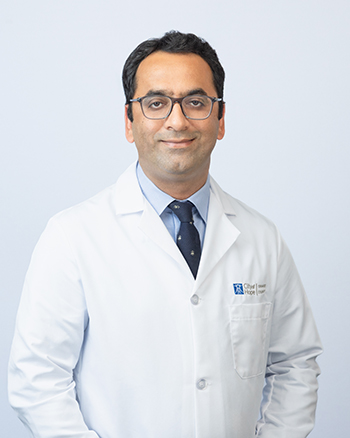
Lewis was preparing to meet with a surgeon in Northern California when a family member learned about the diagnosis. Their conversation helped connect Lewis with Pashtoon Kasi, M.D., the medical director of GI medical oncology at City of Hope Orange County.
Expertise that inspired confidence
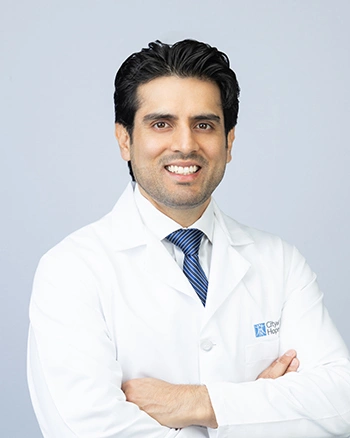
Considered one of the nation’s leading experts in the genomics of cancer and the development of personalized therapies, Dr. Kasi recommended Lewis participate in a specialized clinical trial of immunotherapy given prior to colon cancer surgery. The innovative approach — known as neoadjuvant immunotherapy — utilizes medication to activate the immune system to destroy cancer cells before primary surgery is performed. Lewis and her husband Mark next met with Dr. Kasi and City of Hope Orange County colorectal surgeon Amir Esparza, M.D. The physicians explained every facet of the comprehensive treatment plan they would develop and implement for her: advanced immunotherapy, then minimally invasive surgery.
For Lewis, whose faith steadied her throughout, the connection felt like more than good timing. “I feel like God had his hand in this,” she says.
City of Hope’s cancer-focused expertise and research leadership gave the Lewis’s confidence that she was in the best of hands and receiving the best care. In addition, it meant a lot to them that both of her doctors are also active in medical missions, which resonated with the Lewis’s own commitment to service. “They have the same kind of heart that we have,” she says.
A lifesaving surgery
Lewis received two infusions of immunotherapy. Then, Dr. Esparza successfully performed a right hemicolectomy. Dr. Esparza’s use of single-port robotic-assisted technology for the complex procedure places City of Hope among the first centers in Southern California to offer the approach to patients with colorectal cancer.
Using the da Vinci SP surgical system, Dr. Esparza introduced a flexible camera and three robotic instruments through one incision, in contrast to the several small incisions usually required in conventional robotic colorectal surgery. The instruments move independently, providing exceptional levels of precision and maneuverability.
“Minimally invasive surgery offers meaningful advantages over open techniques, and single port surgery only magnifies those advantages,” Dr. Esparza says. “The benefits for patients typically include less pain after surgery, a quicker return home from the hospital, fewer complications and reduced scarring. As we add to our experience and data, and as the technology continues to evolve, I believe there will be increasingly rapid adoption of this breakthrough approach.”
Lewis went home the next day and was recovering well at her one-week follow-up. “When the pathology results came in, Dr. Kasi and Dr. Esparza were so happy,” Lewis says. No cancer remained in the tissue removed during surgery. Dr. Esparza told her the results were worth framing, she recalls. The Lewis’s reaction was immediate. “Tears,” she says.
Back to being Grandma
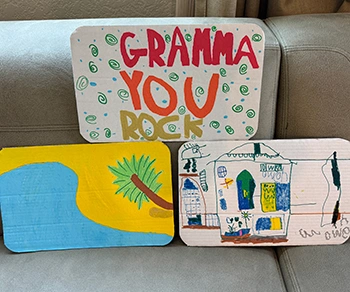
Lewis still marvels at how quickly everything happened. “Within a two-month span, I was diagnosed and treated, and now I am cancer-free,” she says. She continues her follow-up care with tests and imaging, but her days are again filled with watercolor classes, a book club and volunteering at church alongside her husband. “I just feel like I’m back,” Lewis says.
Married for 44 years, the Lewis’s enjoy spending time with their four children and six grandchildren, most of whom live nearby. “The biggest gift is that I get to be around for our grandchildren,” Lewis says.
Lewis feels deeply grateful for the advances that made her care possible, and she shares her story to offer hope and encouragement to people facing a cancer diagnosis. “Because of the hope City of Hope offered us, our second opinion became our first choice. I can’t thank them enough,” Lewis says.
Ending cancer starts with Hope. To make an appointment at any of City of Hope’s Orange County locations, call 888-333-HOPE (4673).
Talking Hope: Robotic surgery for colorectal cancer: A trailblazing treatment technology
Immunotherapy Before Surgery Is Warming Up “Cold” MSS Colorectal Cancer