Zero recurrences to date in the NEST trial point to two missing pieces: timing and a next-generation mmunotherapy, BOT/BAL, that activates immune cells and depletes regulatory T cells that shield the tumor.
For most people with colorectal cancer, immunotherapy has been a door that wouldn’t open.
Roughly 85% of colorectal cancers are “cold” tumors — mismatch repair-proficient (pMMR), also called microsatellite stable (MSS) — and they have barely responded to the drugs that transformed melanoma and lung cancer. For years I wondered whether the problem wasn’t only the drugs, but also when we were giving them.
In an earlier NEST clinical trial, first presented at the 2024 ASCO Gastrointestinal Cancers Symposium, we saw results that challenged the common belief that immunotherapy is not effective for patients with colorectal cancer.
Much of what we knew about immunotherapy in colorectal cancer came from patients with metastatic disease, where pMMR tumors rarely responded. Yet there was encouraging work with a novel combination called BOT/BAL, and I wondered whether we were testing the right treatment at the wrong stage.
I designed and led that study as its sponsor-investigator. In the phase 2 NEST trial, patients received this combination before surgery, while their tumors were still in place.
Treatment did not delay surgery for any patient. And as of the data cutoff at submission — 32 months of median follow-up for NEST1 and 24 months for NEST2 — 100% of patients remain disease-free. Not one has recurred.
Those findings suggest immunotherapy may have a role for a far broader group of patients with colorectal cancer than we believed.
A Different Approach

The idea is simple. An intact tumor gives the immune system more to see, including more antigen and intact lymph nodes in which to mount a response. Give immunotherapy after surgery, and that opportunity is gone.
We were standing on the shoulders of giants. Myriam Chalabi and the NICHE investigators at the Netherlands Cancer Institute had already shown that dual checkpoint blockade before surgery could produce responses in a subset of pMMR colon cancers. And in melanoma, the NADINA trial showed that the same drugs given before surgery, rather than after, led to substantially better event-free survival. The question we asked was whether a next-generation combination could push those signals further.
The need is real. For patients with high-risk stage 2 and stage 3 colon cancer, at least one-third are not cured despite surgery and adjuvant (“mop-up”) chemotherapy. There have been no treatment advances for this population in over two decades; we are still giving these patients the same regimen studied in the early 2000s.
That concept became the foundation of the NEST studies (Novel Exploratory Study to Test), which evaluated whether immunotherapy could work better earlier in the course of treatment.
In the early studies, we found that patients who had more time between immunotherapy and surgery appeared to have deeper responses. In NEST2, extending the window from four weeks to eight deepened responses further. That observation raised another question: Does timing matter as much as the treatment itself?
What We Found
The recently published phase 2 NEST study in Clinical Cancer Research evaluated botensilimab and balstilimab, an investigational immunotherapy combination, before surgery in patients with localized colorectal cancer.
Nearly 60% of patients saw their tumors shrink or show significant signs of treatment response before surgery. For 41%, 90% or more of the cancer was gone by the time of surgery — a major pathologic response. Nearly one-third of patients had no remaining invasive cancer detected at all.
More importantly, we have seen no recurrences to date. That speaks to immunotherapy clearing micrometastatic disease, not just shrinking tumors, and potentially curing more patients.
Many patients with residual tumor were significantly downstaged, some from stage 3 to stage 0 or 1.
And this 100% disease-free survival came despite many patients declining adjuvant chemotherapy afterward. That was not the intent of the study, but it is worth noting.
The goal is to cure more patients. In this approach, surgery becomes partly a diagnostic tool; it tells us, through pathology, whether any tumor is left. As we develop better ways to measure response and identify exceptional responders, we can begin to ask who might be spared surgery, spared chemotherapy or have their chemotherapy de-escalated.
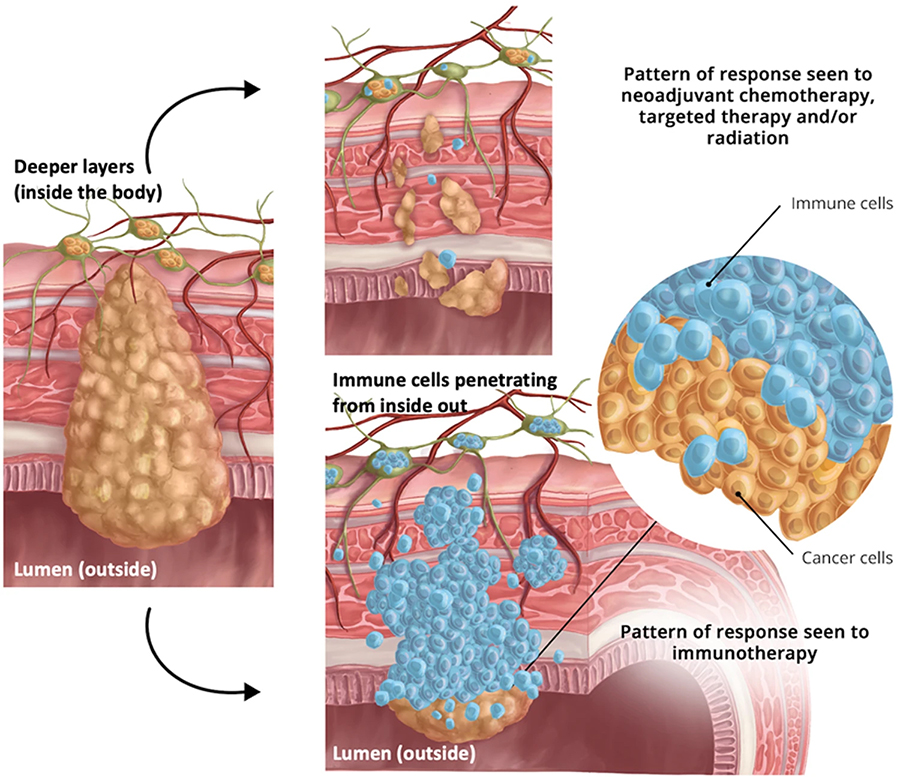
We also saw striking changes inside the tumor itself. Cancer-fighting CD8 T cells increased, immune-suppressing regulatory T cells decreased, and immune cells organized into the clustered patterns of an active anti-tumor response. The tumor was being destroyed from the outer wall inward, the opposite of what we typically see with chemotherapy. We called it the “inside-out” pattern of response.
Circulating tumor DNA, or ctDNA, provided another signal. Seven of eight patients with detectable ctDNA before treatment cleared it before surgery. In other words, the blood turned negative while the tumor was still in the body. After surgery, ctDNA remained undetectable in every patient tested. That, more than any single number, is what reassures me about the 100% disease-free survival. As assays improve, serial ctDNA may become the tool that tells us who is cured. We are testing this in real time in the ongoing NEST3 trial.
Taken together, the findings suggest the immune system was doing far more than shrinking tumors. It was actively reshaping the tumor environment and potentially eliminating microscopic disease beyond what surgeons could see.
Why It Matters
This work comes at a time when colorectal cancer is rising in younger adults.
Early in my career, colon cancer was largely considered a disease of older adults. Today, I regularly see patients in their 30s and 40s. Many are raising families, building careers and planning their futures when cancer suddenly becomes part of their lives.
The biggest unanswered question in colorectal cancer immunotherapy has been how to extend its benefits to the 85% of patients with pMMR disease. That question has guided my work for the past five years.
The standard approach for localized colon cancer has long been surgery, often followed by chemotherapy. Those treatments remain essential. Yet at least one-third of higher-risk stage 2 and stage 3 patients still recur — and that is before counting patients with stage 4 disease.
Our goal is to improve the odds by activating the immune system earlier, when it may be most capable of recognizing and attacking cancer.
The Next Chapter
NEST3 (NCT07595874), which I lead as overall principal investigator, is now open. It enrolls patients with high-risk stage 2 and 3 colon and rectal cancer who are candidates for surgery and adjuvant chemotherapy.
It is also one of the first investigator-initiated trials to run through City of Hope’s national clinical trial model, with Orange County as the lead site and more than 10 sites across four states — including Chicago, Atlanta, Phoenix and multiple locations in California. A trial like this used to require a single academic center. Now a patient in Atlanta can enroll close to home.
None of this happens alone. My deepest thanks go to the patients and caregivers who trusted us, especially in NEST1, when we had no data to show them and only an idea and a promise. Every one of those patients had a surgery date on the calendar and agreed to move it so we could give a single dose of immunotherapy first. That takes a particular kind of courage.
I am also grateful to the philanthropic supporters who have backed this work and to Agenus, which believed in the neoadjuvant idea early and is now advancing it further through the ROBBIN trial alongside NEST3.
Beyond expanding access, NEST3 will help answer important scientific questions. Can a longer treatment window deepen responses? Can biomarkers such as ctDNA, immune profiling and spatial biology identify the patients most likely to benefit?
Those answers could help move the field toward more precise, personalized immunotherapy strategies.
At the end of the day, patients care about being there for their families and living full lives beyond cancer. What excites me most is the chance to bring immunotherapy to more people with colorectal cancer and to improve their odds of long-term remission.
That is the real promise of this work: more cures. It is the reason we keep asking the next question.
Further Reading
NEST Phase 2 results: Clinical Cancer Research, 2026
NEST1 initial report: Oncogene, 2023
NEST1 first presentation: ASCO GI Cancers Symposium, 2024
NEST2 report (deeper responses with longer time to surgery): Annals of Oncology, 2024
NEST3 trial listing: ClinicalTrials.gov NCT07595874
NICHE trial (Chalabi et al.): Nature Medicine, 2020
NADINA trial (Blank et al.): New England Journal of Medicine, 2024
About the Author
Pashtoon Kasi, M.D., is medical director of gastrointestinal medical oncology at City of Hope Orange County and holds the Rad Family Endowed Chair in Gastrointestinal Oncology. He cares for patients with colon and rectal cancer and other gastrointestinal malignancies and leads research aimed at bringing more effective, personalized treatments to patients. His work focuses on expanding the benefits of immunotherapy and advancing early-phase trials of novel therapies that could help more people achieve long-term remission.