Department of Stem Cell Biology & Regenerative Medicine
The Department of Stem Cell Biology & Regenerative Medicine’s mission is to battle tissue degeneration, aging and cancer by making scientific progress in:
- Developing new anti-cancer therapeutics and identifying approaches to prevent /attenuate long-lasting degenerative consequences of cancer therapies
- Organoids & 3D-cellular models to model human diseases
- Identifying new approaches to treat genetic disorders
- Developing new diagnostic and therapeutic agents that leverage new findings in developmental and stem cell biology
Top Image: Dictyostelium discoideum (Usman Bashir CC BY-SA 4.0)
Research in the Department of Stem Cell Biology & Regenerative Medicine is firmly rooted in discovery biology. Research teams in the department explore fundamental questions in developmental and stem cell biology to develop new approaches that can be applied to regenerative medicine and novel cancer therapeutics.
The Department has active programs in neurobiology, neurodegenerative diseases, hematopoiesis and vascular biology, cardio-oncology, immuno-oncology, cancer biology, and aging. These research programs study stem cells and induced pluripotent cells using advanced microscopy, as well as gene manipulation techniques to reprogram the cells with the goal of using them to improve and repair tissue functions.
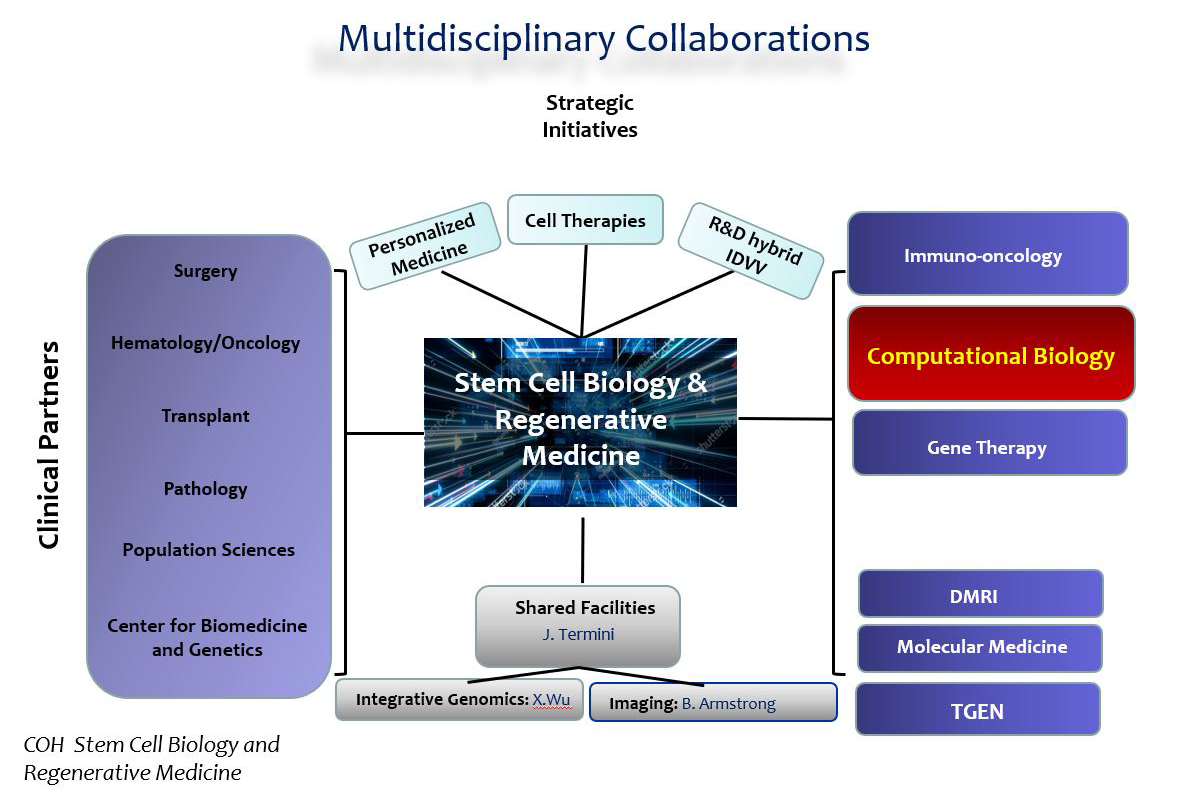
Research in the Department is highly multidisciplinary and couples stem cell and developmental biology with computational and systems biology to resolve the complexity of biological processes, identify the mechanisms underlying diseases, and create new knowledge to lay the foundation for new therapies. Department researchers work very closely with mathematical biologists and oncologists in the Department of Computational and Quantitative Medicine and at TGEN, and with physician-scientists in the City of Hope® Medical Center. The Department supports several clinical trials and has strong collaborations with the City of Hope Clinical Oncology and Immunotherapy programs to develop new approaches using stem cells as drug discovery platforms as well as delivery systems for cancer therapeutics.
Historically, the Department of Stem Cell Biology & Regenerative Medicine (previously called the Department of Developmental & Stem Cell Biology) has grown from its original founding as the Department of Neurosciences, one of the first neurobiology departments in North America and established by Dr. Eugene Roberts in 1968. Studies on neurobiology and brain tumors conducted in the original Neurosciences department set a remarkable paradigm for interdisciplinary research and generated discoveries that advanced our understanding of other cellular systems and treatments of many other cancers, including ovarian, breast, and prostate cancers, as well as hematological malignancies. These efforts have naturally evolved and expanded and are at the core of Department of Stem Cell Biology & Regenerative Medicine’s mission today.
Research in the Department is funded by the National Institutes of Health (NIH) and California Institute for Regenerative Medicine (CIRM). The department is also heavily involved in biomedical education through the training of graduate students and postdoctoral fellows and high school and undergraduate students through CIRM-funded STEM programs, including the CIRM/COH Research Training Program in Stem Cell Biology and Regenerative Medicine.
Division of Stem Cells & Cancer Therapeutics
The Division of Stem Cell Biology Research, previously Directed by Yanhong Shi (2015-2022), has been renamed Division of Stem Cells and Cancer Therapeutics and is currently under the leadership of Dr. Karen Aboody.
The Division of Stem Cells and Cancer Therapeutics, reflects the efforts and the commitment of the Department of Stem Cell Biology and Regenerative Medicine to Translational Medicine. Dr. Aboody has a longstanding track record in translating basic research into the clinics. The division includes faculty with clinical research expertise and provides guidance to all researchers in the Dept. in developing IND and move forward to clinical trials.
Collaborations and Resources