CIRM Research Training Grant “CIRM Scholar” Award
The mission of the Research Training Program in Stem Cell Biology and Regenerative Medicine is to train the next generation of leaders in stem cell, gene therapy and regenerative medicine, while enhancing their understanding of patients’ needs and of the complexities of implementing novel stem cell trials.
Our program leverages the strengths of our institution in stem cell biology, regenerative medicine, and innovative clinical trials. Our CIRM scholars, postdoctoral fellows and graduate students, are engaged in mentored independent research and in curriculum activities: i) formal courses in fundamental biology of stem cells and regenerative medicine, clinical translation and ethical issues; ii) participation in patient outreach and education activities and, iii) community outreach. Thirty-two research faculty participate as mentors across several programs bridging basic science and clinical practice.
Through these activities and in this rich scientific and clinical environment, our program goal is stimulating innovative multidisciplinary research leading to discoveries with the potential to treat incurable diseases and diseases that are an economic burden to the health care system such as diabetes, blood disorders, sickle cell disease and blood cancers, Alzheimer’s disease and other neurological conditions, and many other disorders. Through the planned patient and community engagement and outreach activities our Scholars are acquiring awareness of the inequities that impact implementation of therapies for all patients and are encouraged to be active participants in better meeting the needs of patients in underrepresented and underserved communities.
Program Leaders

Michael Barish, Ph.D.
At the Intersection of neurobiology and immuno-oncology.

Nadia Carlesso, M.D., Ph.D.
Modulation of the bone marrow niche to redirect cellular networks in stress and malignant hematopoiesis

Yanhong Shi, Ph.D.
Disease modeling and therapeutic development for neurological diseases and cancer.
Scholars
CIRM Training Grant Scholars
2022-2025 Cohort
- Eric Carlson (Ph.D. Candidate)
- Jonas Cerneckis (Ph.D. Candidate)
- Diana Gumber (Ph.D. Candidate)
- Leonce Kouakanou(Post-Doctoral Fellow)
- Elaine Kang (Post-Doctoral Fellow)
- Ottavio Napolitano (Post-Doctoral Fellow)
- Zahir Shah (Post-Doctoral Fellow)
- Alonso Tapia (Ph.D. Candidate)
- Wilma Tixi (Post-Doctoral Fellow)
- Ryan Urak (Post-Doctoral Fellow)
- Sneha Varghese (Post-Doctoral Fellow)
- Er Yue (Post-Doctoral Fellow)
- Zhenyu Dai (Post-Doctoral Fellow)
- HyunJun Kang (Post-Doctoral Fellow)
2024-2027 Cohort
- Soraya Aramburo (Ph.D. Candidate)
- Cesar Gonzalez (Ph.D. Candidate)
- Tali Kiperman (Ph.D. Candidate)
- Ken Kudo (Post-Doctoral Fellow)
- Negar Seyedhassantehrani (Post-Doctoral Fellow)
- Nuozi Song (Post-Doctoral Fellow)
- Hanif Ullah (Post-Doctoral Fellow)
- Yin Wang (Post-Doctoral Fellow)
- Kai Zang (Post-Doctoral Fellow)
- Heather Zook (Post-Doctoral Fellow)
- Xinying Guo (Ph.D. Candidate)
- Xiujian Ma (Post-Doctoral Fellow)
- Konnie Urbaniak (Post-Doctoral Fellow)
- Meghna Sur (Post-Doctoral Fellow)
Prospective Scholars
CIRM Training Grant in Stem Cell Biology and Regenerative Medicine Program
The program consists of:
- Mentored independent research.
- Formal course work in fundamental biology of stem cells, gene therapy, and regenerative medicine; clinical implementation of this basic science; and ethical issues emerging from implementation of this research.
- A workshop on research presentation.
- Patient engagement activities in the medical center.
- Community outreach activities, including efforts to enhance diversity, equity, and inclusion.
The training grant will support projects addressing significant questions in stem cell biology, gene therapy, or regenerative medicine. These projects need not originate from traditional stem cell laboratories, but they should be related either to the fundamental biology of stem cells, or to their use in the treatment of disease.
These fellowships are for three years (pending yearly review), and each CIRM Scholar is expected to complete the full three years of the program. Each appointment comes with a stipend at COH scale (please note that the CIRM predoctoral salary cap is presently less than the COH scale, but CIRM is considering changing its cap), a research and travel allowance ($6,000/year predoctoral and $12,000/year postdoctoral), and health insurance.
Eligibility
Predoctoral applicants are expected to have completed their second year and to have selected a mentor and research laboratory. They need not have formally advanced to candidacy, but their qualifying exam should be eminent.
Postdoctoral applicants are expected to have a PhD, MD, or equivalent degree, and to be at the early stages of their training, having completed not more than two years of postdoctoral research. However, as personal circumstances are varied, please contact us for clarification of eligibility if there is any question. Please note that US visa rules are such that a postdoctoral CIRM Scholar can hold a J-1 visa that will cover the entire three-year period of the award, but not an H-1 visa, as CIRM Scholars are not technically COH employees.
Prospective mentors are expected to be in the Professor series. Individuals in the Research Professor series are expected to have their own research program with committed space and at least partially independent research funding. The training grant office maintains a catalog of potential mentors; interested investigators should contact us regarding eligibility to serve as CIRM Scholar mentors.
The most important criteria for selection are:
- The applicant (including commitment to stem cell biology, gene therapy, and/or regenerative medicine).
- The significance of the question to be addressed.
- The experimental strategy.
- The scientific and financial ability of the prospective mentor to effectively guide and support the project.
- The suitability of the prospective training environment, including the mentor’s previous experience supervising and training postdoctoral fellows, graduate students, and interns.
For clarifications of eligibility or for further information, please contact Nousha Javanmardi ([email protected]).
Faculty Mentors
Curriculum
Curriculum’s Overview at Glance
During the three-years scholarship the CIRM Scholars undertake a program of:
- Formal course work in fundamental biology of stem cells and regenerative medicine; translation of stem cell therapy into clinical practice; and ethical issues emerging from this research and its implementation.
- Workshops
- Participation in patient outreach and education activities/ Community outreach through integration in ongoing programs.
- Research Events.
Courses
Course I. Stem Cells, Gene Therapy and Regenerative Medicine. This course covers the fundamental biology and conceptual tools of stem cells and gene therapy, and their applications in regenerative medicine. As part of the course, students prepare and defend a research proposal addressing a stem cell/gene therapy/regenerative medicine research problem.
Course II. Translating Stem Cell Therapies into Clinical Practice. This course stems from the longstanding experience of COH in conducting clinical trials applying stem cells and gene therapy to regenerative medicine. The course features scientific and clinical principal investigators, research nurses, and institutional officials involved in regulatory and commercialization activities. The course provides CIRM Scholars with critical understanding of the path from discoveries to clinical applications and describe the breath of stem cell and gene therapy research discoveries.
Course III. The Ethical, Legal, and Social Implications of Stem Cell Research and Therapies. This course, required of CIRM Scholars, emphasizes the ethical issues raised by use of stem cells in the laboratory and clinic, and features presentations from institutional officers in research protection and clinical research operations, patient advocates, and researchers into ethical and social aspects of these endeavors.
Workshops & Activities
Presentation Skills Workshop. This is a monthly training course held over one year focusing on proper delivery of scientific research to different audiences. The course is restricted to CIRM Scholars to build an environment conductive to open and constructive comment and criticism.
Responsible Conduct of Research (RCR), Scientific Rigor, and Reproducibility. This workshop is required for all COH and for CIRM Scholars. Its objectives are to raise awareness of ethical issues, facilitate discussion of ethical dilemmas, identify institutional resources for managing scientific disputes, and provide training in rigorous scientific research design and conduct. Discussions are led by members of the COH community involved in research oversight. The workshop fulfills all NIH requirements on instruction in RCR, scientific rigor and reproducibility.
Stem Cell and Regenerative Medicine Journal Club, Seminar Series, and Forum. All CIRM trainees are required to attend and present at the Stem Cell Journal Club as well as the Stem Cell and Regenerative Medicine Seminar Series, featuring invited nationally and internationally speakers, and the Stem Cell and Regenerative Medicine Forum, hosted by COH faculty.
Patients’ Community Outreach & Education
Patient Engagement and Community Outreach Activities. To engage CIRM Scholars with patients and communities, and to promote diversity across all levels of the training program.
Patient and Healthcare Engagement Activities: As many of the clinical activities at COH are essentially stem cell therapies, we work with the Medical Center Department of Supportive Services to involve CIRM Scholars in patient education and outreach programs, enhancing patients’ understanding of the fundamental biology and translational medicine behind their treatments
Alpha Stem Cell Clinic (ASCC). The program leverages the ASCC experience at COH, which has developed a long-lasting infrastructure supporting gene editing research, manufacturing, trial design, and regulatory activities essential for the translation of cell-therapies in clinical trials.
Community Outreach and Education Activities: CIRM Scholars collaboration with the Roberts Summer Academy and our community engagement team, which includes participation in school presentations and institute tours, and active support of programs to promote diversity, equity, and inclusion and to reduce health disparities.
Events
Other seminar programs the CIRM Scholars have access to are: the Beckman Research Institute Seminar Series, which features a broad scope of scientific areas, including cancer research, diabetes, stem cell biology, immunology, and neurobiology; the City of Hope Comprehensive Cancer Center seminar series, which meets monthly and hosts renowned cancer scientists to communicate the most recent cancer-relevant findings, ideas, and technologies; the Leading Edge Lecture seminar series hosted by the students of the COH/BRI graduate school; and City of Hope Disease Team Meetings that involve nurses, biostatisticians, pharmacists, physicians, clinical and research fellows, and biomedical researchers engaged in treating or researching a particular tumor type.
Stem Cell Research Day. A yearly event at which current CIRM trainees and other graduate students and postdoctoral fellows conducting research relevant to stem cells, gene therapy, and regenerative medicine, will give oral or poster presentations on their projects, explaining the goals, specific aims, and progress of their research. This event will be open to the entire COH community, including patients and their families, with the goal of presenting these areas of research and fostering new cross-disciplinary collaborations.
The annual COH/CIRM Symposium in Stem Cell Biology, Gene Therapy, and Regenerative Medicine. Presentations are given by selected CIRM training grant mentors, Scholars, and invited speakers. This event will be open to UC Riverside and other local CIRM Scholars, and their mentors, from nearby institutions (Caltech, USC and UCLA).
Events
Community Outreach and Education are important components of the CIRM Stem Cell Biology and Regenerative Medicine Training Gant, aligning with the overall COH mission to develop a diverse and inclusive workforce in the biomedical sciences. Our CIRM Scholars have mentored high school students from underrepresented backgrounds within the COH Roberts Summer Academy program as well as CIRM Bridge students from CSUSB and CSULB. CIRM Scholars and their mentors have also co-led visits of high school students to the COH campus and its laboratories, and they have promoted incorporation of stem cell research and education into curricula serving the student populations within the COH Bioscience Research summer internship program. We have also joined the Foothill K12 Consortium Program, which works to recruit students from underserved communities into STEM activities. The Foothill K12 consortium includes high schools from Azusa, Monrovia, Duarte and Charter Oaks, all schools in the San Gabriel Valley having high representation of Latinx, low income, and first-generation higher education students.
Patient and Family Advisory Council (PFAC). An important component of our training plan is fostering a commitment among trainees to accelerating the delivery of treatments to patients with unmet needs. To coordinate patient-healthcare engagement activities for the CIRM scholars we have partnered with the Patient & Family Services and Patient/Family/Community Education Department at COH. All CIRM Scholars took the HIPPA training and were assigned to attend at least one meeting of the PFAC and El Concilio, the Spanish-speaking council meeting.
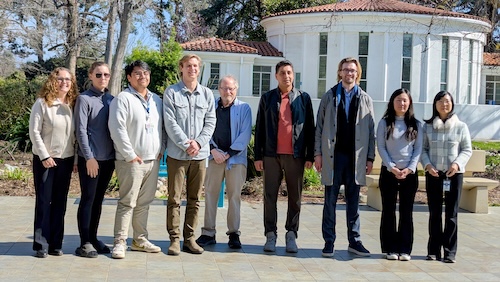
Inland Empire Stem Cell Consortium's (IESCC) Annual Symposium (November 6, 2025). IESCC Annual Symposium will be hosted by City of Hope this year. The Consortium aims to foster a collaborative atmosphere for the interaction of stem cell laboratories within the Inland Empire, to create extensive training opportunities for students in the field of stem cell biology, and to offer a platform for enhancing the visibility of stem cell research in our region to the local community. To achieve these objectives, we are implementing joint initiatives that encompass seminar series, community and patient outreach programs, and an annual symposium. The IESCC consists of researchers engaged in stem cell research across the Inland Empire, representing institutions such as the University of California, Riverside, City of Hope, Western University of Health Sciences, Loma Linda University, California University of Science and Medicine, and California State University at San Bernardino. Registration information will be posted.
CIRM Scholar Day (June 29, 2025). Current COH CIRM scholars presented and discussed their projects on this day. The day was concluded with round table discussion on various themes and constructive feed-back on the CIRM training program.
CIRM/BRIDGES/COMPASS Social (June 5, 2025). BRIDGES scholars gave their final presentations on their projects, followed by our CIRM, BRIDGES and new COMPASS interns group discussion and networking.
CIRM Cohort 1 Final Presentations (February 10, 2025). All Cohort 1 scholars gave their final presentations on their CIRM projects and received their completion certificates. The day was concluded with round table discussion on various themes and constructive feed-back on the CIRM training program.
CIRM /Bridge Scholar Day (June 28, 2024). All COH CIRM scholars as well as Bridge Students presented and discussed their projects on this day. The day was concluded with round table discussion on various themes and constructive feed-back on the CIRM training program.
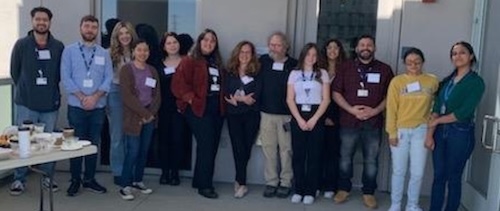
Stem Cell Biology and Regenerative Medicine Symposium (March 29, 2024). Exploring the many forms of stem cell biology has given insight into diverse areas of biomedicine. Indeed, stem cell-centric views of development, adaptation and plasticity, and multiple diseases, have changed the way we look at many areas of organismal biology. The speakers in this symposium considered stem cell origins and eventual residency in mature organs, roles of stem cells in tissue repair and regeneration, and stem cell participation in disease therapies. These talks stimulated conversations among the speakers and participants, generating new ways of thinking and hopefully new collaborations.
Inland Empire STEM Cell Consortium Symposium (November 3, 2023). The Inland Empire Stem Cell Consortium, IESCC, consists of several institutions residing in Riverside and San Bernardino counties. These include University of California Riverside (UCR), Loma Linda University (LLU), California State San Bernardino (CSUSB), Western University of Health Sciences (WUHS) and California University of Sciences and Medicine (CUSM). Every year IESCC organizes a Stem Cell Symposia for the trainees, and this year our CIRM training grant joined this event.
CIRM Bridge students and Scholars “Breakfast Meet and Greet” (October 12, 2023). This “breakfast event” provided the opportunity for CIRM Scholars to meet in person the CIRM BRIDGES interns recently recruited by COH. During this meeting, each trainee (scholars and bridges) introduced themselves and gave an overview of their projects. Formal introduction was followed by students mingling over breakfast and networking. Each Bridges student was able to invite one CIRM Scholar to a pre-paid lunch to discuss research interests and begin a mentor/mentee collaboration.
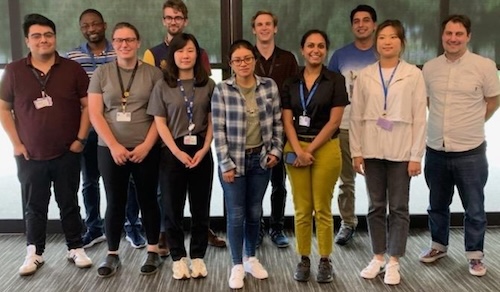
CIRM Training Grant Scholar Day (July 31, 2023). All COH CIRM scholars presented and discussed their projects on this day. The day was concluded with round table discussion on various themes and constructive feed-back on the CIRM training program.
City of Hope & UCR Winter Retreat (January 17, 2023). In collaboration with CIRM training program at UCR, City of Hope & UCR held a one-day Winter Retreat event. CIRM training grant trainees from both institutions submitted their abstracts two weeks in advance and gave a 10 min. PowerPoint presentation on their CIRM research projects at the retreat. The presentations were divided into five categories (Disease Modeling I and II, Regulation of Tissues' Stem Cells, Tumor Targeting Strategies, Regulation of Pancreas and Skeletal Muscles). There was a 15-minute round table discussion after each category's presentation lead by two scholars, one from each institution. The event was held in person within each institution, and it was broadcasted in real time by zoom between the two institutions.
Publications
- Sayaman RW, Miyano M, Carlson EG, Senapati P, Zirbes A, Shalabi SF, Todhunter ME, Seewaldt VE, Neuhausen SL, Stampfer MR, Schones DE, LaBarge M. Luminal epithelial cells integrate variable responses to aging into stereotypical changes that underlie breast cancer susceptibility. Elife. 2024 Nov 15;13:e95720. doi: 10.7554/eLife.95720. Epub ahead of print. PMID: 39545637.
- Varghese SS, Hernandez-De La Peña AG, Dhawan S. Safeguarding genomic integrity in beta-cells: implications for beta-cell differentiation, growth, and dysfunction. Biochem Soc Trans. 2024 Oct 30;52(5):2133-2144. doi: 10.1042/BST20231519. PMID: 39364746; PMCID: PMC11555696.
- Tapia A, Liu X, Malhi NK, Yuan D, Chen M, Southerland KW, Luo Y, Chen ZB. Role of long noncoding RNAs in diabetes-associated peripheral arterial disease. Cardiovasc Diabetol. 2024 Jul 24;23(1):274. doi: 10.1186/s12933-024-02327-7. PMID: 39049097; PMCID: PMC11271017.
- Tapia A, Kaur Malhi N, Liu X, Chen M, Chen ZB. Isolation of Mouse Pancreatic Endothelial Cells. J Vis Exp. 2024 Jun 21;(208). doi: 10.3791/66690. PMID: 38975772.
- Kiperman T, Ma K. Circadian Clock in Muscle Disease Etiology and Therapeutic Potential for Duchenne Muscular Dystrophy. Int J Mol Sci. 2024 Apr 27;25(9):4767. doi: 10.3390/ijms25094767. PMID: 38731986; PMCID: PMC11083552.
- Cerneckis J, Cai H, Shi Y. Induced pluripotent stem cells (iPSCs): molecular mechanisms of induction and applications. Signal Transduct Target Ther. 2024 Apr 26;9(1):112. doi: 10.1038/s41392-024-01809-0. PMID: 38670977; PMCID: PMC11053163.
- Shah Z, Tian L, Li Z, Jin L, Zhang J, Li Z, Barr T, Tang H, Feng M, Caligiuri MA, Yu J. Human anti-PSCA CAR macrophages possess potent antitumor activity against pancreatic cancer. Cell Stem Cell. 2024 Jun 6;31(6):803-817.e6. doi: 10.1016/j.stem.2024.03.018. Epub 2024 Apr 24. PMID: 38663406; PMCID: PMC11162318.
- Wang C, Cerneckis J, Shi Y. Directed Differentiation of Neurons from Human iPSCs for Modeling Neurological Disorders. Methods Mol Biol. 2024;2794:141-155. doi: 10.1007/978-1-0716-3810-1_12. PMID: 38630226.
- Yu V, Yong F, Marta A, Khadayate S, Osakwe A, Bhattacharya S, Varghese SS, Chabosseau P, Tabibi SM, Chen K, Georgiadou E, Parveen N, Suleiman M, Stamoulis Z, Marselli L, De Luca C, Tesi M, Ostinelli G, Delgadillo-Silva L, Wu X, Hatanaka Y, Montoya A, Elliott J, Patel B, Demchenko N, Whilding C, Hajkova P, Shliaha P, Kramer H, Ali Y, Marchetti P, Sladek R, Dhawan S, Withers DJ, Rutter GA, Millership SJ. Differential CpG methylation at Nnat in the early establishment of beta cell heterogeneity. Diabetologia. 2024 Jun;67(6):1079-1094. doi: 10.1007/s00125-024-06123-6. Epub 2024 Mar 21. PMID: 38512414; PMCID: PMC11058053.
- Zook HN, Quijano JC, Ortiz JA, Donohue C, Lopez K, Li W, Erdem N, Jou K, Crook CJ, Garcia I Jr, Kandeel F, Montero E, Ku HT. Activation of ductal progenitor-like cells from adult human pancreas requires extracellular matrix protein signaling. iScience. 2024 Feb 15;27(3):109237. doi: 10.1016/j.isci.2024.109237. PMID: 38433896; PMCID: PMC10904999.
- Murtadha M, Park M, Zhu Y, Caserta E, Napolitano O, Tandoh T, Moloudizargari M, Pozhitkov A, Singer M, Dona AA, Vahed H, Gonzalez A, Ly K, Ouyang C, Sanchez JF, Nigam L, Duplan A, Chowdhury A, Ghoda L, Li L, Zhang B, Krishnan A, Marcucci G, Williams JC, Pichiorri F. A CD38-directed, single-chain T-cell engager targets leukemia stem cells through IFN-γ-induced CD38 expression. Blood. 2024 Apr 18;143(16):1599-1615. doi: 10.1182/blood.2023021570. PMID: 38394668; PMCID: PMC11103097.
- Sriram K, Qi Z, Yuan D, Malhi NK, Liu X, Calandrelli R, Luo Y, Tapia A, Jin S, Shi J, Salas M, Dang R, Armstrong B, Priceman SJ, Wang PH, Liao J, Natarajan R, Zhong S, Bouman Chen Z. Regulation of nuclear transcription by mitochondrial RNA in endothelial cells. Elife. 2024 Jan 22;13:e86204. doi: 10.7554/eLife.86204. PMID: 38251974; PMCID: PMC10803041.
- Tixi W, Maldonado M, Chang YT, Chiu A, Yeung W, Parveen N, Nelson MS, Hart R, Wang S, Hsu WJ, Fueger P, Kopp JL, Huising MO, Dhawan S, Shih HP. Coordination between ECM and cell-cell adhesion regulates the development of islet aggregation, architecture, and functional maturation. Elife. 2023 Aug 23;12:e90006. doi: 10.7554/eLife.90006. PMID: 37610090; PMCID: PMC10482429.
- Cerneckis J, Shi Y. Context matters: hPSC-derived microglia thrive in a humanized brain environment in vivo. Cell Stem Cell. 2023 Jul 6;30(7):909-910. doi: 10.1016/j.stem.2023.05.013. PMID: 37419102; PMCID: PMC10505011.
- Cerneckis J, Bu G, Shi Y. Pushing the boundaries of brain organoids to study Alzheimer's disease. Trends Mol Med. 2023 Aug;29(8):659-672. doi: 10.1016/j.molmed.2023.05.007. Epub 2023 Jun 21. PMID: 37353408; PMCID: PMC10374393.
- Urak R, Gittins B, Soemardy C, Grepo N, Goldberg L, Maker M, Shevchenko G, Davis A, Li S, Scott T, Morris KV, Forman SJ, Wang X. Evaluation of the Elements of Short Hairpin RNAs in Developing shRNA-Containing CAR T Cells. Cancers (Basel). 2023 May 20;15(10):2848. doi: 10.3390/cancers15102848. PMID: 37345185; PMCID: PMC10216594.
- Cerneckis J, Shi Y. Modeling brain macrophage biology and neurodegenerative diseases using human iPSC-derived neuroimmune organoids. Front Cell Neurosci. 2023 Jun 5;17:1198715. doi: 10.3389/fncel.2023.1198715. PMID: 37342768; PMCID: PMC10277621.
- Tompkins J, Lizhar E, Shokrani A, Wu X, Berley J, Kamali D, Hussey D, Cerneckis J, Kang TH, Wang J, Tsark W, Zeng D, Godatha S, Natarajan R, Riggs A. Engineering CpG island DNA methylation in pluripotent cells through synthetic CpG-free ssDNA insertion. Cell Rep Methods. 2023 May 4;3(5):100465. doi: 10.1016/j.crmeth.2023.100465. PMID: 37323577; PMCID: PMC10261899.
- Todhunter ME, Miyano M, Carlson EG, Hinz S, LaBarge MA. Sustained postconfluent culture of human mammary epithelial cells enriches for luminal and c-Kit+ subtypes. Breast Cancer Res. 2023 Jan 18;25(1):6. doi: 10.1186/s13058-022-01595-z. PMID: 36653787; PMCID: PMC9847146.
- Kim YW, Zara G, Kang H, Branciamore S, O'Meally D, Feng Y, Kuan CY, Luo Y, Nelson MS, Brummer AB, Rockne R, Chen ZB, Zheng Y, Cardoso AA, Carlesso N. Integration of single-cell transcriptomes and biological function reveals distinct behavioral patterns in bone marrow endothelium. Nat Commun. 2022 Nov 24;13(1):7235. doi: 10.1038/s41467-022-34425-z. PMID: 36433940; PMCID: PMC9700769.
2024 Symposium
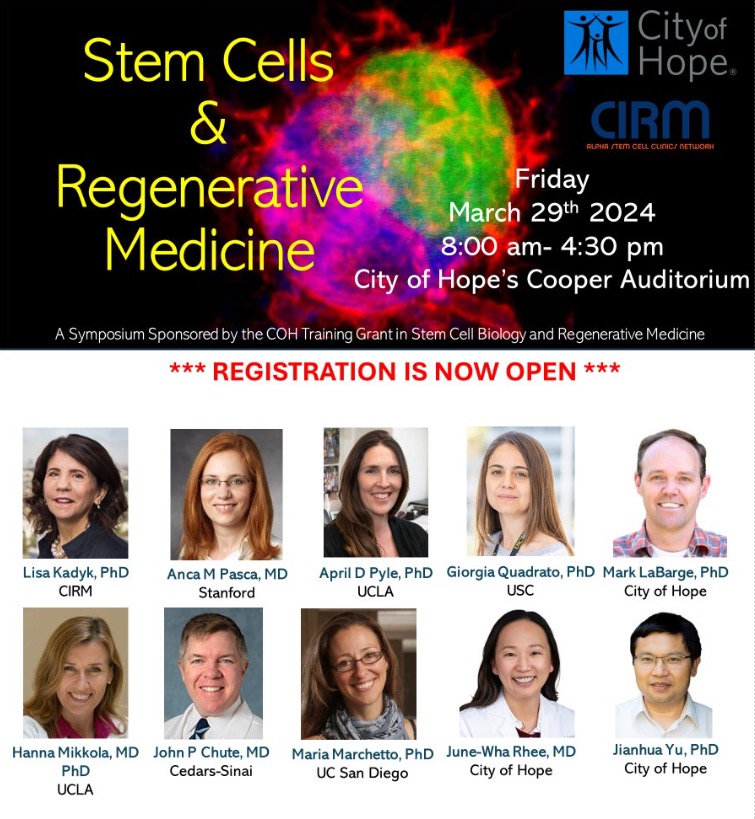
* REGISTRATION CLOSED *
Lunch will be provided
Registration is free but required
CIRM BRIDGES Program
Department of Stem Cell Biology & Regenerative Medicine
Principal Investigator: Michael Barish, Ph.D.
February 2024
Contact
For more information, please contact us below:
Nousha Javamardi
Administrative Program Coodinator
Stem Cell Bio & Regen Med, Beckman Research Institute
Email: [email protected]