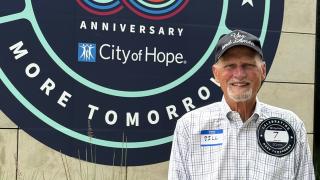
Willard Dunlap’s faith, humor, and positive attitude have carried him through many difficult times in his cancer journey. His upbeat mindset encourages others to do the same.
Take 2018 for instance, not long after the Orange County resident was diagnosed with acute myeloid leukemia (AML) and admitted to City of Hope’s hospital in Duarte for lifesaving daily chemotherapy. Dunlap, 77, undertook the extended stay with characteristic optimism. Every morning for more than five months, after waking in the hospital, he showered, shaved, put on a crisp dress shirt and pants and went strolling the hallways.
Passersby might have assumed he was heading off to his job, not chemotherapy, and that’s just the mindset he’s wanted.
“I just treated it like I was going to work,” says Dunlap, a retired construction consultant who has lived in Newport Beach for more than 40 years.
Dunlap’s IV line, which was attached to a rolling tower, came with him wherever he went — a small inconvenience he naturally saw humor in. “My wife and I named her Ivy Tower, and she was my live-in roommate. I was attached to her the entire time,” says Dunlap.
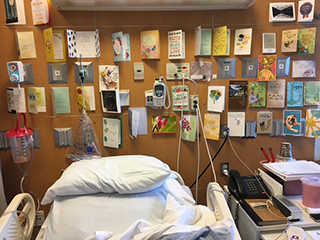
Whenever possible, Dunlap would invite other patients to walk the halls with him. Creating this routine helped Dunlap feel normal and not like a patient. “It gave me the sense that I’m not so ill, I’m OK,” he said. He and his wife put prayer cards he received up on his wall for everyone to see. After successfully completing his treatment, Dunlap returned home and went back to work.
Dunlap’s upbeat attitude helped him — and many other patients —even more when he was admitted again for a stem cell transplant. City of Hope has performed more than 20,000 of these lifesaving procedures in the nearly 50-year history of its transplant program.
First, his body was conditioned with high-dose chemotherapy; and when he was ready, a stem cell donation was flown in from a 30-year-old man in Germany because none of Dunlap’s family was a match.
Be the Match: National Marrow National Marrow Donor Program at City of Hope
As is common for patients who’ve received a stem cell transplant, Dunlap developed a moderate case of GVHD, or graft vs host disease. This means the transplanted cells attack the recipient’s normal cells, causing a variety of potentially dangerous complications that must be addressed. “As my wife likes to say, it’s like having neighborhood friends over to the house that you really don’t want to stay long,” says Dunlap.
He coped by living as normally as possible, and he encouraged the patients on his floor of the hospital to do the same. He wanted to make his room and life as upbeat as possible. This efforts worked so well that Dunlap created a checklist of suggestions for other patients to help make their hospital stay pleasant and even fun.
One suggestion, “Open up the shades and turn on the lights. Make your room bright and inviting as you are going to have lots of visitors today, i.e., PAs, nurses, doctors, staff, family and friends,” was especially helpful for others, Dunlap says.
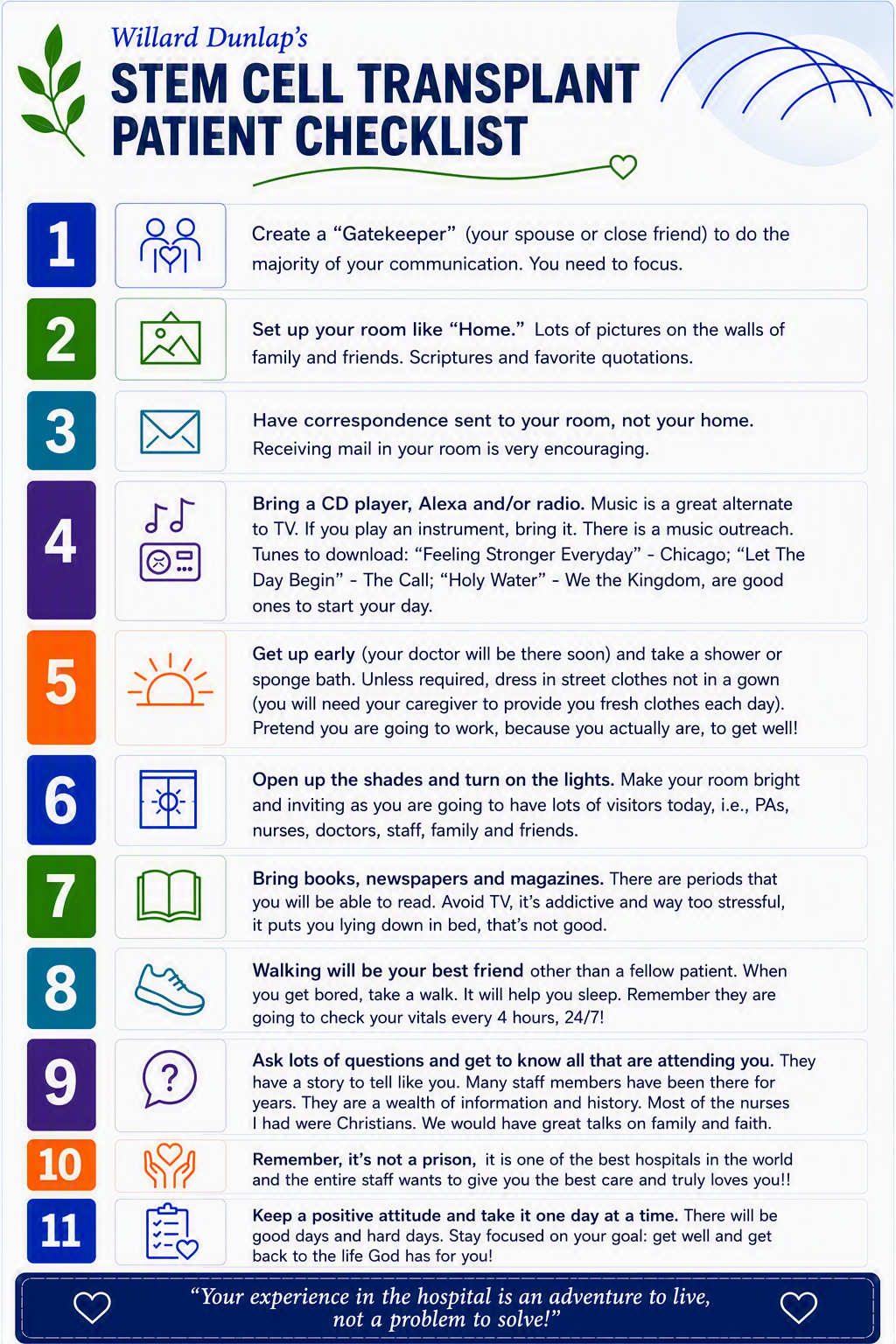
“I wanted to put this list together to share with people in the same situation as me,” he said, adding that some patients remained glued to the TV and never ventured out of their rooms. “That’s not the deal. You’ve got to get up and start the day,” he says. He encouraged others to join him walking through the hospital hallways.
Dunlap also enjoyed music therapy. As a drummer in a band that’s played for 28 years, he was happy to play percussion instruments along with the Beatle tunes that were provided for patients.
“I was always playing music,” says Dunlap now recalling those hospital stays. “My daughter brought me an Alexa so I could download my music off my phone onto a little amplifier.” He also spent time reading. “I tried to stay away from the TV,” he says. When a dog was brought in for visits with patients, Dunlap always played with him.
Not long after Dunlap’s stem cell transplant, City of Hope opened its academic cancer campus in Orange County, and he was happy to be able to get all his regular tests close to home. He also receives acupuncture there to help with cancer-related neuropathy — one of many integrative oncology therapies offered by City of Hope.
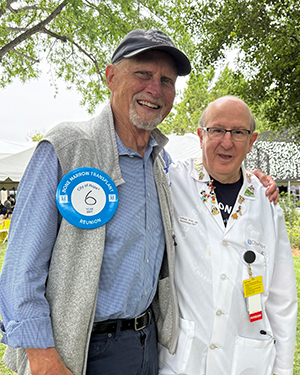
Though he is naturally a positive person, Dunlap credits his faith and his wife Jann — who drove 100 miles daily to see him — for giving him strength and comfort during the seven years of his cancer journey. These days, he enjoys being with his family, which now includes four grandchildren. He follows the Mediterranean diet, exercises as much as possible and attends City of Hope’s annual reunions for BMT patients.
Dunlap especially appreciates the high-level, cancer-focused expertise at City of Hope, with special thanks to hematologist-oncologist Anthony S. Stein, M.D., and nurse practitioner Cassie Shukla. “I’m grateful for the research, the treatment and the way they care for the whole person. No place fights cancer and cares for patients with cancer like City of Hope does,” he says.
Also read:
CAR T vs. Stem Cell Transplant: Understand These Lifesaving Treatment Options for Blood Cancer
Orange County teen creates journal for young people touched by cancer
For Patients with Blood Cancer, A Promise Fulfilled