
Abby Kanarek doesn’t mince words when talking about City of Hope®:
“Unless they want a kidney, I will do anything for them!” she exclaims.
Now 68, the medical editor from Laguna Beach, California, makes a point of volunteering in any way she can, whether by speaking publicly or participating in a new brand campaign. “I’m on call for anything they want,” she says.
It was March 2019 when the fiercely independent Kanarek received devastating news. Her back had been aching more than the usual discomfort she felt from her scoliosis and a spinal fusion to treat it. After getting X-rays and heading home, she was startled to hear from the doctor almost immediately. “Come back,” he said. “You have a large lesion on your right lung.”
“I was surprised but not shocked,” she recalled. There was, after all, cancer on both sides of her family and Kanarek herself had smoked for many years. She made plans to see an oncologist.
But then she lost her balance. And her left side went numb.
“I couldn’t get out of bed. I couldn’t feel my left side,” she said. An ambulance rushed her to the hospital. Kanarek worried that she’d had a stroke. A series of scans told a different story, revealing multiple lesions in her brain.
A Life-Changing Diagnosis
Then the diagnosis came: stage 4 non-small cell lung cancer that had metastasized to the brain. Her doctors gave her 18 months to live.
“I lost it,” recalled Kanarek. She was three days away from a trip to Southeast Asia. She canceled it. She also tried to end her relationship with her partner, Richard Epstein.
“I wanted him to leave,” she said. “He was just about to move in with me, but this is a big deal to throw on someone. I didn’t want him to feel obligated to take care of me. It was the really big elephant in the room.”
Epstein stayed. “You know what?” he told her. “I’m going to step up to the plate and be the person you think I am.”
They married in 2021. “He’s been amazing,” she said.
Kanarek’s tumor tested positive for PD-L1 expression. PD-L1 is a protein whose normal function is to stop the immune system’s T cells from attacking healthy cells. Cancer cells can use elevated PD-L1 expression to evade an immune response, allowing the cancer to grow and spread. Testing showed PD-L1 expression in 90% of Kanarek’s tumor cells.
Finding the Right Care Team

After treating the smaller brain lesions with Gamma Knife radiation, Kanarek resolved to find the best PD-L1 expert she could. Through friends and family, she researched several cancer centers but ultimately chose City of Hope Los Angeles because of Ravi Salgia, M.D., Ph.D., the Arthur & Rosalie Kaplan Chair in Medical Oncology and professor and chair of the Department of Medical Oncology & Therapeutics Research.
“He knows more about PD-L1 than anyone else,” she said. And he displays that knowledge in a manner that impressed Kanarek from the start.
“He’s soft-spoken [and] he talks to you like he has all the time in the world. His curiosity is boundless. He sold me on himself. He listens, and he explains things in a very linear, no BS fashion that really appeals to my brain. He even encouraged me to question him if I ever disagreed with him. He inspired me and gave me hope not to die. I knew he’d be the one.”
She also loved City of Hope’s campus with its centralized layout (“no running from one building to another,” she said). She was equally impressed by the people she met there, from the parking valet who assured her, “You’re in the right place,” to her “amazing” patient navigator and the doctors who collaborated freely and easily. “Everyone talks to each other, and they all want to be innovators.”
Dr. Salgia was equally impressed with Kanarek, calling her “a wonderful person.” He recalls that she was seriously ill with metastatic non-small cell lung cancer. “I explained that while we had to be aggressive in our approach, we also had to think about any genetic or protein abnormalities, and whether there might be targeted therapies available,” he said.
The drug that held out the most promise was Keytruda® (pembrolizumab), an immunotherapy treatment approved four years earlier by the Food and Drug Administration. Pembrolizumab is an immune checkpoint inhibitor that stops the action of PD-L1 so the immune system can successfully attack the cancer. Kanarek immediately started reading up on this new drug.
“My greatest love is research,” she said. “So, I searched Keytruda.” She and Dr. Salgia had high hopes.
Unfortunately, after only her fourth infusion, Kanarek developed severe inflammation in her liver and kidneys. Her treatment had to stop.
“I was so disappointed,” said Kanarek, frustrated that the treatment she had hoped would help was hurting her instead.
Hope After a Difficult Setback
Then, seemingly out of the blue, disappointment flipped to elation. After four treatments, imaging showed no remaining evidence of malignancy. “There’s nothing there!” exclaimed Kanarek. “This surprised me more than my original diagnosis!”
It surprised Dr. Salgia too.
“We're finding that patients who develop toxicities may have a better survival. Who would have thought that?” he said. “The immune system is so involved; it's fighting some of the normal cells as well as the cancer cells.” The findings led to an original manuscript that Dr. Salgia and colleagues published in 2021.
And as for Kanarek’s case? Dr. Salgia told her, “You’re my miracle child!”
The miracle has lasted seven years. With a few bumps in the road.
“She did have a new lung cancer that was contained,” said Dr. Salgia. Other than that, “She is disease-free. If we have to deal with recurrence, we do have considerable new medications” including a targeted therapy originally used to treat pancreatic cancer.
Dr. Salgia is also conducting a $23.7 million study to better understand the mechanisms of resistance, identify which patients are most likely to benefit from immunotherapy and determine which patients may experience early failure.
Kanarek is realistic and matter of fact about her situation and future. “I’m NPD [no progression of disease] for as long as I’m NPD,” she said.
Embracing What Comes Next
She also soberly points out that surviving cancer is, in itself, a challenge. Aside from regular scans and blood work every three months, Kanarek has tapped into City of Hope’s multidisciplinary expertise, managing her various cancer-and-non-cancer-related ailments with a team of doctors: a radiation oncologist, nephrologist for her kidneys, gastroenterologist for her liver, endocrinologist and psychological counselors who provide emotional support. She takes medications to manage seizures and help prevent bone loss.
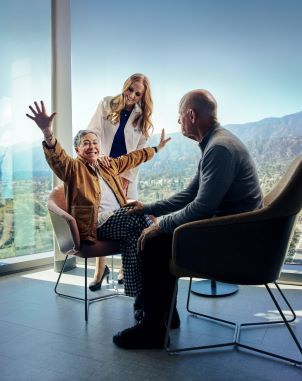
“I adore my doctors,” she says. Some of those physicians are closer than ever, working at City of Hope Orange County Lennar Foundation Cancer Center, which opened in 2022. Kanarek loves the atmosphere there, not to mention the shorter commute.
Not that she minds traveling. She and Epstein follow the credo of “let’s go live somewhere else for a month.” In the past few years, they’ve ventured near and far: Spain, Mexico, Japan, road trips to Carmel, California, plus a very happy trip to New York to meet their first grandchild, who was born in July 2026.
She knows how lucky she is and advises other cancer survivors to take care of their mental health. “Don’t get into your own head,” she said. “Enjoy your life. Do what you can do. Go outside. Get a dog. Play with a baby. Your mental state should not be ignored.”
Above all, she’s grateful.
“I had a disastrous diagnosis,” she said. “But everyone who took care of me didn’t give up on me. There’s no place like City of Hope. It’s the most remarkable place in the world.”