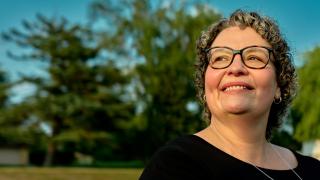
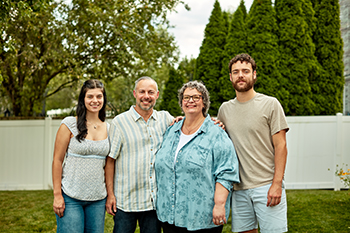
“Barb is very jovial and has a big laugh,” described hematologist-oncologist Tulio Rodriguez, M.D., who treated Gargano at City of Hope Chicago. “She makes everybody around her feel better.”
Laughter is what Gargano says helped her get through, and ultimately beat, an exceptionally aggressive case of non-Hodgkin’s lymphoma.
Her highly competitive spirit was also a driving force, as well as the gratitude that if anyone in her family was going to get cancer, the wife and mother of two was glad it was her. “As shocking as it was to find out I had cancer, I’m a fighter and felt I could handle it,” Gargano said.
An Abrupt Diagnosis
Gargano’s cancer journey began with a severe case of COVID-19 in June 2024. Progressively worsening symptoms, and an unexplainable pain in her abdomen prompted her to visit the emergency room.
Once the tests and scans were completed, the ER doctor told Gargano that her COVID-19 case was lasting longer than usual and that the pain in her abdomen “was just my cancer,” Gargano recalled.
Imaging had revealed a massive tumor, nearly 5x5 inches, on Gargano’s adrenal gland and multiple enlarged lymph nodes.
“I didn’t think it was real. I told him, ‘That’s not me,’” Gargano said. “He’d assumed I was already in active treatment because of the tumor’s large size and told me I needed treatment right away.”
Gargano went home and immediately started researching her options. However, her condition soon took a dire turn.
An ‘Explosive’ Cancer
Just days later, Gargano became overwhelmingly fatigued and was struggling to breathe. Her husband, Paul, took her back to the hospital where they learned Gargano’s organs were shutting down.
Dr. Rodriguez refers to Gargano’s unique cancer as “explosive.” “The quick progression shows the lymphoma was not dormant for very long,” he explained.
Gargano had stage 4 diffuse large B-cell lymphoma, an advanced form of non-Hodgkin's lymphoma. She also had a rare double B-cell mutation that caused the cancer to grow and spread rapidly.
Gargano was in the hospital for about a month as the team worked to stabilize her and determine the most appropriate chemotherapy regimen. “There were at least two times that my husband was told I may not make it through the night,” Gargano remembered.
Seeking Care at City of Hope Chicago
Fortunately, Gargano responded well to chemotherapy and was able to go home. Once discharged, her first call was to City of Hope, which she was aware of because her company, Fellowes Brands, have been supporters of City of Hope for decades,
“I always wanted a second opinion, and I knew City of Hope was at the forefront of cancer and research and may have options not available anywhere else.”
When Gargano met with Dr. Rodriguez in August 2024, she recalls feeling impressed that he was already thoroughly familiar with her case. “He had a positive demeanor but also didn’t sugarcoat anything, which I appreciated,” Gargano said.
Dr. Rodriguez advised Gargano to finish chemotherapy at her local hospital, because it was the same treatment he’d offer and to come back to City of Hope once that was completed.
Gargano followed his recommendation and kept Dr. Rodriguez updated on her progress. Although she continued to do well with chemotherapy, Gargano still had active cancer by the time she finished treatment. She returned to City of Hope in December 2024.
“I walked out of my local hospital without any more options,” Gargano said, “and into City of Hope where Dr. Rodriguez had three new ones: radiation, CAR-T cell therapy or a stem cell transplant.”
Competitiveness as Motivation
The initial plan for Gargano was CAR-T cell therapy, a personalized immunotherapy in which the patient’s own immune cells are genetically engineered in a lab to recognize and kill cancer cells. CAR-T cell therapy has proven effective against hard-to-treat blood cancers, but the side effects can be intense. As Dr. Rodriguez recalled, Gargano expressed concern about potential neurological symptoms such as trouble speaking, confusion and tremors.
“We agreed that a stem cell transplant was the best option at that time,” said Dr. Rodriguez. A stem cell transplant includes a strong chemotherapy regimen to kill any remaining cancer, before infusing the patient with healthy stem cells.
This gameplan provided Gargano with a new challenge that brought out her competitive nature. Dr. Rodriguez had explained that the recovery would be easier if they used her own healthy stem cells, as opposed to donor cells. He said they needed to collect 1.5 million stem cells.
“I’m about beating the odds, and that’s what motivated me all through cancer [treatment],” Gargano explained. “Even though I couldn’t actually control my own cells, I was thinking, ‘oh heck yes, I can do this.’”
And she was right. Over two collections, each involving several days in the hospital, Gargano produced 1.4 million cells. “Dr. Rodriguez told me, ‘Close enough, let’s go.’”
Gargano’s stem cell transplant took place on April 16, 2025. The procedure was successful, and she entered remission.
Embracing the Funny
Even though the transplant went well without complications, Gargano couldn’t go home yet. Stem cell transplant recovery includes several weeks in the hospital to give the immune system time to heal.
Gargano spent about three months total in the hospital over the course of her cancer treatment, and she faced the final inpatient stretch just like she had the rest: with her signature humor.
“There were times throughout treatment when I couldn’t shower, use the bathroom or get out of bed on my own. When you lose control of so many functions, you just have to laugh because at some point it’s ridiculous,” Gargano explained as she laughed.
“I also realized I could bring laughter to other residents going through the same thing, and that became my mission while in the hospital.” she said.
Gargano adds that the City of Hope community was especially critical for her recovery. “Everybody there, from the nurses and doctors to the housekeeping staff, they’re in it with you and fighting alongside you. You bond so much and they become like family.”
A Mother’s Day Deadline
The transplant recovery process gave Gargano another obstacle to overcome. She needed to reach a certain blood count number to be released from the hospital – a goal she set out to accomplish before Mother’s Day 2025.
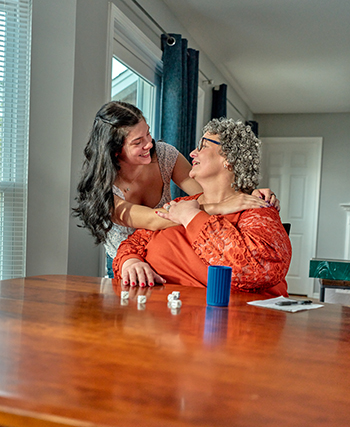
“They told me there was no way I’d make it home before Mother’s Day, but every milestone in the hospital was a competition for me,” Gargano said. “So, I did the exercises, the breathing techniques and ate the protein-heavy diet to reach that goal.”
Gargano was successful again. She walked out of City of Hope with one day to spare. “That Mother’s Day was really special, just being home in my own bed and seeing my family and walking my dogs. It was fantastic.”
Another fantastic development? Gargano’s prognosis. She has been cancer-free for about a year and a half. As Dr. Rodriguez explains, that makes him “very optimistic” about her long-term health.
“Cancer gave me more than it took away,” Gargano shared. “It brought my family closer together. My anxiety is gone, and I appreciate every moment more.”
One of the things she especially appreciates now is the opportunity to create new beautiful memories with her family. In August 2026, Gargano, her husband and their two children went on a family vacation to Tennessee, a trip that was originally postponed because of the cancer.
“I also had a ‘once in a lifetime’ trip planned to Ireland in 2024 with my mom and sister,” Gargano said. “That’s the trip we plan on conquering next year and I can’t wait.”