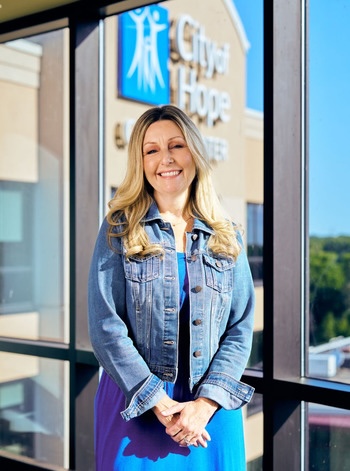
The GI doctor’s next recommendation would turn out to be far more consequential than Sanders could have imagined. “The doctor asked me, ‘Why don’t we do a colonoscopy at the same time? You’re 46, and they’ve lowered the age for colonoscopy screenings,’” Sanders remembers. “I said OK.”
The procedures were scheduled for October. The upper endoscopy revealed eosinophilic esophagitis, a noncancerous inflammatory condition that can be managed with medication and dietary changes.
However, “that was the least of my worries,” Sanders said.
The GI doctor found and removed a polyp during the colonoscopy. A few days later, the biopsy revealed the polyp was cancerous.
“I didn’t know the staging or anything at that point,” Sanders said. “As a single mom, I had to tell my kids I had cancer, and they were both so scared.”
Swift Care at City of Hope
Fortunately, Sanders didn’t have to dwell on her diagnosis for long. Just one week after the colonoscopy, and one day after being told she had cancer, Sanders had a consultation at City of Hope Cancer Center Chicago.
Sanders was well aware of City of Hope’s expertise and reputation for cancer treatment because her sister was a nurse practitioner there. “I knew that's where I wanted to go,” she said.
Medical oncologist Ajaz Khan, M.D., M.B.A., C.P.E., chief of the Department of Medical Oncology at City of Hope Cancer Center Chicago immediately ordered imaging and a laboratory workup, which determined the cancer hadn’t spread outside the colon. Dr. Khan and surgical oncologist Shen Li, M.D. concluded the cancer was operable and scheduled surgery for the following week.
“I found so much peace of mind with City of Hope because they treated me so quickly. I didn’t have to sit around wondering if I had cancer all over my body,” Sanders said. “My whole care team was also comforting, and I felt I was in good hands. They were so knowledgeable and explained everything very clearly.”
On October 16, Dr. Li performed a left hemicolectomy to remove the section of the colon where the polyp was found, along with 32 lymph nodes.
As Dr. Khan explained, “We evaluated all of that and identified no residual cancer. The cancer had been contained within the polyp itself.”
The results meant Sanders’ colorectal cancer had been Stage I, and she therefore wouldn’t require additional treatment. “Usually for Stage 1 colorectal cancers, we don't treat them with chemotherapy because there's no benefit,” Dr. Khan said.
Just a couple of weeks after undergoing the colonoscopy, Sanders was told there was no evidence of remaining cancer.
The Importance of Early Detection
Colorectal cancer was once considered an older person’s disease, but rising rates among younger adults have changed the narrative. To address that trend, in 2018 the American Cancer Society updated its screening guidelines for people at average risk of colorectal cancer. The organization lowered the recommended age to start routine colorectal cancer screening from 50 to 45. The U.S. Preventive Services Task Force followed suit in 2021.
However, national data show that only about one-third of adults aged 45 to 49 are up to date with their colorectal cancer screening. Colonoscopies are considered the gold standard for detecting colorectal cancer early.
“Everybody should have a colonoscopy at 45 regardless of their clinical risk status,” Dr. Khan emphasized. “Heather’s story really shows you can have a good outcome if you get screened early, follow through with what you need to do and come to a place like City of Hope for rapid care.”
Since completing treatment, Sanders is committed to spreading the word about colorectal cancer and encouraging others to schedule their routine colonoscopies.
“Getting a colonoscopy wasn’t on my radar. I was thinking age 50 for that,” Sanders said. “But they’ve lowered the screening age for a reason. I tell people I had the best cancer experience I could have had because we found it early.”
Ongoing Monitoring for Breast Cancer Risk
Sanders has applied that same optimistic mentality about early detection and treatment to a newfound challenge she is facing: an elevated risk for breast cancer.
During her initial consultation with Dr. Khan, Sanders shared that although no one in her family had colon cancer, there was a family history of breast cancer. She’d been diligent about getting annual mammograms, but Dr. Khan felt it was important for the team at City of Hope to do their own assessment.
Once she recovered from colon surgery, Dr. Khan instructed Sanders to come back for a repeat mammogram and an MRI.
While Sanders didn’t have breast cancer, the tests revealed abnormalities including a complex cyst and calcifications. Genetic testing also identifed an abnormality that Dr. Khan described as a “variant of unknown significance.”
Sanders now comes in for follow-up evaluations every six months. “With the family history of breast cancer and the abnormalities, you have to do more than just the regular screenings,” Dr. Khan said. “This way, if something does change, we’re on top of it.”
Sanders has taken the news in stride. “It's hard not to worry about cancer resurfacing, but I try to focus on the present. I hope that since I am under surveillance, any new cancer would be found at an early stage, and that thought brings me some relief.”
A New Life and a New Family
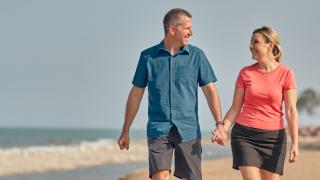
Sanders’ life has been transformed in many positive ways since overcoming colon cancer. About eight months after her surgery, her now-husband Dave proposed during a vacation to Hawaii.
They got married in early 2026 in Sanders’ hometown of Kenosha, Wisconsin, in a small ceremony overlooking Lake Michigan. “We’re a new family now,” Sanders said. “I'm so glad that I got the opportunity to move on with my life and have that second chance at love and at life.”
That second chance includes getting back into activities that bring her joy, such as line dancing. “When I’m dancing, I’m free of worries and it’s a celebration that I’m not sick,” Sanders said. She and Dave are also indulging their shared interest in travel by planning trips to every state in the U.S.
They are also the proud grandparents of a little girl, and they’re excited about the possibility of more grandchildren in the future.
“I’m out there doing the things I love because City of Hope was able to give me the treatment I needed,” Sanders said. “Go get your screening. It really saved my life.”