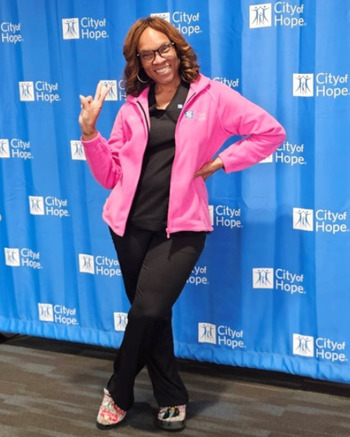
Lakeitha Rousseau, an oncology nurse at City of Hope Cancer Center Atlanta, was only 37 and enduring one of the most challenging periods in her life when she learned she had breast cancer. At the time, she was mourning the recent death of her husband while navigating her new life as a single mom.
Fortunately, Rousseau didn’t have to face these hurdles alone. Overnight, her colleagues on the breast cancer unit at City of Hope became her care team. “They were my people,” Rousseau said. “It was amazing because I knew them so well and on my last day of chemo, they did a whole celebration for me in the clinic.”
Eleven years later, Rousseau, now 48, is thriving. Her breast cancer is now considered cured, and her two proud children look up to her as a beacon of strength.
She is also committed to using her experience to instill hope in others. As a community leader, cancer advocate and breast oncology nurse at City of Hope Cancer Center Atlanta, Rousseau values the opportunity to live her life out loud and show others that a cancer diagnosis isn’t the end of the story.
“My journey gave me more purpose,” Rousseau said. “I want to continue to be that example for anybody who needs to know there’s life after cancer.”
An Instinct and a Cancer Diagnosis
Rousseau, a registered nurse, had been working with breast cancer patients at City of Hope for about a year when she decided to ask her gynecologist about getting a mammogram. She didn’t have any concerning symptoms or a family history of breast cancer, and at age 37, she wasn’t yet at the recommended age for routine screenings.
However, Rousseau had a nagging feeling that a mammogram would be a good idea. “We know our bodies better than anyone, and we know when something is off,” Rousseau said. “My life is built on my faith and I also felt like God was whispering to me, ‘Ask for the mammogram,’ so that’s what I did.”
Her instinct proved to be right, and in August 2015, Rousseau was diagnosed with stage 1 invasive ductal carcinoma. IDC begins in the milk ducts and is the most commonly diagnosed type of breast cancer, accounting for about 80% of cases.
“My husband had just passed away a year prior, and I was left with my two boys, one of whom has developmental delays,” Rousseau said. “I just thought, ‘Whatever I have to do to make sure I’m here for my kids, that’s what I’m going to do.’”
Surgery, Chemotherapy, Radiation and Hormone Therapy
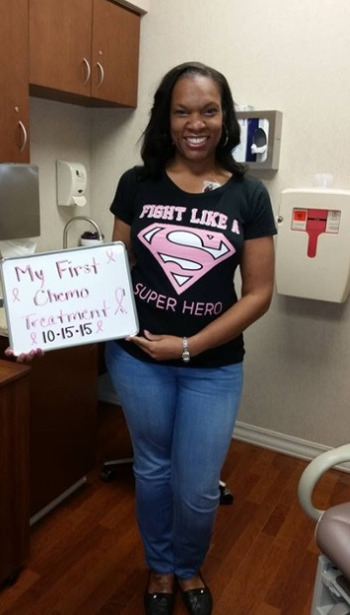
Less than two weeks after learning of her diagnosis, Rousseau underwent a lumpectomy to remove the 1-centimeter tumor from her breast.
Specialists then performed genomic testing on the tumor tissue to help determine the next treatment steps. The Oncotype DX test analyzes the likelihood of cancer recurrence and whether the patient will benefit from chemotherapy.
Rousseau’s results were a toss-up. Chemotherapy might help prevent the cancer from coming back, or it might be unnecessary. That meant it was up to her to decide whether to go through with it.
For Rousseau, it wasn’t a very hard choice. “My medical oncologist told me, ‘You have many years to live. You need to do everything possible to make sure this doesn’t come back,’” Rousseau recalled.
She proceeded with four rounds of chemotherapy, followed by four weeks of radiation. “I did my last radiation treatment on what would’ve been me and my husband’s wedding anniversary,” Rousseau shared. “It was a bittersweet day.”
In addition to the daily encouragement she received from her City of Hope colleagues, Rousseau credits her faith for helping to keep her strong physically and mentally during treatment. “I leaned heavily on my faith in God and I had an amazing church family that really helped me get through the journey,” she said.
The next phase of Rousseau’s treatment included five years on hormone therapy with Lupron Depot® (leuprolide acetate) to block estrogen production. While Rousseau admits she wasn’t thrilled that the medication put her into chemically induced menopause, her mindset and resolve hadn’t changed. “I did what I had to do at that time to make sure I’m here at this time.”
Cured and Helping Others
More than a decade after her diagnosis, Rousseau says her breast cancer is considered cured.
Her good health allows her to be present as a mother and now as a grandmother. She continues to care for her son, who has developmental delays and lives with her. “He doesn’t really grasp what I went through, but he tells me every day that he loves me,” Rousseau said. “My other son, who lives in Texas, always tells me how strong I am and how proud of me he is.”
In her professional life, Rousseau temporarily worked in other areas of nursing before returning to City of Hope’s breast cancer clinic in 2023. She says physicians often cite her case to encourage other patients that a positive outcome is possible.
Rousseau appreciates the perspective that her cancer journey gave her, allowing her to provide truly empathetic support to each patient she treats. “I don’t think you can fully tell someone you know what they’re going through until you’ve actually experienced the nausea, the fatigue, and the emotional side of it like trying to process what happens to my children if something happens to me. It’s a whole other perspective when you’ve been in that seat,” she said.
In addition to her nursing role, Rousseau is still a City of Hope patient herself. She sees medical oncologist Nitika Sharma, M.D., every six months for routine surveillance and blood work. Since hormone therapy increased her risk for osteoporosis, Rousseau also receives twice-yearly Prolia® (denosumab) injections to strengthen her bones.
“I came to Dr. Sharma in my survivorship mode, and she’s been absolutely amazing,” Rousseau said. “I work with her sometimes as a nurse, but I appreciate that during our appointments, she separates the two and treats me just as her patient.”
Advocacy and Outreach
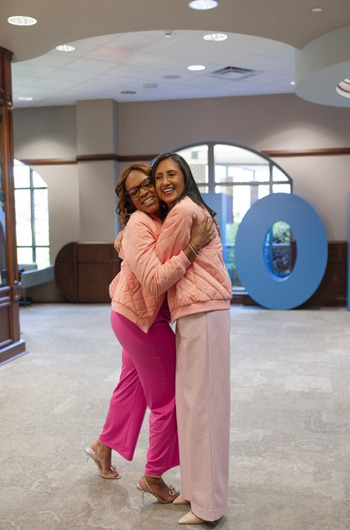
For Rousseau, survivorship isn’t just about living for herself and her family. She is living to serve others and to show others there is hope for a fulfilling life beyond cancer.
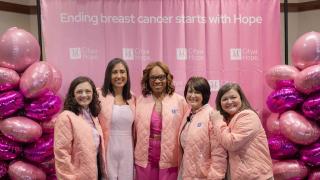
That positivity was on full display at the recent Hope Starts Here: A Breast Cancer Survivorship Event hosted by City of Hope Cancer Center Atlanta. Rousseau and four other breast cancer survivors received pink coats from their physicians as a symbol of everything they’ve overcome.
The event was especially meaningful for Rousseau as both a survivor and care provider. A patient she treated several years ago was one of the women honored with a pink coat. “To know that she’s still here, and we had a part in that. It does your heart so much good,” Rousseau said.
Rousseau further extends her service with community outreach. She volunteers through her church and works with a local doctor to administer routine health screenings. As part of her outreach efforts, she strongly emphasizes the importance of staying up to date with regular screenings.
“Never get too busy for yourself,” Rousseau said. “If you put self-care on the back burner and then something happens to you, what happens to your family then? Self-care needs to be a priority.”
Rousseau also serves as the executive director of the Charge Up Campaign, an organization that provides resources for cancer patients, survivors and caregivers throughout Georgia, with an emphasis on mental health support.
She encourages other cancer patients and survivors to embrace life and not be controlled by fear. “Some people can’t get past the fear that the cancer will come back, but you can’t stay stuck in the diagnosis. You have to live past it,” Rousseau said. “Cancer was just a stumbling block in my life. I went over it and here I am now. That’s why I’m sharing my testimony, and I really feel like my purpose is to live out loud.”