Esophageal Cancer Facts
May 25, 2025
This page was reviewed under our medical and editorial policy by Jae Y. Kim, M.D., associate professor, Division of Thoracic Surgery, Department of Surgery, City of Hope® Cancer Center Duarte
Approximately 22,000 people in the United States are diagnosed with esophageal cancer every year, according to the American Cancer Society. This includes an estimated 17,430 men and 4,640 women.
What Is Esophageal Cancer?
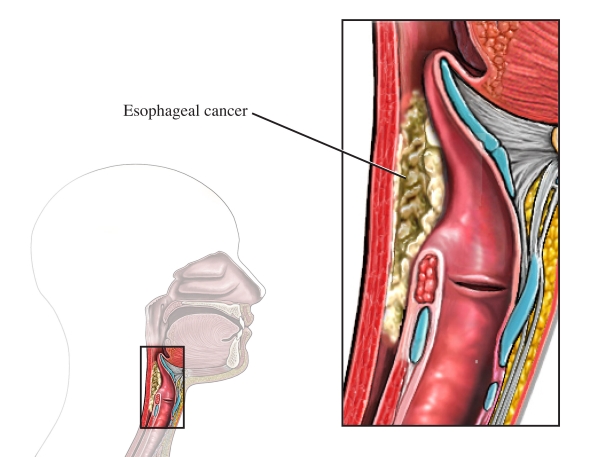
Esophageal cancer is a disease affecting the esophagus — a muscular tube that moves food and liquid from the throat to the stomach. This condition is also referred to as esophagus cancer.
What Causes Esophageal Cancer?
Esophageal cancer develops when cells in the esophagus mutate (change) and grow out of control, crowding out healthy cells. Although researchers have not yet pinpointed the exact cause of this disease, scientists have identified certain risk factors that may increase a person’s likelihood of developing the disease.
Esophageal Cancer Risk Factors
Smoking tobacco and drinking alcohol are the most significant risk factors for developing esophageal cancer. Additional details on risk factors are listed below.
- Age: The chance of getting esophageal cancer increases with age; more than 85% are diagnosed in people age 55 or older.
- Alcohol: Alcohol consumption is linked with a higher risk of esophageal cancer, particularly in people who do not metabolize alcohol well due to an inherited enzyme deficiency.
- Barrett’s esophagus: Chronic reflux of stomach acid into the esophagus can damage the inner lining of the esophageal tract. Over time, the normal squamous cells lining the esophagus are replaced with gland cells — a condition known as Barrett’s esophagus. This increases the risk of adenocarcinoma.
- Diet: A diet high in processed meat may increase esophageal cancer risk, while a diet high in fruits and vegetables may lower it. Additionally, drinking very hot liquids frequently may increase risk due to its long-term damage to esophageal lining.
- Esophageal conditions: In addition to Barrett’s esophagus and gastroesophageal reflux disease (GERD), people with conditions such as achalasia (the esophagus sphincter fails to relax properly), Plummer-Vinson syndrome (which causes esophageal webs that can obstruct food’s passage into the stomach) and tylosis (an inherited disease that causes people to develop small esophageal growths) are at an elevated risk for developing esophageal cancer.
- GERD: For people with GERD, the digestive enzymes and acid in the stomach escape into the lower part of the esophagus, causing frequent heartburn or pain in the middle of the chest. People with GERD have a slightly elevated risk for developing adenocarcinoma of the esophagus. GERD also elevates the risk for developing Barrett’s esophagus, another risk factor for esophageal cancer.
- Gender: Men are three times more likely than women to get esophageal cancer.
- Human papillomavirus (HPV) infection: Up to 33% of patients with esophageal cancer in certain parts of South African and Asian countries have HPV, although this infection is not commonly linked to esophageal cancer in the United States.
- Overweight/obesity: People who are overweight or obese have a higher chance of developing esophageal cancer, possibly due to their increased likelihood of experiencing gastric reflux.
- Tobacco: The use of cigarettes, cigars, pipes or chewing tobacco has been linked to a higher likelihood of developing esophageal cancer. The risk increases with more frequent or prolonged use of tobacco products.
Types Of Esophageal Cancer
The two main types of esophageal cancer are based on the type of cell affected.
Squamous cell carcinoma: This type of cancer begins in the squamous cells, which line the esophagus, and can occur anywhere along the esophageal tract.
Adenocarcinoma: This type of cancer starts in gland cells, which produce and secrete mucus that helps food move through the esophagus, and is more common in the lower esophagus. Other cancers, such as lymphomas, sarcomas and melanomas, may start in the esophageal tract, but they are exceedingly rare.
American Cancer Society (2025, August 14). Key Statistics for Esophageal Cancer.
https://www.cancer.org/cancer/types/esophagus-cancer/about/key-statistics.htmlNational Cancer Institute (2025, May 12). Esophageal Cancer Treatment (PDQ)-Patient Version.
https://www.cancer.gov/types/esophageal/patient/esophageal-treatment-pdqAmerican Cancer Society (2025, August 14). What Causes Esophageal Cancer?
https://www.cancer.org/cancer/types/esophagus-cancer/causes-risks-prevention/what-causes.htmlYang, C., Chen, X., et al., Gastrointestinal Tumors (2016, February 3). Etiology and Prevention of Esophageal Cancer.
https://www.ncbi.nlm.nih.gov/pmc/articles/PMC5040887/American Cancer Society (2025, August 14). Esophageal Cancer Risk Factors.
https://www.cancer.org/cancer/types/esophagus-cancer/causes-risks-prevention/risk-factors.html