Peyronie's Disease Facts
January 21, 2026
This page was reviewed under our medical and editorial policy by Humberto Villarreal, M.D., assistant clinical professor, Division of Urology and Urologic Oncology, Department of Surgery, City of Hope® Cancer Center Duarte.
Peyronie’s disease, also called acquired penile curvature, affects up to 11% of men in the United States. The condition has both an acute and a chronic phase, and it may cause painful erections or pain with intercourse.
What Is Peyronie's Disease?
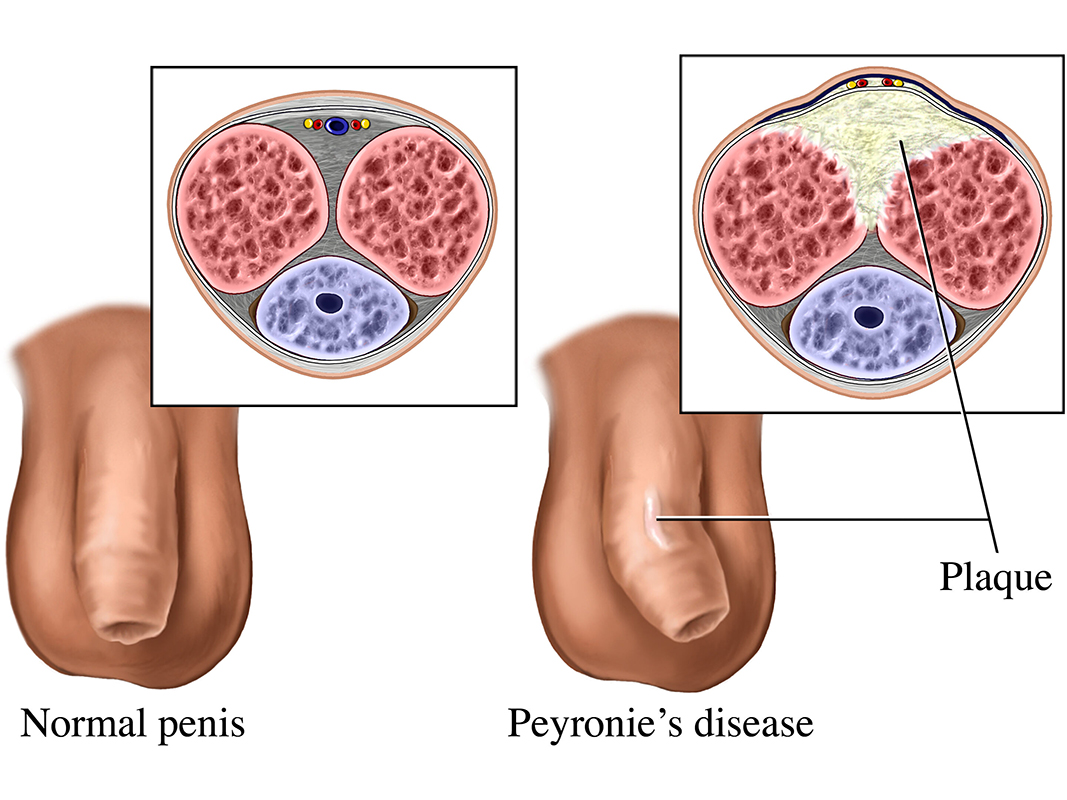
Peyronie’s disease is a condition in which scar tissue (known as plaque) forms on the outer lining of the penile erectile bodies. As the plaque builds up, the penis will curve or bend, which may cause painful erections. Curves in the penis may make sexual intercourse painful, difficult or impossible.
The plaque that develops in Peyronie’s disease is not the same plaque that can develop in arteries. The plaque seen in Peyronie’s disease is benign, or noncancerous, and is not a tumor. Peyronie’s disease is not contagious or caused by any known transmittable disease. Usually, men with Peyronie’s disease are referred to a urologist for treatment.
Peyronie’s Disease vs. Normal Curvature
Some penile curvature may be normal, but if the curve is significant or it occurs along with pain, palpable lumps or erectile dysfunction, it could be related to Peyronie’s disease. See a doctor if the penile curve is concerning. The care team can perform exams to diagnose Peyronie’s disease and recommend Peyronie’s disease treatment.
Hourglass Peyronie’s Disease
In extreme cases of Peyronie’s disease, scar tissue will form on both sides of the corpora cavernosa, and the penis will form an indentation, or hourglass deformity. When this happens, the penis may have a hinge-like effect during an erection.
How Does Peyronie’s Disease Develop?
To understand how this condition develops, it’s important to know about the anatomy of the penis. The visible part of the penis is composed of three primary chambers: the urethra and its surrounding supportive tissue and the two paired chambers that become firm during erections. These structures are composed of a dense elastic covering called the tunica albuginea. The tunica forms a long, balloon-like structure that is filled with a highly vascular, spongy tissue.
When an erection occurs, the spongy tissue fills with blood and the elastic tunica is stretched and becomes firm. As the corpora become hard, small veins normally allow the blood to exit the spongy tissue that becomes plugged to trap blood in the penis during an erection.
In the case of Peyronie’s disease, scar tissue develops within the tunica albuginea, which may be painful at first. The patient may be able to feel the scar tissue in the non-erect penis, which feels like a firm lump in the shaft. Finally, the scar tissue will cause the penis to bend toward the side of the scar.
In severe cases, it may be difficult for men to keep an erection due to scar tissue opening the tiny veins that are normally closed during an erection.
Peyronie’s Disease Stages
There are two phases of Peyronie’s disease: acute and chronic.
Acute Phase
Plaque forms in the patient’s penis during the acute phase, which can last as long as 18 months. During this period, a curve may develop and the patient’s penis may begin to hurt, particularly during erections.
Chronic Phase
Once the plaque has formed in the penis, the patient enters the chronic phase of Peyronie’s disease. During this period, the penile curve may become less severe and the pain may decrease. The patient may develop worsening erectile dysfunction.
What Causes Peyronie's Disease?
Medical experts do not know the exact cause of the plaque buildup that leads to Peyronie’s disease. Many believe that Peyronie’s disease may be the result of:
- Acute injury to the penis
- Chronic, or repeated, injury to the penis
- Autoimmune disease — a disorder in which the body’s immune system attacks the body’s own cells and organs
Risk Factors
The following factors may increase the chance of developing Peyronie’s disease:
- Vigorous sexual or nonsexual activities that cause microscopic injury to the penis
- Certain connective tissue and autoimmune disorders
- A family history of Peyronie’s disease
- Diabetes and erectile dysfunction
- Older age
- A history of surgical treatment for prostate cancer
- Stuntz, M., Perlaky, A., et al. PLoS One. The prevalence of Peyronie’s disease in the United States: A Population-Based Study. February 23, 2016.
https://pmc.ncbi.nlm.nih.gov/articles/PMC4764365/ - National Institute of Diabetes and Digestive and Kidney Diseases. Penile curvature (Peyronie’s disease), August 2019.
https://www.niddk.nih.gov/health-information/urologic-diseases/penile-curvature-peyronies-disease - NHS (U.K.), Peyronie’s disease. June 3, 2024.
https://www.nhs.uk/conditions/peyronies-disease/