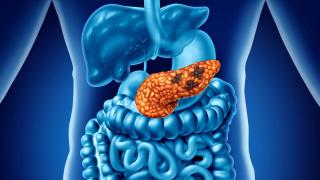
Pancreatic cancer remains one of the toughest cancers to treat, and today the five-year relative survival rate is still low at about 13%. That means that roughly 13 out of every 100 people diagnosed with pancreatic cancer will live at least five years after their diagnosis, according to Cancer Facts & Figures 2026, a new report from the American Cancer Society (ACS).
But there’s reason for optimism. That 13% survival rate is about three times higher than it was just a few decades ago, reflecting progress in early detection, treatment and supportive care that helps people live longer and fuller lives.
While these numbers show there’s still a long way to go, they also indicate that research, advances in care and advocacy are making a meaningful difference for people facing pancreatic cancer.
This article covers:
- Why is pancreatic cancer so hard to treat?
- Pancreatic cancer survival triples
- Pancreatic cancer breakthroughs being studied
If you or a loved one is concerned about possible signs or symptoms of cancer and would like an initial appointment or a second opinion, call us 24/7 at 877-460-4673.
Why Is Pancreatic Cancer So Hard to Treat?
One major reason pancreatic cancer survival rates are so low is that early symptoms are often vague or easy to miss, making it difficult to treat before it spreads. Signs like fatigue or digestive changes may be mistaken for common health issues, so many people aren’t diagnosed until the cancer is more advanced. In fact, about 80% of pancreatic cancers are found only after the disease has reached an advanced stage, eliminating surgical removal as a treatment option.
There’s also no routine screening test for pancreatic cancer like there is for breast or colorectal cancer. Without a reliable way to catch it early, the disease is often found only after it has grown or spread.
In addition, pancreatic tumors are biologically complex. They tend to form a dense layer of tissue that makes it harder for treatments like chemotherapy or immunotherapy to reach cancer cells. The cancer also tends to spread early, even when tumors are small.
Together, these challenges make pancreatic cancer harder to detect and treat.
Pancreatic Cancer Survival Triples
At 13%, the five-year survival rate for pancreatic cancer is still low compared with many other cancers, but it’s about three times higher than it was decades ago in the United States. For example, historical data show that in the late 1970s and early 1980s, the five-year survival rate was in the 1-to-3% range — meaning only a handful of people out of every 100 survived five years.
In the 1970s and early 1980s, only about 2% to 3% of people lived five years after a pancreatic cancer diagnosis.
Over the next few decades, survival ticked up gradually.
Today, with improvements in treatment and care, the five-year survival rate is 13% — about three times higher than those earlier years.
What’s Behind the Improvement?
Even as challenges remain, progress in earlier detection, precision medicine, smarter technology and strong research support are helping drive pancreatic cancer survival higher, according to the Pancreatic Cancer Action Network (PanCAN).
And while detecting cancer early is important, there are also promising treatments for people with Stage 4 pancreatic cancer, like Chris Parrish, who was diagnosed in 2008 and treated with intra-arterial chemotherapy (IAC).
“Years of sustained research investment, advocacy and collaboration are beginning to converge in meaningful ways,” Anna Berkenblit, M.D., M.M.Sc., PanCAN’s chief scientific and medical officer, said in a news release. “While there is still much work to be done, the progress underway offers hope that the future of pancreatic cancer care can look different through earlier diagnosis, more effective treatments, and longer, better lives.”
Areas of progress in diagnosing and treating pancreatic cancer include those listed below.
Earlier detection research: Using new tools, including blood-based tests and artificial intelligence (AI), researchers are pushing to find pancreatic cancer earlier, when treatment is more effective. For example, they’re studying people at higher risk — such as those with new-onset diabetes — to spot warning signs sooner.
More personalized treatments: By analyzing a tumor’s genetic makeup, doctors are better able to match patients to therapies — including newer drugs that target specific mutations.
Growing role of AI and data: AI and advanced data platforms are speeding research by identifying patterns in scans, medical records and tumor biology to help researchers design smarter studies and explore new treatment combinations more quickly.
Stronger research and patient support: Organizations like PanCAN are also playing a key role by funding research, connecting patients to clinical trials and expert care and advocating for greater investment — with the goal to raise the pancreatic cancer five-year survival rate to 20% by 2030.
Pancreatic Cancer Breakthroughs Being Studied

Many providers are excited about the promising work underway to improve pancreatic cancer survival in the years ahead.
"We’re exploring some really promising directions in pancreatic cancer research — from vaccines that train the immune system to target tumors to drugs that go after KRAS mutations,” says Mustafa Raoof, M.D., M.S., a surgical oncologist and researcher at City of Hope® Cancer Center Duarte who specializes in gastrointestinal cancers.
Cancer Vaccines
Researchers are developing vaccines that train the immune system to attack pancreatic cancer cells. Some target common mutations like Kirsten rat sarcoma viral oncogene homolog (KRAS), while others, such as personalized mRNA vaccines, are designed to target the unique mutations in a patient’s tumor.
Targeting KRAS Mutations
KRAS mutations cause about 90% of pancreatic cancers. "That’s why we’re currently testing new drugs that can block KRAS signals and potentially combining them with immunotherapy in the future," says Dr. Raoof.
Early studies suggest these combinations may shrink tumors and improve outcomes.
Improving Immunotherapy
Because pancreatic tumors are wrapped in a complex barrier of surrounding cells that may block immunotherapy, scientists are finding ways to modify immune cells and reshape the tumor environment to help treatments work better.
Combination Treatments
Research is also focused on combining targeted drugs, immunotherapy and chemotherapy to outsmart cancer’s resistance. For example, in 2026, multiple phase 3 trials will begin for previously untreated metastatic pancreatic cancer to investigate whether adding targeted therapy to chemotherapy can improve patient outcomes.

“Though many of these approaches are still in clinical trials, each one is a critical — and possibly game-changing — step toward better outcomes for our patients,” Dr. Raoof adds.
Laleh G. Melstrom, M.D., M.S., a surgical oncologist at City of Hope Cancer Center Duarte with extensive experience treating pancreatic cancer, underscores how far pancreatic surgery has evolved.
“A critical component of long-term survival is the ability to undergo an operation,” she explains.
She notes that advances in technique have made surgery safer and recovery easier for many patients.
“Pancreatic surgery has come a long way in terms of safety and recovery. At City of Hope, we’ve completed hundreds of robotic pancreatic surgeries, allowing for faster recovery times and return to function,” she says. “This technical advancement and level of expertise have been a fortunate offering for our patients.”
If you or a loved one is concerned about possible signs or symptoms of cancer and would like an initial appointment or a second opinion, call us 24/7 at 877-460-4673.