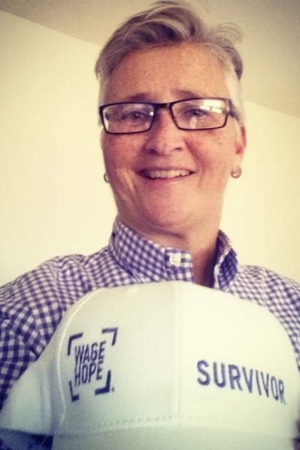
When Chris Parrish was in her mid-30s, subtle but persistent issues — indigestion, back pain beneath her shoulder blades, and unexplained weight loss — began creeping into her life. At the time, she didn’t realize these were early signs of something more serious.
“When I say awful, it was the worst acid reflux, gut awfulness that I've ever experienced, and I was popping Tums like candy,” she remembered.
Parrish visited her doctor in Maine many times over the years, but they continued prescribing pills that didn’t help. Feeling frustrated and dismissed, she eventually stopped seeking medical care. But after five years of worsening symptoms and extreme weight loss, she hit a point in the summer of 2008 when she could no longer tolerate the discomfort.
Parrish’s First Pancreatic Cancer Symptoms
“I hadn't been able to eat for like three days. I couldn't pee; I couldn't defecate; nothing was working,” Parrish said. The severity of her symptoms finally prompted her physician to run a series of tests, including an MRI and blood work. A few days later, she was called into the office, which was atypical. Her doctor had always given results over the phone.
“My doctor didn’t even tell me, they sent the physician’s assistant in who was in tears saying that I had a golf ball sized mass in my pancreas right in the middle, and numerous lesions in the right lobe of my liver,” Parrish said. “My life flashed before my eyes and I started crying. I don't even think I heard the rest, because I was in denial.”
It wasn’t until Parrish had a consultation with an oncologist that she received an official diagnosis: stage 4 pancreatic cancer. They told her she had six months to live. She was only 40 years old.
Betting on a Miracle With Intra-Arterial Therapy
Seeking a second opinion, Parrish went to a cancer center in Boston, where she received the same prognosis. Like the oncologist in Maine, they gave her the option to take chemotherapy with a 2% survival rate.
“I’m a betting girl, and no flipping way I'm taking that bet,” said Parrish. “I knew I'd have to be a miracle, but I also knew I could be a miracle.”
Remembering a television commercial she had seen in the years prior to her diagnosis for Cancer Treatment Centers of America Chicago (now City of Hope® Cancer Center Chicago in Zion, Illinois) that featured a stage 4 pancreatic cancer survivor, she sought a third opinion at their location in Chicago.
“It’s always important for patients to get a second or third opinion, especially at larger cancer centers that may have more options than provided in local communities,” said Evan Pisick, M.D., chief of medical oncology at City of Hope Chicago and Parrish’s current oncologist.
It took a lot of work to travel all the way to Illinois and a week of additional testing to work up a plan, but Parrish’s belief in better odds paid off.
“When everybody else told me I was going to die, they did not,” she said. “They came back with a non-traditional treatment regimen, and I jumped on it.”
In August 2008, Parrish began an aggressive treatment journey that consisted of monthly intravenous chemotherapy sessions with floxuridine and leucovorin (a B vitamin folate that helps protect healthy cells) for more than three years. In the first four months, she also received intra-arterial chemotherapy (IAC) in sessions that lasted 15 hours a day, for five consecutive days. IAC delivers 40 times the amount of medication directly to tumor sites via a catheter.
“I know not many people qualified for it, but I did because I was a chemo virgin at that time and I was young,” Parrish said. “It was a major deal to do intra-arterials and they kicked my butt, but my tumor markers dropped significantly. I started out with other patients I called my classmates, and out of my class, I was the only one that made it through.”
Trusting the Process
Like many strong chemotherapies, IAC wipes out both good and bad cells, so Parrish had to take antibiotics along with a medication to prevent stomach ulcers. She fought through nausea, fatigue, hair loss and low blood cell and platelet counts that required her to get blood transfusions so that she could stay on her treatment regimen.
“It was my job to beat cancer, and I was relentless in that job,” remembered Parrish. “You do what you got to do to survive.”
Once she made it through the first super tough months, she started to feel better and her disease markers continued to improve. She did so well that her doctors recommended taking extra weeks off here and there between infusions when she wanted to do something fun and needed a little extra energy.
“The care team was really good about letting you live,” Parrish recalled. “Those breaks really taught me to trust the process. I was a workaholic all my life, and to live was such a spectacular thing to embrace.”
During the years that she spent a week each month at the cancer center, Parrish, along with her mom who stood by her side the entire time, took full advantage of Supportive Care Services.
“I utilized everything, as did my mom when she was out with me, because caregivers need that too,” said Parrish, who received massages, acupuncture, chiropractic care, Reiki and more to help with side effects and anxiety. “All the services and practitioners gave me some good tools to navigate PTSD, which I was diagnosed with later. They're all the reason I'm still here today.”
In early 2012, Parrish received her final dose of chemotherapy.
“I was scared to death of stopping chemo, because I really thought that was what was keeping me alive,” she said. “I had to weigh it a lot, but I really wanted to get some good living in.”
A Voice of Hope
This summer will mark 18 years since Parrish was told she had six months to live. She is now at a place where she sees an oncologist just for monitoring. But despite still living in Maine — more than 1,000 miles away from Chicago — she continues to do her follow-up care at City of Hope.
“There’s no way I would transfer,” she said. “I just started seeing Dr. Pisick, but he is brilliant. You just don't mess with a good thing.”
Parrish has taken some of the habits she formed during treatment into survivorship, like doing guided meditations and practicing gratitude. A lifelong athlete, she stays active through daily walks and invests her time in fun hobbies and loving relationships.
“My cancer journey taught me that you might not get the quantity of life that you want, but you are your own precipitator of the quality of your life,” said Parrish. “That's what I can control each day, so that's what I do.”
She’s also using what she learned to help others. The same year she finished chemotherapy, Parrish founded the Purple Iris Foundation to raise awareness for pancreatic cancer.
“I needed something to keep my mind off cancer and to deal with people I lost, so we started out planning hope gardens in Maine,” Parrish said. “The purple iris was our anchor flower. It means faith, hope, courage, wisdom, and it was a beautiful name for what I wanted to create.”
Now approaching 14 years in operation, the foundation has evolved to offer financial assistance grants and navigation services to help patients with any type of cancer and their caregivers find resources.
“Once we started doing assistance, I wasn't going to discriminate,” Parrish explained. “We help Mainers all over Maine, and I'm very proud of the work we do.”
Active on social media, her pancreatic cancer advocacy reaches far beyond her home state. Through platforms like TikTok and YouTube, she engages with patients around the world every single day. Parrish has also written a book about her journey that she plans to distribute for free, participates in pancreatic cancer awareness initiatives, and aims to share her story with anyone who might need to hear it.
“Pancreatic cancer is devastating and it's relentless and people need hope,” Parrish said. “I made it my mission to be present, to be open and to be there for people.”
If you or a loved one is concerned about possible signs or symptoms of cancer and would like an initial appointment or a second opinion, call us 24/7 at (877) 516-9365.