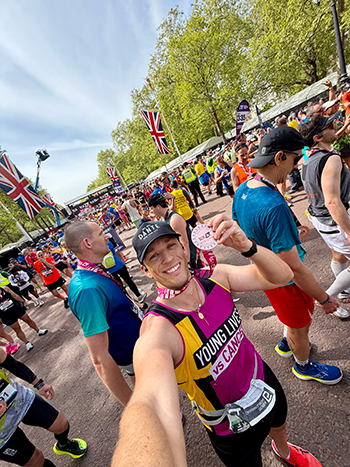
In April of 2026 he traveled to London to compete in that city’s annual Marathon. Accompanied by his family, Kargodorian enjoyed returning to a place he’d visited and loved in early 2020 but had to abruptly leave when the pandemic broke out.
“It was a great experience,” he said of the race.
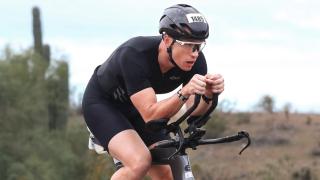
A few months earlier, in November of 2025, Kargodorian took the plunge – quite literally – as he swam, ran and cycled through the Ironman triathlon in Tempe, Arizona. He earned elite “All World Athlete” status with the Ironman organization.
And just for good measure, let’s toss in one more: October 2023: A three-day, 225-mile bike race from Santa Barbara to San Diego!
“I trained on a friend’s old bicycle,” he recalled, smiling.
Now it’s true that many people hit the road for long distance bike races, more than a million run marathons, and perhaps a quarter million triathletes regularly test their Ironman mettle. Completing such endurance events is certainly significant, but hardly unique.
Dante, though, is different.
Growing up in Porter Ranch, California, “I was not nearly this active,” he said. “I did weights, but not cardio. I played sports but I was no ‘jock.’ And I hated swimming!”
So what changed?
In a word, lymphoma.
In 2021, just out of college and newly-liberated from the COVID lockdown, Kargodorian sought to shed the “pandemic pounds” he had accumulated. Strangely though, over the next year, the weight came off, and kept coming off, even when he stopped trying. At the same time, he began having breathing trouble. “I’d be out of breath and exhausted, just going up the stairs,” he said.
Then the pain came.
Every couple of weeks Kargodorian would flinch from a sudden, sharp pain in his abdomen. A local doctor blamed it on diet. Then one day as Kargodorian drove to work, an especially strong attack struck. By the time he’d reached his office the pain was so intense he called his parents, who took him to the emergency room.
After multiple scans, tests, and ten days in the hospital (“the same hospital where I was born,” he points out), doctors detected a large tumor in Dante’s chest, with fluid steadily building. They suspected lymphoma and a biopsy confirmed it: Stage 4 Hodgkin lymphoma, a form of blood cancer that strikes about 9,000 people in the U.S. each year.
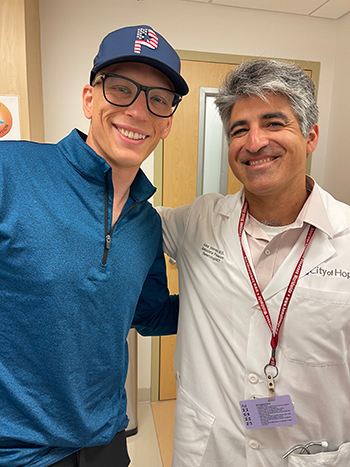
“In Hodgkin lymphoma, your B-lymphocytes lose their identity as B-cells,” explained Alex Herrera, M.D., Chief, Division of Lymphoma, Department of Hematology & Hematopoietic Cell Transplantation at City of Hope. “and this lymphoma hides from your immune system.”
Most Hodgkin lymphoma patients are in their teens and 20s. Kargodorian was 23 and the news hit hard.
“I was scared, I was in shock. This is not what you want to hear,” he said. “I was just beginning my own life, my first job, getting ready to leave home, figuring it all out and suddenly it all changes!”
But his doctors emphasized to Kargodorian that his disease was treatable, even curable.
Since the 1970s doctors have successfully treated Hodgkin lymphoma with a combination of four chemotherapy drugs known by their initials: ABVD – adriamycin, bleomycin, vinblastine and dacarbazine, which damage cancer cell DNA and prevent cells from growing and dividing.
In the last decade researchers determined that adding the targeted therapy drug brentuximab vedotin (and removing bleomycin to avoid possible lung damage caused by the combination) is even more effective. Five-year survival rates for Stage 4 Hodgkin lymphoma top 80%.
(Also, in March of 2026 – too late for Kargodorian to take advantage of it - the Food and Drug Administration approved adding the immunotherapy drug nivolumab for even better results. Dr. Herrera and City of Hope pioneered the work that led to the FDA approval).
Kargodorian liked his odds, but he and his family did not like the hospital or its doctors. One physician went so far as to say that Dante’s disease was “not a priority cancer” for them. Kargodorian didn’t like the sound of that, so he set about looking for a second opinion.
They called City of Hope and were welcomed “with open arms,” he recalled. Kargodorian soon found himself meeting with Dr. Herrera.
“He was very sick,” Herrera remembered. “He’d lost 40 pounds, he was having night sweats, there was this big mass across his chest. He was pretty weak. It was very scary for him.”
Herrera was impressed with Kargodorian and his family.
“Dante is a wonderful young man,” said Herrera, “and his family is lovely. His mother was always there by his side at every visit. His resilience throughout these years has been inspiring."
For his part, Kargodorian felt that, unlike the non-City of Hope physician who didn’t consider this a “priority cancer,” Dr. Herrera struck all the right notes.
“Dr. Herrera couldn’t have been nicer,” said Dante. “He was very sharp and professional.”
Nevertheless, Kargodorian felt a need to search further. He and his mom flew to Houston, Texas to consult with doctors at a major cancer center in that city. What they saw and heard convinced them that returning to City of Hope would be the right move.
“As soon as we got there, Mom and I saw that the place was not nearly as well-organized as City of Hope,” said Kargodorian. He says City of Hope felt like a “well-oiled machine” where everyone was “super friendly, helpful,” and knowledgeable.
When they mentioned they had met Dr. Herrera, the Houston doctor simply said, “Dr. Herrera is the best in the business! He’ll take the best care of you.”
“That validated our thinking,” said Kargodorian. That, plus the advantage of getting treatment in Southern California, rather than thousands of miles from home.
Kargodorian began a six-month chemo regimen at City of Hope, a total of 12 infusions, given every two weeks. It wasn’t easy. Kargodorian coped with the typical side effects including weakness, nausea and hair loss.
“That was tough,” he said of his vanishing mane. “That was a big thing for me.”
He also struggled with near-constant anxiety, not all that unusual for a young person facing a deadly disease. “I was down on myself mentally,” he said.
But it worked.
When he began treatment, his PET scan showed nearly his entire chest “lit up” in yellow indicating cancer everywhere. After his last treatment, the yellow was gone. So was the anxiety.
“I was so happy!” he remembered. “What a weight off my shoulders!”
That was May of 2023. Note the date. Barely five months later he’s cycling down the California coast, as a member and beneficiary of the Challenged Athletes Foundation, an organization that supports people who want to achieve their personal best despite physical limitations.
And Kargodorian definitely wanted to show his best. He had changed.
“I hadn’t been using my body well before,” he explained. “This was a wake up call… it inspired me, made me want to do better, to take advantage of my (restored) ability.”
It was that same determination that sent him to Arizona for the Ironman event. “I wanted to show that I’m capable of doing hard things. Like beating cancer!”
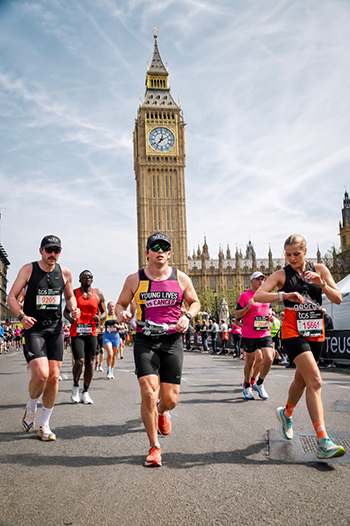
And when he ran the London marathon he didn’t do it alone. He signed up with Young Lives Versus Cancer, a UK-based organization that helps children and young adults dealing with cancer, with a special emphasis on their mental health.
Going forward, Kargodorian hopes to use his experiences to raise awareness and inspire other young people facing similar challenges. “If I can help even one other person,” he says, “that’s a win for me.”
He’s proud of the "All World Athlete" designation by Ironman for his performance in the races and hopes it will be a positive detail for inspiring other lymphoma patients.
Getting the right care team is critical, he says. But so is knowing yourself, and setting your personal goal, whatever it may be….. even finishing a triathlon!
“Cancer may not be something that permanently changes you. But you have to find your own light at the end of the tunnel.”