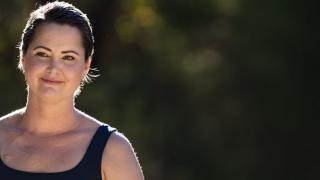
“I’m here. I’m alive. Cancer may have slowed me down, but I’m not broken.”
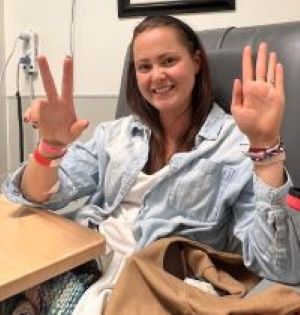
As Alisa Secaida celebrated her 40th birthday, a milestone she once feared she would never reach, she had every reason to ask, “Why me?” after all she had endured.
Instead, what emerges is strength, determination and resilience in someone who fiercely advocates for herself and makes people listen.
“She is an amazing person,” said City of Hope lung cancer specialist Ravi Salgia, M.D., Ph.D., “Definitely a role model for all of us.”
She remembers the day in November 2021 when she had to sit her children down at home in La Verne, California, and tell them, “Mommy is sick.” Olivia was 7. Benjamin was 5.
Secaida knew something was wrong before her doctors did. She was coughing. She felt fatigued. Breathing became difficult. Her chest felt tight and her shoulder ached. One physician suspected asthma and gave her an inhaler, but her symptoms worsened. A second doctor blamed long COVID and told her to ease up on her schedule. “They said I was working too much,” she recalled.
Secaida took matters into her own hands and used a Groupon offer to pay for her own computed tomography (CT) scan.
Secaida knew she needed to see a lung specialist and advocated for a referral. Even then, it took several weeks before she was able to schedule an appointment.
At the pulmonology appointment, Secaida had a PET (positron emission tomography) scan, which is better able than a CT to spot cancerous cells. The doctor called as Secaida was driving home. “Something’s wrong,” he said. “And it looks like cancer.”
Her next step should have been an immediate biopsy, but once again Secaida had to advocate for herself. Several doctors refused to perform the procedure, claiming it was too risky: a lung biopsy can occasionally cause chest infections or collapse the lung. But there is no other way to accurately measure a tumor’s stage, a critical element in determining treatment.
It took a few weeks, but Secaida did get her biopsy and was told, “You need to see an oncologist.”
Secaida headed straight for City of Hope Los Angeles, a short distance from her home.
“I was in tears. I was shaking,” she recalled.

There, Secaida was diagnosed with stage 4B non-small cell lung cancer. A cancerous lesion had developed on her brain as well.
Dr. Salgia, the Arthur & Rosalie Kaplan Chair in Medical Oncology & Therapeutics Research at City of Hope, started his patient on the immunotherapy drug Keytruda® (pembrolizumab), which stimulates the immune system to destroy cancer cells, plus the chemotherapy drugs carboplatin and pemetrexed. Radiation oncologist Arya Amini, M.D., also used stereotactic radiosurgery (SRS) to pinpoint and destroy Secaida’s brain lesion.
By July 2022, Secaida had reached no evidence of disease (NED) status, but there was a problem. Ten rounds of pembrolizumab left Secaida with liver toxicity, an unfortunate and known side effect of cancer treatment.
“Every therapy can have toxicity,” said Salgia.
Secaida may have been especially vulnerable. Living with type 1 diabetes since age 21, she had been managing the autoimmune disease for more than a decade. Pembrolizumab can sometimes trigger an autoimmune attack in such patients.
Her care team stopped the treatment. “That panicked me,” said Secaida. She worried about a recurrence. “But Dr. Salgia said it was more important at that moment to fix the liver.”
A course of steroids took care of the liver problem, but the cancer returned in January 2023. There was, however, an encouraging development.
Further testing revealed that Secaida’s cancer carried an actionable ALK-positive mutation and could be treated with targeted therapies specifically designed for it. Secaida began taking alectinib, putting her cancer under control.
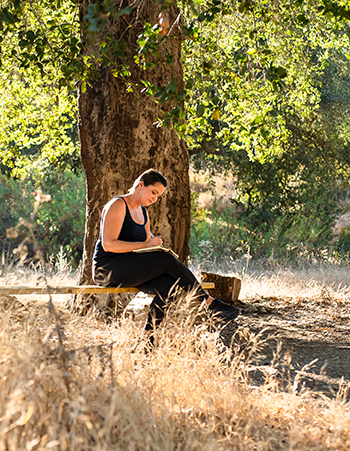
For more than a year afterward, Secaida felt a sense of relief each time a follow-up scan showed no sign of disease. But a disturbing thought lurked in her mind. What if it comes back one day?
“It was like living with a loaded gun to my head,” she said. Her concerns escalated when later scans began to show the tumor again. "I was determined to stay ahead of it. I started on a quest for surgery,” she said, to increase her chances of living longer.
Her quest took her to several institutions but eventually brought her back to City of Hope. On February 3, 2025, Jae Y. Kim, M.D., removed the upper left lobe of Secaida’s lung, plus some lymph nodes. Pathology reports showed the primary tumor was still active, and cancer cells were detected in the nodes. For that reason, Secaida followed up with 35 sessions of intensity-modulated radiation therapy (IMRT) to eradicate any remaining malignant cells.
Over the summer, Secaida needed more steroids to handle some lung inflammation. But, by and large, she felt she was finally out of the woods. She wasn’t.
In August 2025, Secaida felt a lump in her breast. She immediately contacted City of Hope and was paired with Hope S. Rugo, M.D., whom she already knew: they had appeared on a webinar together.
The news was not what either wanted. Secaida had stage 2 triple-negative breast cancer, a malignancy separate from her earlier lung cancer.
“This is a very aggressive cancer and the most difficult to treat,” said Rugo.
It is extremely rare for a lung cancer patient to later develop breast cancer. When it does occasionally happen, it’s frequently because of a specific genetic anomaly the patient has inherited. Secaida didn’t have it.
“I haven’t been drawing the best cards,” Secaida said.
Nor could Secaida receive the treatment of choice, a combination of chemotherapy and immunotherapy, because of the complications she had previously experienced.
Rugo opted for the “red devil” chemotherapy, doxorubicin combined with carboplatin, followed by a lumpectomy and five sessions of radiation, administered to her face down to protect her still-fragile lungs.
Secaida got through the chemo: nausea, hair loss and all the emotional twists and turns with help from family and friends whom she thought would have been “burnt out” by now. They showed up and sat with her for those six- to eight-hour infusion sessions, cracking jokes all the way. “We’re just sitting there, laughing,” she says, crying as she remembered the story.
As of April 2026, Secaida is listed as having a “pathological complete response.” In English: her breast cancer is gone.
Now she’s ready to celebrate her 40th birthday. She and her husband Aldo are taking a cruise to Mexico.
Looking back, she can’t say enough about the people at City of Hope who saw her through two separate cancer diagnoses.
“I had to fight a complicated war on two fronts,” she said. “No one else (but City of Hope) could have done it. They are so great at communicating with patients and caring for them, giving them a fighting chance.”