
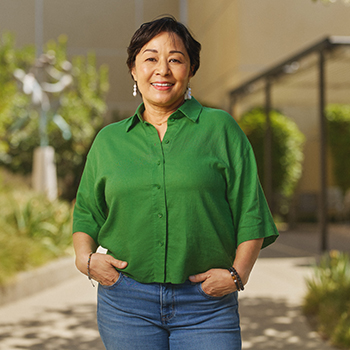
No matter what life throws at her, even two highly complex cancer diagnoses at once, this wife, mother and grandmother finds a way to laugh and enjoy the good in her life.
“My philosophy is that life never asks our permission,” Onodera-Jimenez said. “But I get to choose how I react to things.”
A Routine Checkup
Onodera-Jimenez didn’t have any symptoms before her cancer diagnoses. She scheduled an appointment with a new primary care provider in October 2023 simply because she hadn’t had a routine physical in a while.
To her surprise, the doctor found a large lump that Onodera-Jimenez hadn’t noticed and referred her for a mammogram and biopsy.
Onodera-Jimenez didn’t initially think much about the tests. At the time, her father was ill and she was preparing to travel out of state to help care for him.
When the doctor called just three days later with the news that she had a rare type of breast cancer, her first reaction was to laugh. “I’ve been sick only twice in my life and both times, I was rushing to go take care of my dad,” she said. “That’s why I was laughing.”
When her doctor recommended City of Hope, Onodera-Jimenez didn’t hesitate before saying yes.
An “Odd” Diagnosis
It’s standard practice at City of Hope to begin treating new patients as soon as possible and Onodera-Jimenez was no exception.
The care team led by Cynthia Lynch, M.D., a medical oncologist and medical director of the Breast Cancer Program at City of Hope Arizona, moved quickly to evaluate Onodera-Jimenez and develop a treatment strategy.
Onodera-Jimenez had Stage 2B metaplastic breast cancer, an aggressive and rare form accounting for less than 1% of all breast cancers. It can be resistant to chemotherapy, which Dr. Lynch says is why metaplastic breast cancer often has “a very poor prognosis.”
However, that wasn’t even what made Onodera-Jimenez’s case “one of the most complicated cases ever,” as Dr. Lynch described it.
Imaging had revealed a secondary metastatic cancer that was entirely separate from the breast cancer. Two pathology teams analyzed the results and couldn’t determine where the second cancer originated. “It took weeks to get a diagnosis because it was just so odd,” Dr. Lynch said.
Staying Strong Physically and Mentally
Onodera-Jimenez was in treatment for most of 2024 for both the breast cancer and the secondary metastatic cancer. Her treatment included chemotherapy, radiation therapy and a partial mastectomy, with Dr. Lynch overseeing her care.
Throughout treatment, Onodera-Jimenez focused on keeping both her body and her mental state as strong as possible. She embraced City of Hope’s multidisciplinary resources, including cognitive therapy, support groups, naturopathic medicine and physical therapy.
She leaned on the doctors, nurses and other staff for emotional support along the way. “I had a great team that was very caring and not afraid to build a real relationship with me,” Onodera-Jimenez said. “At City of Hope, they want to get to know you and I think that support helped me.”
As an additional stress reliever, she also exercised at a local gym. She walked on the indoor track, did chair yoga and eventually advanced to Zumba and other dance classes.
Onodera-Jimenez felt passionately about staying active through chemotherapy and radiation. Just a few years earlier, in 2017, another rare illness had left her struggling to walk: a noncancerous tumor in her spine. “I named the tumor Herman,” Onodera-Jimenez added with a laugh.
A thoracic surgeon successfully removed the tumor, but the recovery was challenging. She wore an upper-body cast and used a walker to stay mobile. Onodera-Jimenez said it took three years before her body healed enough for her to exercise again. After enduring all that, she was determined to keep moving through cancer treatment.
Her optimism and refusal to allow her illness to get her down left an impression on her care team. “Even when I told her that her cancer was treatable but not curable,” Dr. Lynch recalled, “[Angela] would say she was thankful for every day she had. She was always the same joyful person.”
No Evidence of Active Disease
The long months of treatment were successful and Onodera-Jimenez’s breast cancer entered remission in early 2025. As Dr. Lynch emphasized, metaplastic breast cancer can be especially challenging to beat – making Onodera-Jimenez’s results notably remarkable.
“I definitely think [Angela’s] positive attitude has contributed to how well she’s done,” said Dr. Lynch.
Onodera-Jimenez also logged a win against the secondary metastatic cancer. Although the cancer is still present, there is no longer any evidence of active disease. She receives IV infusions of the immunotherapy drug Keytruda® (pembrolizumab) every three weeks to manage the disease.
Onodera-Jimenez talks about the metastatic cancer without losing her signature humor. “I have hitchhikers in my body,” she explained with a smile. “As long as it’s not causing me problems, I’m just going to keep on enjoying my life.”
Looking Forward
For Onodera-Jimenez, enjoying life means savoring quality time with her family. In December 2024, shortly after completing treatment, her extended family gathered for a large Christmas celebration in Colorado.
“We hadn’t all gotten together like that since my kids and my brother’s kids were very young,” she explained. “That was wonderful that I could actually be there to see them all.”
Today, Onodera-Jimenez continues to maintain an active lifestyle. She is still taking those dance classes at the gym and likes to go camping and paddleboarding with her husband, Juan.
She also dedicates her time volunteering at City of Hope events and uses her experience to inspire other cancer survivors to keep living fully for as long as they can.
“Don’t get me wrong, I have had my moments when I felt sad or scared about having cancer,” Onodera-Jimenez said. “But I chose to let that go and enjoy life and try to give back and help other people learn how to feel that, too.”