
“My greatest asset is hope. And it’s priceless!”
Hope was hard to come by in 2021 for Onjalai Brown, a business owner and church ministry worker now living in Phoenix, Arizona. That’s because just about everything went wrong.
The year had started out promising. She’d married in March and looked forward to life with her new husband in Dallas, Texas.
But trouble came quickly. Brown had a miscarriage. The marriage faltered. By May the couple had separated, headed for divorce. Later Brown would lose her job and also face eviction. And on top of everything, she was diagnosed with breast cancer. She was only 36.
Which makes it all the more extraordinary that these days, Brown’s mantra is, “Who am I blessing today?”
Brown is one of the many women under 50 who are diagnosed with cancer each year. The incidence of cancer in women has risen to 82% higher than in men within the same age range. These women are increasingly advocating for their own health and taking their cancer journeys into their own hands.
A Family History of Breast Cancer
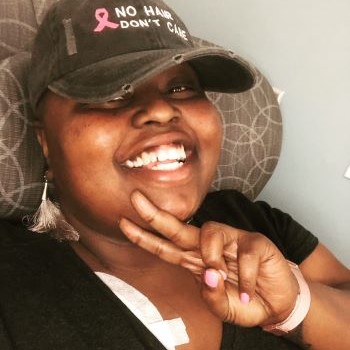
Growing up, the much-traveled (born in Oregon, moved to Missouri, back to Oregon, then Mississippi, Texas, Colorado, Arizona) Brown did have hints of trouble to come. On her mother’s side cancer was everywhere - eight women diagnosed with breast cancer and four men with prostate cancer, the likely result of the BRCA2 mutation in the family.
“But I never thought, ‘oh, I’m next!’” said Brown. Nor did she ever consider preventive, prophylactic surgery, as many do. Still, when it happened to her, Brown remembers thinking, “same as Mom.”
It started in mid-2021 with a pain Brown felt behind one nipple, as she rolled over in bed. Taking a closer look Brown says she felt a lump “the size of a ping pong ball.” She was scared. “I felt a lump in my throat and a drop in the pit of my stomach,” she recalled.
Brown wanted a mammogram right away but was advised to wait several weeks; she had recently received the COVID vaccine which sometimes caused swelling in the lymph nodes. She got the mammogram in September, followed by an ultrasound and then a biopsy. That same day she flew off to Hawaii for a planned vacation.
That’s where she got the phone call with her diagnosis: invasive ductal carcinoma, the most common form of breast cancer. Caught early enough, survival rates approach 100%. Brown’s cancer was Stage 2, which means cancer cells were detected in some lymph nodes.
She was eager to start treatment, so she asked her doctor for an oncology referral...and a painful feeling of deja vu kicked in.
“I found myself sitting across the table from the same doctors who treated my sister,” said Brown. She’d lost Jewel – her little sister and best friend – to breast cancer barely a year earlier. Still struggling emotionally over the loss, Brown didn’t like what she was hearing or feeling. “I felt anxious and powerless. I didn’t want to go through that same process. It wasn’t that she didn’t have good care. There were just things that I wanted to be different for myself as the patient.”
She wanted a second opinion. “You need to speak up,” she now says. “You need to have a sense of comfort and peace pretty quickly.”
Seeking Treatment Hundreds of Miles Away
A friend recommended City of Hope in Phoenix – a long way from Dallas. She called anyway. “They called back in 25 minutes and set up a consultation,” she said.
Her City of Hope medical team scheduled a lumpectomy to handle Brown’s tumor, followed by 20 rounds of chemotherapy plus 36 rounds of radiation to eliminate the cancer cells in her lymph nodes. Brown realized she would be all alone and far from home for all of it, not a happy prospect.
She had the surgery in December. The side effects of the chemo and radiation were tough: pain, fatigue, infections, hair loss, nausea and depression. Brown admits that during those long days, the weight of her illness, her personal troubles, the weekly plane flights back and forth, and her loneliness took their toll. More than once she contemplated suicide.
Then one day, a few words from a nurse changed everything.
“She spoke life into me,” Brown said. “She said I light up her day!” She also encouraged Brown, saying, “Once you get to the other side, I just know you’re going to shout it from the rafters and let everyone who hears your voice be encouraged by what you’ve been through.”
It was an Aha! moment for Brown and she acted on it. Immediately.
She’d heard another patient nearby, crying. Brown went over to talk to her. The patient was despondent because today was her birthday, “and no one came.”
Brown sat with her for some time.
“Something clicked that day,” Brown says. “I made the decision that not only was I going to beat this, but I was going to use it to encourage other people in similar circumstances.”
She has been climbing, even soaring, ever since.
Guided By Faith
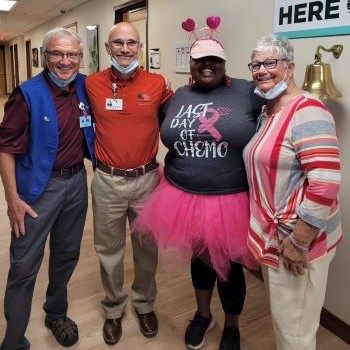
With nothing left for her in Dallas, Brown made the decision in late 2022 to relocate to Phoenix, obviously closer to her care, but also a new opportunity. She connected with a local church and also benefitted from spiritual and other supportive care provided by City of Hope, including survivorship groups of young women like herself.
A person of deep faith, Brown is determined to use her experiences in a positive way.
“Given the gravity of what happened to me,” she says, “It had to be orchestrated by God. I’m happy I’m on the other side now and can help others.
“It was worth every heartache and headache.”
She is a big fan of City of Hope, where she felt a “night and day difference compared to other medical institutions.” She appreciates the “holistic approach to care,” mindful that very often in other places, “there’s a dehumanizing effect of cancer, you can get lost in all the decisions.”
To ensure other young patients like Brown receive the cancer care they deserve, City of Hope is collaborating with the American Cancer Society, Together for Supportive Care, Tigerlily Foundation and other organizations to raise awareness about these issues and advocate for change.
Brown is especially devoted to her oncologist, Sagun Shrestha, M.D., medical director of medical oncology at City of Hope Phoenix, for helping her make those critical decisions. When Brown wondered why Shrestha laid out such an aggressive treatment approach, Shrestha said that’s appropriate for a younger patient.
They also talked about non-medical things.
“She opened up to us that her personal life was in shambles,” Dr. Shrestha said. “We talked about it often. That's how we catch issues that help us make better decisions.”
Brown has been cancer-free for three years now. Seeking that second opinion, she says, is a big reason why. “People assume the doctors with all those letters after their name know everything,” she said. “Just remember, you know your body. You don’t owe anybody anything. And it’s worth your life to get that second opinion.”