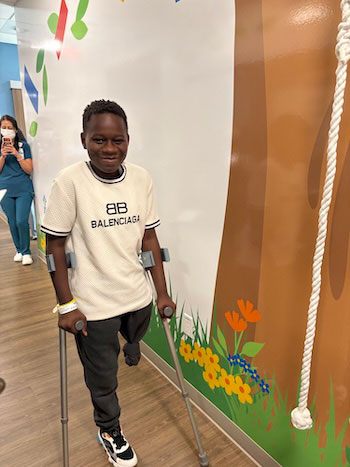
“My name is Gift, because I am a gift!”
That’s how 13-year-old Gift Likanga, born in the impoverished settlement of Kabiria outside Nairobi, Kenya, explains his unusual name. (Actually, it’s not that unusual. Many Kenyans name their children “Gift” or its Swahili equivalent, “Zawadi,” as a public declaration of the child’s immense value to both the family and the wider community.)
His broad, ever-present smile leads most who meet him to assume Gift is an essentially happy child.
But there’s a story behind the smile.
“Sometimes,” he explained, “I smile to be brave for my mom.” The declaration shocks Violet Lugalia, who took in the orphaned Gift at age 2 and is the only “mom” he’s ever known.
“I didn’t know he was being strong for me,” she said.
When Gift was 11, he came home complaining of pain in his left leg. The limb was swollen at the knee.
“It was 2024,” Violet recalled. “December 29. We women are good at remembering dates!”
Doctors at the local hospital took X-rays but couldn’t determine what was wrong.
Painkillers didn’t help. Violet insisted they look further. An ultrasound revealed what looked like fluid buildup in Gift’s knee, but doctors were unable to drain it. They put Gift on antibiotics, which also didn’t help.
A determined Violet (“We need to find the problem,” she said) brought Gift to neighboring Nairobi and the country’s largest teaching hospital. There, an MRI and biopsy revealed that Gift had osteosarcoma, a rare bone cancer with about 25,000 cases annually worldwide that primarily strikes young people during growth spurts, especially in rapidly growing areas such as the knee or shoulder.
“At first, I didn’t know what cancer was,” Gift recalled. “I didn’t take it seriously. But my mom explained it to me, and I realized it was really bad."
“I felt very sad. And I was scared.”
The doctors in Nairobi put Gift on chemotherapy, the standard treatment for osteosarcoma, and planned to amputate his leg above the knee. But as they prepared him for surgery, they discovered that Gift’s cancer was stage 4. The malignancy had spread to his lungs. Chemotherapy and amputation would no longer be enough.
“With stage 4, the long-term prognosis is poor,” explained City of Hope pediatric oncologist Hung Tran, M.D., associate clinical professor in the Division of Oncology, Department of Pediatrics and with City of Hope Children's Cancer Center. “But if you resect the lung lesions, there’s better hope.”
The hope would not come from Kenya.
The hospital informed Violet that it was not equipped to provide the additional treatment needed. Gift had already spent several weeks there, receiving eight rounds of chemotherapy, enduring the painful amputation and living in an overcrowded ward (“It felt like a prison,” he recalled), where he watched other children die.
Better care was available in the U.S. But how could they get there?
“The most important thing was for Gift to get well,” Violet said. “Other stuff came second.” She was prepared to leave her home, her job and the rest of her family, including two adult daughters, to bring Gift to America if a way could be found.
Unlike other African children facing similarly dire challenges, Gift had a guardian angel. His name is Ray.
“Gift has been a part of my family for a lot of years,” explained Ray Stradley, a marketing researcher from Claremont, California. In 2018, Stradley’s daughter Charlotte met Gift on a church mission to Kenya when he was 4. She immediately decided to sponsor him through Chosen Children of Promise, or CCP, a Christian organization that helps children in poverty-stricken communities reach their full potential.
Stradley met Gift a few years later on his own trip to Kenya. Gift was 9 at the time. When Gift became ill, Stradley felt it deeply and personally. He still gets emotional talking about it.
“I was sad for a month,” he remembered. “You want to see the light at the end of the tunnel. But when we heard about those lung tumors, it sounded like a death sentence. I felt a burden to do something.”
Stradley knew about City of Hope because his mother had been treated there. He reached out, hoping Gift would be accepted as an international transfer. On March 17, 2026, City of Hope said yes, triggering a flurry of diplomatic, medical and financial activity, with Stradley advocating nonstop on Gift’s behalf. Gift and Violet needed passports and visas. And they needed money.
Stradley organized fundraising campaigns through CCP and CaringBridge. Almost daily, he called on friends, neighbors and community members to pray and contribute. On April 24, when Gift and Violet finally reached California, Stradley was waiting at the airport to bring them to his home, where they have lived ever since and will continue to stay until Gift’s treatment is complete.
“We are home!” Violet exclaimed.
City of Hope moved quickly to assemble a multidisciplinary team. Dr. Tran oversees Gift’s maintenance chemotherapy. Thoracic surgeon Jae Kim, M.D., performed two surgeries to remove the lung lesions, most of which turned out to be inert. The chemotherapy in Nairobi had worked after all.
Orthopedic surgeon John A. deVries, M.D., shortened Gift’s amputated limb by 5 centimeters, preparing it for a prosthesis while calculating Gift’s future growth. It was not an easy task.
“He’s grown 3 inches and one to two shoe sizes in just the time he’s been here!” he said.
Drs. Kim and deVries also agreed to operate together, simultaneously treating Gift’s leg and lungs “to save him one more anesthesia,” deVries said.
“What’s most special about City of Hope,” he continued, “is our ease of collaboration across all our people. There is zero pushback. It would be very hard to find another place like this, having such selfless experts at every point along the way.”
Meanwhile, pediatric psychologist Jeanelle Folbrecht, Ph.D., began counseling Gift to help him cope with the trauma of cancer and traveling to an unfamiliar country for treatment.
If this sounds like above-and-beyond care, City of Hope insists it’s not.
“City of Hope is devoted to your care no matter where you’re from, regardless of your circumstances,” Tran said. “We will coordinate care, literally across oceans.”
Indeed, they did.
City of Hope’s prosthesis provider contacted his counterpart in Kenya to make sure the device being made was compatible and that all necessary batteries, spare parts and other items would be available in Kenya once Gift goes home.
As of September 2026, Gift was eagerly awaiting his first prosthesis fitting. His doctors expect him to acclimate quickly and be ready to return to Kenya with his mom in February 2027.
But that won’t be a final goodbye.
Children treated with chemotherapy can develop other health problems later, especially heart-related illnesses and hearing damage. Gift has moderate hearing loss in both ears, and a member of Stradley’s church community has provided hearing aids.
City of Hope will maintain contact with Gift’s doctors in Kenya as part of its extensive Child, Adolescent and Young Adult Survivorship Program, which provides specialized follow-up care.
“This is a fantastic story with a happy ending,” Violet exclaimed. “This last year was really hard. We were trying to get used to seeing Gift with just one leg. I’m so happy and thankful to City of Hope, the doctors, the nurses ... everyone there.”
Gift agrees and knows exactly what he’s going to do when he sees his friends again.
“I will give them my testimony!” he says with a smile.
About City of Hope
City of Hope's mission is to make hope a reality for all touched by cancer and diabetes. Founded in 1913, City of Hope has grown into one of the largest and most advanced cancer research and treatment organizations in the United States, and one of the leading research centers for diabetes and other life-threatening illnesses. City of Hope research has been the basis for numerous breakthrough cancer medicines, as well as human synthetic insulin and monoclonal antibodies. With an independent, National Cancer Institute-designated comprehensive cancer center that is ranked among the nation’s top cancer centers by U.S. News & World Report at its core, City of Hope’s uniquely integrated model spans cancer care, research and development, academics and training, and a broad philanthropy program that powers its work. City of Hope’s growing national system includes its Los Angeles campus, Orange County, California, campus, a network of clinical care locations across Southern California and cancer treatment centers and outpatient facilities in the Atlanta, Chicago and Phoenix areas. City of Hope’s affiliated group of organizations includes Translational Genomics Research Institute and AccessHope™. For more information about City of Hope, follow us on Facebook, X, YouTube, Instagram and LinkedIn.