

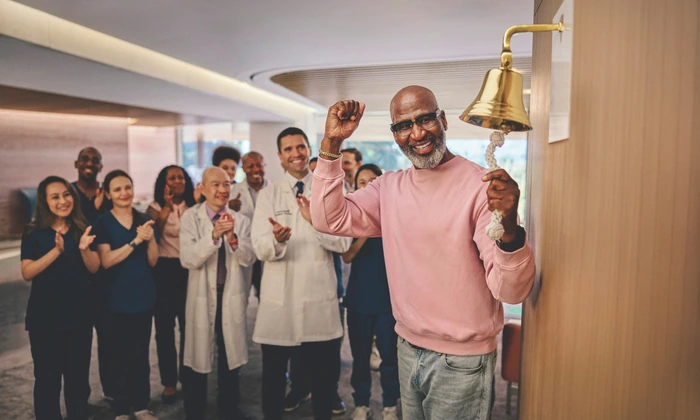
Prostate cancer was the catalyst that ultimately led Kevin Connor to transform his life for the better. His triumph over cancer contributed to a “total reset” that renewed his spirit and strengthened his relationships.
It was a long, grueling journey, one that Connor, now 53, almost didn’t take. However, with support from a radiation oncologist and a behavioral health specialist at City of Hope Cancer Center Chicago, Connor is more determined than ever to live his best life and encourage others to never give up hope.
A Delayed Diagnosis
Connor is a lifelong athlete who played basketball in college and professionally overseas. After retiring from the sport, he stayed active by working physically demanding jobs and helping at his father’s farm.
When Connor started experiencing back pain and a frequent need to urinate, he wrote it off for several months. “Prior to this, I was a phenomenal athlete and super healthy. In my mind, it was just about getting older, and I told myself I was fine,” Connor said.
Shortly after his 50th birthday in May 2023, Connor made an appointment with a primary care physician who administered a prostate-specific antigen (PSA) test, a routine blood test used to screen for prostate cancer.
Connor’s PSA levels were high, prompting the doctor to repeat the test and then refer him to a urologic oncologist. However, Connor delayed making the appointment, waiting until October to go in for a biopsy.
When the urologic oncologist told him he had cancer and would likely need surgery to remove his prostate, Connor kept the news to himself. “I walked out of the room, smiled and told my wife it wasn’t an issue,” Connor said.
Refusing Treatment
Connor was diagnosed with stage IIC prostate cancer classified as an unfavorable intermediate-risk, meaning the disease had a higher chance of growing and spreading beyond the prostate. Connor remembers the urologic oncologist trying to convince him to come back in for treatment.
Connor refused.
He feared the possible side effects of prostate removal surgery, which can include sexual dysfunction and urinary incontinence. He also was adamant about not wanting chemotherapy.
A few years prior, Connor had watched his father struggle through chemotherapy before passing away from brain cancer. “My father went from being a healthy man to a person I couldn’t recognize,” Connor said. “I wasn’t going to do that to my family and my kids.”
On top of that, Connor was processing the diagnosis and the possible consequences of refusing treatment all alone. For nearly two months, he told no one what was going on. At the time, Connor’s marriage was coming to an end, and he was living in a hotel.
“It was a lonely place and I was in a deep depression,” Connor said.
Unexpected Intervention
Connor changed his mind about treatment after receiving encouragement from an unexpected source. A minister Connor knew through his youngest daughter’s friend group had invited him to church multiple times.
In December 2023, Connor accepted the invitation and attended a service. “This is God’s honest truth,” Connor explained. “A woman stood up and said, ‘I don’t know who this message is for, but God told me to tell you that you won’t die from this.’”
Feeling newly inspired, Connor decided he was done carrying his cancer burden alone. He called a good friend, a nurse practitioner, who helped research his options and pushed him to consider City of Hope Chicago.
Two days before Christmas, a phone call from radiation oncologist Kevin King, M.D., confirmed for Connor that City of Hope was the right choice. Dr. King was already familiar with his case and was offering a path forward that didn’t include chemotherapy or prostate removal. “He won me over,” Connor said.
Hormone Therapy, Radiation and Mental Health
In January 2024, Dr. King prescribed an anti-androgen hormone therapy to lower Connor’s testosterone. As Dr. King explained, the side effects of hormone therapy can be especially daunting.
“Testosterone feeds prostate cancer. But when you take away testosterone, it essentially puts men through male menopause,” Dr. King said. “They can experience a range of symptoms including mood changes, weight gain, mental fogginess, lack of libido and erectile dysfunction.”
While on the hormone therapy, Connor underwent five weeks of external beam radiation. Once that was complete, radiation oncologist Karan Shah, M.D., performed a procedure to administer high dose rate (HDR) brachytherapy, an advanced technique that involves placing radioactive seeds into the prostate for a few minutes before removing them. This method delivers high doses of radiation directly to the cancer and spares the surrounding tissue. Dr. King describes brachytherapy as an intensive form of radiation treatment.
Through all this, Connor continued living in a hotel and relied on ride-share services to attend appointments because the treatment drained his energy. The side effects from hormone therapy also hit Connor hard and compounded his feelings of depression.
What kept him going, Connor said, was constant support from Dr. King. “I could text him any time and share, ‘I feel horrible today’ or ‘I don’t feel like a man at all,’” Connor said. “I can’t even call it a brotherhood, because it was closer than that.”
“I give all my patients my personal cell phone number,” Dr. King added. “We want patients to feel comforted, safe and able to trust the care they’re getting.”
Dr. King was also focused on making sure Connor’s emotional and mental well-being was addressed alongside his physical health. In March 2024, he referred Connor to City of Hope behavioral health specialist Alexandria Callahan, Ph.D., LCPC.
After initially feeling hesitant and skipping appointments, Connor went on to embrace his meetings with Dr. Callahan as an opportunity to, in his words, “fix myself, be available for my kids and have a better life."
“Dr. Callahan and I talk about everything,” Connor explained. “I have healed so many childhood traumas that had stopped me from having healthy relationships. I was able to grow spiritually, and life is just completely different now.”
Connor has continued to meet weekly with Dr. Callahan.
A Life Reset
By May 2024, Connor’s PSA had fallen to an undetectable level, and his cancer was considered under control. He has regular follow-up appointments to monitor his PSA levels, which have remained low, and Dr. King said Connor’s long-term prognosis looks good.
“One of the great things about Kevin has been the transformation he’s had in his life,” Dr. King reflected. “When he first came in, it seemed like the world was crumbling around him. He used this diagnosis as an opportunity to restart, and now he’s thriving.”
Connor’s perspective now includes an understanding that it’s OK to lean on others for help and a renewed commitment to his faith.
Now in a healthier place both physically and mentally, Connor is continuing to work on strengthening the bonds with his four daughters and other family members.
Connor is also using his experience to help others. He’s committed to paying it forward by raising awareness about prostate cancer and the importance of accepting help when it’s needed.
“The first part is getting past the mental block and just being willing to get a checkup,” Connor said. "I’m thrilled to share this testimony about living better and I want others to know that there is always hope.”