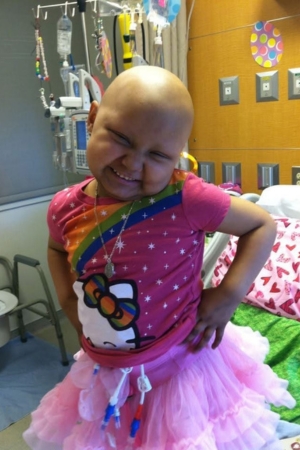
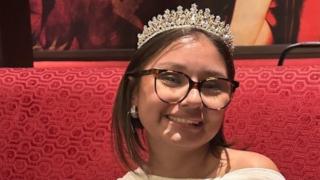
Camila Gonzalez was an energetic toddler who loved climbing over things and crawling around with the family dog. So, when she started preschool at the age of 3 and seemed more tired, her parents Carolyn and Alex didn’t think much of it.
“We just figured she was just trying to adjust to the new schedule or something,” Carolyn remembered. “But then we started noticing that she was having a lot of bruises in different parts of her body. We didn’t think she was that physically active.”
After being assured by the school that nothing was happening there that could lead to such injuries, they made an appointment with Camila’s pediatrician, who immediately ordered blood work after the exam.
“The doctor called later that same day and told us, ‘You need to take Camila to the hospital tonight,’” Carolyn said. “She said, ‘I already called and they’re expecting you.’ No one told us it was cancer until we got there. I guess they felt like it was delicate information we should hear in person.”
Diagnosed with leukemia in October 2011, Camila is now 18 years old and thriving, thanks to a lifesaving bone marrow transplant she received at City of Hope’s National Cancer Center in Duarte, California. But the path to adulthood hasn’t been easy.
A Very Aggressive Disease
Most childhood leukemias are highly treatable. But after a few rounds of chemotherapy at Kaiser Permanente in Los Angeles, Camila’s care team realized her disease was very aggressive and not responding enough to the medications.
“We were getting ready to start another cycle right before Christmas, and they said if we have the same results again, we’re going to have to think about other aggressive forms of treatment or start thinking about the possibility of just keeping her comfortable so she could go in peace,” Carolyn said.
While Camila did respond to the December round of chemotherapy, her doctors recommended initiating the search for a bone marrow donor so that she could receive a transplant. After an aggressive regimen to wipe out leukemia, bone marrow transplants replace damaged stem cells (responsible for making blood cells and platelets) with healthy stem cells that can create a new, disease-free blood system.
Kaiser doesn’t perform bone marrow transplants, so Camila’s pediatric oncologist, Jerry Cheng, M.D., part of the City of Hope®/Kaiser Bone Marrow Transplantation Team, referred her to the cancer center. City of Hope’s bone marrow and blood stem cell transplantation program is one of the largest and most successful in the United States, with more than 20,000 bone marrow transplant procedures performed to date.
“Our first meeting was so thorough,” Carolyn said. “When you have a child with a life-threatening illness, they often throw out many words that are like 20 letters, and you don’t know what they are. But the doctor at City of Hope explained everything to us in plain English; we understood everything she said.”
One of the key points was that they had to find a bone marrow donor for Camila. Immediate family members were not a match, so when a representative from a nonprofit aimed at helping blood cancer patients suggested doing donor drives, Camila’s parents jumped into action.
“You’re more compatible with people within your same race and minorities have smaller numbers in the registry so my husband and I decided we needed to reach out to people like us,” said Carolyn who, like her husband, is Latino. “We did a lot of Spanish-language media and registered a few hundred people. We found out later that some people found donors through those we registered and that was exciting.”
Unfortunately, Camila was not one of the people who was matched, but by February they had found a suitable donor through other means.
Holidays in the Hospital
After a conditioning regimen of full-body radiation and a large dose of chemotherapy that left Camila extremely weak but prepared to receive new cells, she received a bone marrow transplant in March 2012. The next two months were spent in the hospital recovering.
“I know it sounds weird, but it was a beautiful experience,” said Carolyn. “We were there for Valentine’s Day and Easter, and everyone at City of Hope made not just the patients feel special, but the whole family feel very special.”
Camila doesn’t remember much from that time but does recall her cousins visiting and an aunt and godparents who brought gifts. Over the years, though, the emotional toll has become more evident.
“I’ve started to learn that PTSD is something really weird,” Camila said. “I really don’t like the dentist because they shine a light in your face, and I don’t like big hospital doors either. Sometimes I hear the sound of an IV machine beeping at school, or I think I hear it, and it confuses and scares me at the same time.”
Yet she says returning to City of Hope for checkups and to celebrate milestones can feel soothing.
“I don’t remember a lot of good stuff, but when we go, it brings me almost nostalgic comfort,” Camila said. “There is a garden that my mom would visit and pray in, and she told me that as I got better, we would go together. We both like it so much that I took my quinceañera pictures there.”
A Different Perspective
Camila is now enrolled in the Childhood, Adolescent And Young Adult Survivorship Program at City of Hope and visits once a year for follow-up exams. She deals with long-term side effects from treatment like cataracts, arthritis and a short stature, but like in her early days before getting sick, Camila is an active teenager. Over the past few years, she has played softball and flag football and has recently taken up horseback riding.
“I also swim for school,” she said. “I started last season and I’m not very good, but I do love it.”
Currently in her senior year of high school, Camila has applied to a few colleges and is thinking of becoming a teacher, like her mom, or a journalist.
“The power of bone marrow transplants for pediatric patients is giving the gift of time to grow, learn, become independent, experience life, get married, have children and all the events that would have been cut short due to horrible illness,” said Nicole Karras, M.D., a pediatric physician at City of Hope who specializes in treating children diagnosed with blood cancers. “It’s so special to see how our patients overcome their challenges to flourish in their second chances.”
In addition to sports and studies, Camila volunteers with her family to help feed unhoused people in downtown Los Angeles through the Hiccups Pizza Project, an initiative they were first introduced to years ago through Padres Contra El Cáncer, a now-defunct support group for Latino families dealing with childhood cancer.
“I think as a family, our experience going through cancer made us able to show more empathy to others,” said Carolyn, who has two daughters in addition to Camila. “Even our youngest, who wasn’t born yet to experience what Camila went through, has made us stop to share leftovers with someone on the street, and that makes me proud.”
The Gonzalezes also aim to inspire others to get involved in community care by sharing their cancer story and encouraging others to do the same.
“If you motivate somebody to do something, whether it’s to donate money or become a bone marrow donor, or donate blood, anything like that, I would say it’s a win, even if it’s one person,” said Carolyn. “And if you reach more than one person, that’s even better!”
Camila, for her part, hopes to reach other young cancer patients and survivors who might have experiences like hers.
“Growing up with something like this, it’s hard to share,” said Camila. “But there are little kids that probably, like me, will end up feeling different. and I’d like them to know that it’s okay. I’ve come to realize my experiences give me a different perspective. I’ve matured differently than others my age, and I’m grateful for that.”
If you or a loved one is concerned about possible signs or symptoms of cancer and would like an initial appointment or a second opinion, call us 24/7 at (833) 902-5220.