
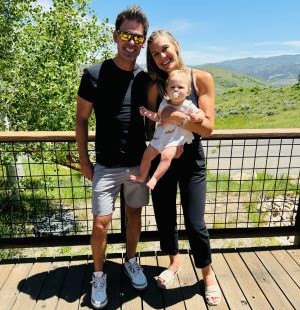
Yuman Fong, M.D., chair of the Department of Surgery at City of Hope® and the Sangiacomo Family Chair in Surgical Oncology, smiles as he pulls out his phone and points to a picture of a beautiful baby girl on the screen. Then he swipes, proudly displaying the child's birth certificate, two little footprints at the top.
The baby's name is Evelyn. Her father, Dan Trombley, sent the images as a token of gratitude to Fong.
"The only reason Evelyn is on this Earth is because of you," he wrote to Dr. Fong. "You saved my life."
At 42, Trombley has a lot of living to do. At 37, it wasn't clear if any of it would happen.
He was a career military man, joining the Navy right out of high school ("I was a troubled teen," he says) and staying for 22 years. He loved it. ("Best thing I've ever done.") He identified with the culture, the lifestyle, the patriotism. And he was good at it, starting as an airman specializing in assembling ordnance — 2,000-pound bombs — aboard battleships, eventually rising to the rank of chief warrant officer. Along the way he met and married Jessica, herself a four-year Navy veteran. They looked forward to having kids.
But in July 2020, while serving aboard the USS Wasp in Norfolk, Virginia, Trombley began to feel unusually tired. Suddenly this super healthy, super fit weightlifter had difficulty doing normal activities like climbing the many ladders onboard ship or working out in the gym.
Doctors detected a low blood count, so they gave Trombley a transfusion, and because they suspected an ulcer, they also scheduled a colonoscopy, just in case.
"Nobody thought cancer," he recalled.
Their thinking changed when Trombley began experiencing severe abdominal pain. The colonoscopy was moved up. The results showed Trombley had a tumor in his colon that his doctors said would be "easy" to treat.
Though surprised by the cancer diagnosis, Trombley felt optimistic. He handled the news in typical stoic military style, saying to Jessica, "Don't treat me any different. I don't want pity. We'll get through this."
Colon Cancer Had Spread to His Liver
But two weeks later, when he went back for a CT scan, everything changed. The news was "way worse than they had thought," he remembered. Trombley's cancer was stage 4. It had spread to his liver, covering some two-thirds of it. The optimism was gone.
"I was very scared," he said. "I called my parents. I was crying a lot."
Doctors at the naval hospital put Trombley on the so-called "kitchen sink" chemotherapy regimen called FOLFIRINOX, a four-drug, go-for-broke combination treatment, with inpatient infusions plus a portable pack of medication that Trombley wore at home. It triggered all the usual side effects: nausea, fatigue, nosebleeds, brain fog, hair loss, hypersensitivity to cold, as well as some stomach pain that everyone thought was "gas."
But it also did the job. Up to a point.
"The chemo was awesome," said Trombley. "It shrunk everything." He'd hoped he could now have surgery to remove what was left. But another complication arose.
Trombley's portal vein, which feeds into the liver, was partially blocked by yet another tumor. This rare condition scared off his doctors, who lacked the expertise and experience to perform so much complicated and risky surgery. They continued his chemotherapy.
But then that "gas" pain flared up into major abdominal distress. His colon tumor had created a blockage. Trombley was rushed into emergency surgery and lost 18 inches of his colon. Surgeons also gave him a temporary ileostomy, bypassing his large intestine with an opening in his abdominal wall for getting rid of waste. But they would not touch his diseased liver or portal vein.
Trombley didn't know where to turn. Conditioned to believe his military superiors, he thought he was out of options. "Every other doctor said, 'It's over, you're done, there's nothing we can do.'"
That's when he realized, "I had to advocate for myself." He consulted Colontown, the large colorectal cancer support group on social media. In short order, a Virginia woman with similar symptoms pointed him to City of Hope and Dr. Fong, who has handled 10,000 liver cases in his 40-year career.
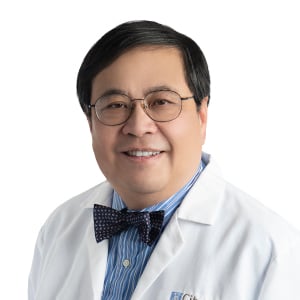
Trombley emailed Dr. Fong and received a reply the next day. By the time they met face to face, Trombley was in rough shape.
"He was beat up from a lot of treatments," recalled Dr. Fong. "The conventional wisdom equates a portal vein clot with incurable cancer. Nobody thought he'd live beyond 2021."
He made no promises, but Fong did make it clear that Trombley was indeed a candidate for surgery, given his youth and overall fitness — not to mention Dr. Fong and City of Hope's deep expertise, something most conventional hospitals could not provide.
Mindful of Trombley's home base in Virginia, Dr. Fong offered to set him up with a surgeon he'd trained who practiced at Johns Hopkins Hospital in Baltimore. But Trombley's mind was made up.
Aiming for a Cure
"I really wanted Dr. Fong," he said. "One set of doctors was leaning toward putting me in the grave; the other doctor told me that he can cure me and I will have the chance to live a long, normal life. I liked (Dr. Fong's) confidence, his demeanor, his desire to 'go for the cure.'"
The military helped, "ordering" Trombley to San Diego and transferring him to its West Coast insurance system, so his time at City of Hope — 12 days in all, plus three more weeks recovering as an outpatient — would be covered.
His surgery took place in May 2021. Dr. Fong removed the remaining liver tumors and even found and excised additional cancer lodged in the duodenum. Meanwhile, colon and rectal surgeon Kurt Melstrom, M.D., associate clinical professor in the Division of Colorectal Surgery, reversed Trombley's ileostomy. After eight hours, he was in the recovery room.
And he was alone. Because of the COVID-19 pandemic, Jessica couldn't stay with her husband in the hospital. So, after completing the surgery, Dr. Fong left the building, went out to the parking lot, found Jessica and let her know that Dan was OK.
"That," said Trombley, "speaks volumes about who Dr. Fong is, not just as a surgeon but as a man.
"He is a remarkable human being."
Dr. Fong says he felt compassion for the family. "They are this young couple, just beginning their lives together, and this bad thing happens."
Since then, Trombley has traveled a bumpy road. Removing that portal vein tumor left scar tissue that continues to cause blood flow problems requiring additional procedures, including embolization of Trombley's spleen. He's endured bouts of severe pain. And in September 2021, when he caught COVID-19, two liters of fluid had to be drained from his chest. Through it all, Trombley praises his wife for "digging in," staying in touch with the doctors even more than Trombley himself, and getting both of them through it.
Slowly, he has regained his strength. He's back in the gym, feeling well, working as a project manager for a defense contractor (the military gave him a medical discharge). The cancer has not returned. Trombley now beats the drums regularly for the need to always seek a second, third, even fourth opinion, and always from cancer specialists.
And on Sept. 9, 2023, when Evelyn was born, Trombley sent that photo to the man whom he believes made it possible. He also made sure Dr. Fong knew Evelyn's middle name.
"It's Hope," he said.