Those losses stayed with him so deeply that he named his sons after his late friends, carrying their legacy forward. So, when Linder found a lump on his hip in 2024, he didn't hesitate to seek help.
"I have three experiences of folks that were really close to me that didn't make it," said Linder, a chief engineer in aerospace and longtime youth coach. "I was like, 'Hey, I gotta go. I'm not waiting. I can't wait.’"
Thanks to his perseverance and the expertise of physicians at City of Hope Los Angeles, Linder was diagnosed with Hodgkin lymphoma at an early stage and quickly began treatment. Now, Linder is back to celebrating wins with his family and the sports teams that kept him going during his fight to get better.
"I just feel indebted to the doctors and the people that are at City of Hope; they saved my life," he said.
Stepping Up to the Plate
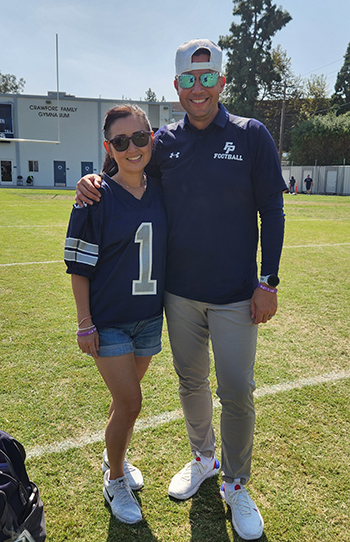
As an athlete who coaches both high school football and Little League baseball, Linder lives an active life. When he first experienced some pain in his hip and later found a bump the size of a grape, he wasn't too worried. His physician said it was on top of a lymph node and sports can often result in minor injuries that inflame the tiny organs.
"I'm not a passive coach, so I get into it a little bit. I'm in the dirt," Linder said. But when the bump grew over just a few weeks' time, he knew it was time to get serious with his care, too. Linder opted for surgery to remove the lump for a biopsy despite his initial doctors’ lack of serious concern.
"The results came back and they're like, ‘Oh, you have cancer,'" Linder remembered. "That was a real shock because a lot of the information I had been getting was that it's maybe just some benign growth."
Linder's primary physician and surgeon both recommended City of Hope, so he jumped on their suggestion and started chemotherapy within weeks of contacting the Los Angeles team and confirming his stage 1 Hodgkin lymphoma diagnosis. Hodgkin lymphoma is a highly curable type of blood cancer, and City of Hope has one of the most successful lymphoma programs in the United States.
Under the guidance of hematologist-oncologist Geoffrey Shouse, D.O., Ph.D., Linder completed four rounds of chemotherapy followed by ten days of radiation.
Even with great odds, cancer takes an emotional toll, which Linder felt. He remembers crying during his last radiation session, knowing he would soon ring a bell to signify the end of treatment.
"I was already really emotional coming out of that moment," Linder remembered. "I turned the corner, and everybody was there, and it was a whole thing. I completely lost it."
Linder's wife, Jannet, organized a surprise party to mark the occasion, inviting not only his family and care team, but also Little League families and some of the high school students he was coaching.
Making It to the End Zone
With the support of Dr. Shouse, Linder kept up with coaching duties during his cancer journey, which helped his mental state.
"He was really an advocate for me to continue my life," Linder said. "He could tell how important coaching was to me and encouraged me to figure out a way to be safe and still do what I wanted."
Chemotherapy and radiation suppress the immune system and can cause severe skin photosensitivity, so Dr. Shouse gave Linder some guidelines: Wear a mask around the kids, keep an arm's length away from them, fully cover up in the sun, don't overexert yourself.
While he did his best to stay on the field, Linder eventually had to hand off some of his responsibilities and step down from coaching full time at the school where he's been training football players for the past two decades. He remembers the touching moments that followed his announcement.
"I'm crying as I'm telling them, and we all came together, and we had this big group hug, and they were like, ‘Hey, it's gonna be okay, coach. We got you. We love you.’" Linder said. "To hear teenage boys say that to a coach, it was really impactful."
The team and their families rallied around him in other ways, too, delivering meals and making bracelets that everyone wore in support of his fight, a powerful symbol of unity that Linder still wears on his wrist. There was even one student who decided that he would do daily push-ups for Linder the whole time he was in treatment.
"Every day he filmed it and sent it to me," Linder said. "And there were times where the whole team was doing it. It was pretty cool."
This fall marks two years since Linder rang the bell at the end of his last radiation session. He is still sharing his passion for sports through coaching and modeling the emotional openness that he experienced during cancer treatment for the young athletes he mentors.
Linder also continues to honor the friends who passed away from the disease and the losses that pushed him to seek timely care. He hopes that by telling his story, he can inspire others to stay on top of their health.
"I want to encourage people to take action on their own health issues," Linder said. "If you feel something weird or funny, go get it checked, because you never know what it might be."