But after being diagnosed with breast cancer in late 2022 at the age of 37, she started to step into the spotlight to educate people, including her family, and help others with cancer feel less alone.
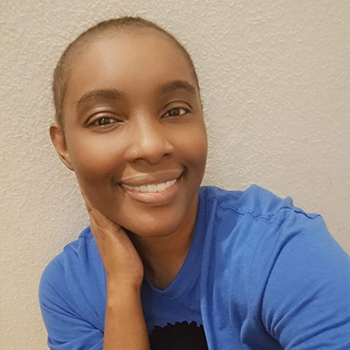
"I thought, 'I'm going to give cancer a new face for my family,'" said Wilson. "And so, I decided to find strength in everything. I went to work. Everything was normal. I just was a bald-headed baddie while doing it."
Now featured in a new City of Hope ad, she's bringing her cancer experience full circle after learning about the cancer center through a television commercial soon after her diagnosis.
"Since the commercial shoot and people asking me about my story, it makes me feel like I have a purpose," said Wilson, who chronicled a lot of her cancer journey on social media. "It's an empowering feeling. I am not the biggest person on sharing my story or doing the camera stuff, but the Lord has been working on my heart lately. If my story can help even one person, I'm okay with that."
Not Another Number
Wilson lost both her grandmother and great-grandmother to breast cancer, so when she had pain in her breast at age 36, she immediately sought care through a local physician. But because of her age, she was initially denied requests for screening. A year later, she asked again, this time receiving an MRI, followed by a mammogram and ultrasound, which is not the typical order.
"The MRI is what found the lump; when they did my ultrasound and my mammogram, they didn't see anything," Wilson said. "And they were like, had you come in for that first, we would have just sent you on your way."
The lump turned out to be stage 1A, HR-positive and HER2-negative breast cancer, the most common subtype of the disease. Originally from Georgia, Wilson wasn't familiar with local cancer care options in Southern California, where she now resides. The first oncologists she saw were fine, she says, but not ideal.
"I just didn't connect and it just felt like I was another number," Wilson remembered. "They tried to sound nice, but it's something about your spirit just not being settled."
Then, one day shortly after her diagnosis, Wilson happened to be watching television when a commercial for City of Hope came on. Its uplifting message inspired her to learn more online, and she quickly found Veronica C. Jones, M.D., a Black breast surgeon at City of Hope Los Angeles.
"As a Black woman with cancer who watched my grandmother and my great-grandmother struggle through it, I didn't want the same experience that they had; I really wanted to try to get to doctors that I felt had my best interest at hand," Wilson said. She reached out to Dr. Jones initially for a consultation.
"I just felt like a person when she spoke with me, so that's what mattered," Wilson said.
Flipping the Script
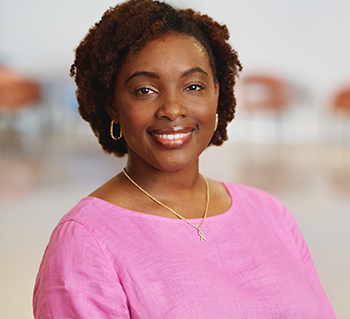
Under the guidance of Dr. Jones, Wilson received a lumpectomy at City of Hope in March 2023. Although tumor testing found no genetic mutations despite a strong family history, an additional test revealed a high oncotype score, which indicates a higher risk of recurrence. To reduce this risk, Wilson had to also get radiation and an aggressive chemotherapy drug called doxorubicin, often referred to as the "red devil."
"I called it my sunshine juice because I don't want to call nothing 'devil' that's going in my body," said Wilson. She initially planned to receive her chemotherapy through an oncologist closer to home, but when their bedside manner felt insensitive, she switched all her care to City of Hope.
"A lot of times doctors just talk over your head and then they're like, ‘Okay, now what do you want to do?’ And I didn't feel like that with Dr. Jones," said Wilson. "Then she got me in contact with Dr. [Joanne] Mortimer, who was amazing in explaining the medicine, how it would work, how it would make me feel.” Wilson also received radiation therapy from Jose Bazan, M.D., a radiation oncologist at City of Hope Los Angeles, who used targeted radiation technology on the tumor area.
While the treatments made her weak, Wilson says she had a relatively easy time during chemotherapy. She knew her daughter had a particular view of cancer, having experienced a bedridden great-grandmother, and Wilson was determined to show her there could be another way.
"We still go to basketball games. I still play softball; life is still normal," Wilson said. "I feel good."
A Full Circle Moment
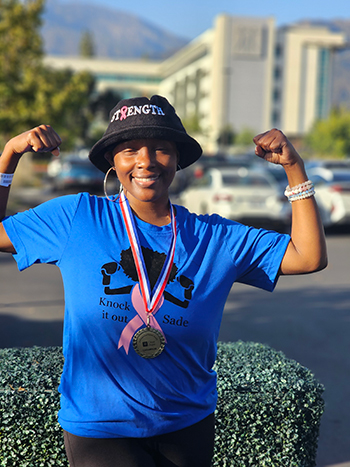
By modeling strength and encouraging emotional openness, Wilson believes her daughter now knows that cancer does not look the same for everyone and that earlier screening and care can help change the story. She hopes the experience will encourage her, and the rest of the family, to stay vigilant about cancer screenings.
"Because of my story, my sister has been getting checked more often, and they found a lot of cysts," said Wilson, noting her daughter has also been approved for early screening measures due to family history. "That makes me feel good because now we can get ahead of everything should there be anything."
For her part, Wilson feels like she is finally in a celebratory phase. She still takes daily doses of tamoxifen — a hormone therapy to reduce the risk of recurrence — and receives monthly leuprolide injections to suppress estrogen. She's working on being more present in her day-to-day life and staying healthy. And while she knows her chance of recurrence isn't zero, Wilson keeps up with Dr. Jones and the latest in breast cancer care.
"She's finding out new information all the time," Wilson said. "I feel like I'm a part of something that is constantly evolving, but I'm evolving on the right end with the right people."
Now more than three years from her first chemotherapy session, she's excited to be sharing her story. In fact, the first day of her recent commercial shoot coincided with that treatment anniversary and took place at the City of Hope location where she was treated.
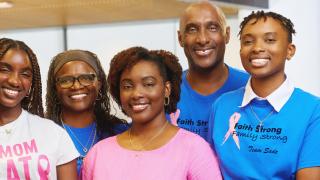
"To be back in the building, but this time celebrating, was a full-circle moment," said Wilson, who had many family members with her for the occasion. "It was a really beautiful experience with my village of people who were there with me through thick and thin. It was a really good celebratory moment."
Still, she says cancer can change who you are and there is a grieving process, but she's focused on spreading hope and awareness.
"It is a part of my story, but it's not who I am; I'm not just the cancer patient, right?" Wilson said. "I am Sade who went through something and I'm on the other side of it."