
Scroll through 39-year-old Jennifer Rancik's Facebook posts and you quickly see two things. At one end is a storybook romance with husband David: They met when she was 15 and are still going strong 25 years later.
At the other end is a stunningly beautiful 6-year-old girl whom Jennifer calls, "My miracle. My twin!" She's the daughter Jennifer and David weren't sure they could ever have.
And her name is Hope.
When Cancer Struck at 31
Growing up in Moreno Valley, California, Rancik remembers a normal, active, healthy childhood with few mishaps. "Never even broke a bone," she says.
But life changed dramatically when Rancik turned 31. Living in Riverside with David and their 10-year-old son Seth, Rancik was studying stenography and moonlighting at a merchandising job, moving heavy appliances. When she felt a pain in her chest, she assumed she had pulled a muscle. The area was tender to the touch.
But there was a lingering suspicion: Could it be something worse?
"Cancer doesn't hurt!" declared her doctor, dismissing her desire to get a mammogram. She insisted.
It wasn't long before the results came in, and she was told to go for a biopsy. Three days after that procedure, the hospital called: "Gather your family and get down here NOW," they said.
She had stage 2 triple-negative breast cancer, a variety that's generally more aggressive and tougher to treat.
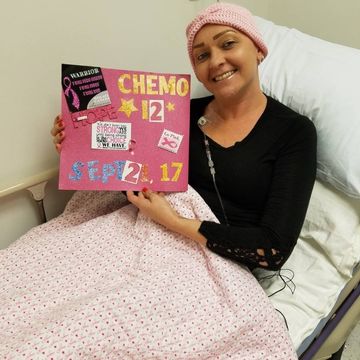
Rancik joins a growing number of women under 50 facing cancer diagnoses each year, a demographic now experiencing rates 82% higher than their male counterparts.
"When I was told those three words, 'You have cancer,' I felt like it was a death sentence," she wrote. "My life turned upside down. This was life changing. I didn't know if I would make it. I was scared. And I felt so alone."
The family was scared, too.
"David tried to be strong for me," recalled Rancik. "He never let me know he was scared. But once, in the middle of the night, he was in the living room, crying." They broke the news to 10-year-old Seth carefully and emailed his teacher. Seth then "shared" his story with his classmates while they all made get-well cards.
With her family's support rallying around her, Rancik focused on her next step. Determined to advocate for her own care, she talked to her doctor about a referral.
"I asked for City of Hope," she said. "I saw the commercials, and it was the only hospital for cancer that I'd ever heard of."
On her first visit, Rancik arrived with an entourage. Five family members accompanied her and, to her surprise, "they let everybody into the room! The place didn't feel like a hospital. It was so welcoming!"
The next surprise? How her doctor looked her in the eye, said "You're gonna beat this!" then proceeded to pull out a sheet of paper and draw a diagram explaining in clear detail what Rancik would be going through.
It wouldn't be easy. She would need 14 rounds of a powerful chemotherapy called Doxorubicin. While taking the drug, Rancik's hair fell out after the first treatment. She also experienced bone pain so intense that she could barely get out of bed.
But the drug also did its job. "After the second chemo I couldn't feel the lump anymore," she said. "And after the fourth, they couldn't even detect it."
But that wasn't the end. In fact, it was barely the beginning.
A BRCA Gene Discovery
Her medical team at City of Hope urged Rancik to get genetically tested, because when someone so young develops breast cancer, a mutation could be to blame.
The results were troubling. Three mutations were discovered, including the notorious BRCA1, which dramatically increases the risk of more breast cancer as well as ovarian cancer. This left Rancik with another life-changing decision to make. Should she have radical surgery — double mastectomy plus a hysterectomy later on — to stop future cancers?
She didn't hesitate. In fact, even before getting tested, she knew.
"As soon as I was diagnosed," she recalled, "I decided to get rid of everything. So, when I was told I had BRCA I had already decided. And my husband David was fully on board."
Her case was fairly typical.
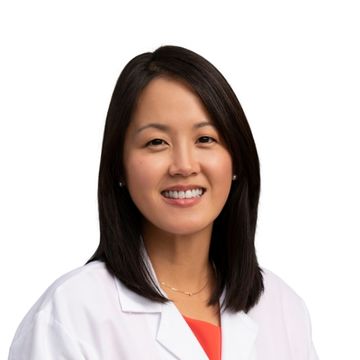
"Patients who come in want to do all they can to prevent cancer," said Mihae Song, M.D., assistant professor in City of Hope’s Division of Gynecologic Oncology, Department of Surgery. Especially ovarian cancer, "because there's no good screening for it and the mortality rate is so high.
"We don't want to treat ovarian cancer. We want to prevent it."
For Rancik, it would be a bumpy road, fraught with challenges ... and one tiny miracle.
A Miracle Named Hope
As soon as her chemo was completed, Rancik had the mastectomy. But she developed an infection not long after, which put her back in the hospital for a week.
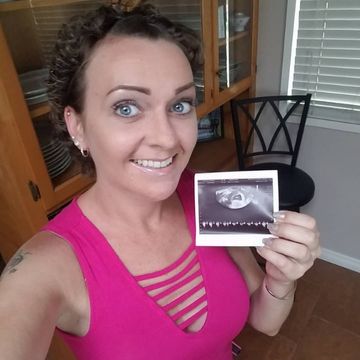
Then the miracle part. Rancik assumed her intense chemotherapy had affected her fertility. Her doctor called it "unlikely" she'd be able to conceive. While some couples facing cancer treatment take steps like harvesting eggs or embryos, just in case, Jennifer and David did nothing. Turns out, they didn't have to.
"In October of 2017, I was told I was in remission," she wrote. "Then, in June 2018 I was told I couldn't have any more children. Well, God had other plans. In July we ended up getting pregnant naturally with our miracle baby." Hope Ann was born in early 2019.
Their daughter's birth cleared the way for Rancik to focus on her next challenge, a hysterectomy. She waited until age 35 — many doctors advise against the procedure any earlier because of an increased risk of heart disease and other complications — and then, in 2021, she underwent the surgery.
Four years later, Rancik joyfully reports she's "doing great! I remember telling myself I'll never be the same, but now there are days when I don't even remember having cancer." Other than an occasional infusion of Zometa to ward off bone pain, she is off all medications, back to her normal life, and grateful for all the help she received, medical and otherwise.
"I spent a whole day (at City of Hope) looking at wigs," she said. "I did makeup with other survivors. And counselors talked to my son and my niece, so they knew what to expect during Mom's chemo."
Now she wants to share her story with others dealing with BRCA challenges.
"I want to inspire," she said. "You've got to take this day by day. Don't think that this is a death sentence. Because it's not."