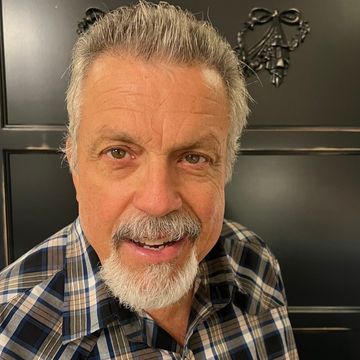
Describing himself as “hard to keep down,” this outgoing landscaper from Upland, California, grew up playing basketball and other sports ("very physical," he says). He has a broad smile, an easy laugh, and when he tells a joke — which he does often — it's usually at his own expense. And until recently, such Eastern, Asian, or "integrative" disciplines had never entered his mind.
And yet, there he is, at age 68, partaking in every possible activity offered at City of Hope's Cherng Family Center for Integrative Oncology, guided by its director, Richard T. Lee, M.D. More than just a convert, Forgette is an evangelist, insisting he is "feeling better than I have in 20 years due to all my lifestyle changes."
What turned him around, he says, was an encounter with a cancer so rare, approximately 2,800 men in the U.S. are diagnosed with it each year.
Two Unexpected Cancer Diagnoses
"I hadn't been to a doctor in 20 years," he said. What finally got him into his doctor's office in 2023 was a sore hand... arthritis in his thumb. He needed surgery.
His preoperative blood work revealed something unexpected: a low-grade, slow-growing case of prostate cancer. No treatment required at this time, the doctor said; we'll keep an eye on it.
The real surprise was yet to come.
"A couple of days later I'm in the bathroom," he recalled. "I bumped my chest, and I felt a lump." Another call to the doctor, who suspected gynecomastia — benign enlargement of breast tissue in men. Just to be certain, the doctor recommended a mammogram.
"Don't you mean a 'man-o-gram'?" asked Forgette.
It felt a little weird to visit the hospital's Women's Center. "Here I am, this scruffy gardener walking in," he said. "I half expected someone to shout, 'Hey pal, prostate cancer is down the hall!'"
Unfortunately, the results were nothing to laugh about. It looked like Stage 2 breast cancer. A PET scan and biopsy revealed a more serious diagnosis. The cancer was Stage 4 and it had spread to the bones and lymph nodes.
"I went from joking around to Stage 4,” he said. "They're telling me it's not curable. Counselors are coming in, talking to me like I'm dying, telling me I might want to get my things in order.”
Finding City of Hope
He didn't like the diagnosis, or the approach. He wanted a second opinion. He remembered how, in his younger days, the family would frequently drive past City of Hope and how he'd hoped to never need its services. Now though, he realized, "I have this world-class cancer center minutes from my home." He looked up the website and cold-called. Within two days he was headed for an appointment with oncologist Joanne Mortimer, M.D.
"He's this amazing guy," said Dr. Mortimer, Baum Family Professor in Women's Cancers and vice chair and professor, Department of Medical Oncology & Therapeutics Research. "A real character. Inquisitive, methodical, thoughtful... hard not to get along with."
Dr. Mortimer says only about 1 in 200 cases of breast cancer afflict men. Their prognosis tends to be worse because many men delay getting diagnosed, dismissing the discomfort in their chest as most likely trauma related.
Although she has treated "many men," Forgette's situation was unique. He had HER2 metastatic, triple-positive cancer, something Dr. Mortimer had encountered in a male only once before. But she says male or female, breast cancer is treated the same way, and this variety, while quite aggressive, responds well to chemotherapy and targeted therapy.
Genetics can often play a role in cancer, and in Forgette's case it did. Testing at City of Hope determined that Forgette had the CHEK2 mutation, which increases the risk of breast, colon and prostate cancer.
There were hints in his family history. Forgette's mother had breast cancer and his daughter is also battling the disease.
Dr. Mortimer told Forgette that his cancer was definitely treatable and Forgette appreciated that. "She answered my questions and made me feel assured," he said. "I like her experience. But it's not just Dr. Mortimer. She consults with her colleagues, and there's this enormity that you feel, that you are important to them, not just a number."
Within nine days of that first visit, Forgette was receiving his first infusion, a combination of the chemotherapy drugs docetaxel and carboplatin, plus the monoclonal antibody Herceptin and Perjeta, an immunotherapy drug. His cancer shrank, but also "my hair fell out, and my fingernails," he recalled. "I felt crummy. The anti-nausea medications made me drowsy and agitated." He didn't lose his sense of humor. "If this stuff you’re giving me for my breast cancer also works on my prostate cancer," he told them, "You're naming this wing after me!"
Next, Dr. Mortimer sought to stabilize Forgette's progress with an injection called Phesgo, which is a maintenance dose of Herceptin and Perjeta. This strategy has been shown to be very effective, but Forgette's response was shorter than the norm. By December 2024, "all my markers were going back up, a PET scan showed all the old areas were lit up again, but the cancer had not spread."
It was a disheartening setback, but Dr. Mortimer told him this was not unusual, just a nudge to switch to a different treatment, and luckily "we are perpetually growing HER2 drugs and finding effective targets," she said.
Dr. Mortimer then chose the antibody-drug-conjugate Enhertu, which uses a monoclonal antibody to bind to HER2 proteins, and, once there, deliver a dose of the chemotherapy drug deruxtecan directly into the cancer cells.
A Complete Transformation
Around this time Forgette realized he could help himself as well. "I'm a fighter with a positive outlook," he said. “If there's a problem, I go fix it." The "fix" involved trying a variety of "things I never would have done before." He saw City of Hope’s supportive care offerings like yoga, cancer counselling and qigong, and dove in. With help from Dr. Lee, he also adjusted his diet, primarily eliminating processed sugar. At this point his wife Ronda did some of her own probing and changed all the home-cooked meals to whole foods only. In a short time, his weight was down, his arthritis was gone, his energy was up and, in Dr. Mortimer's words, "He transformed himself."
He agrees.
"My life is so much different now, compared to pre-cancer," said the former “self-reliant” guy. "I'm much gentler, more in tune with my feelings and much more willing to look to others for anecdotal success stories and words of advice and encouragement.”
Nine months after starting on Enhertu, Forgette's cancer is "dormant." He knows he's not cured but he also knows that, should his cancer recur, he'll partner with his City of Hope care team on a solution together.
For now, he's humbled by all the inspiration from his family and friends, the power of prayer and meditation are such a strong component as well and thankful to all the people at City of Hope. “Even my patient liaison, Mindy, meets me at most every appointment and gives me such support and reassuring conversations.”
"Once I put my trust in City of Hope, I haven't been disappointed any step of the way," he said. "Compared to other hospitals I couldn't wait to get away from, these people are bright, lighthearted and happy to see you.
"Cancer has made me live a better life. I feel at ease, not worried about the unknown.
"I wake up and look forward to each day."