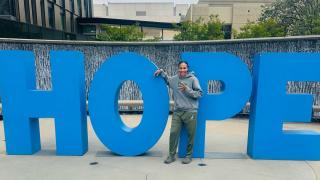
Janina Simmons didn’t set out to make history, but now that she has, she finds it “kinda cool.”
At 35, she is a Sergeant Major — the highest enlisted rank in the U.S. Army — overseeing instructors at the Sergeants Major Academy at Fort Bliss in El Paso, Texas.
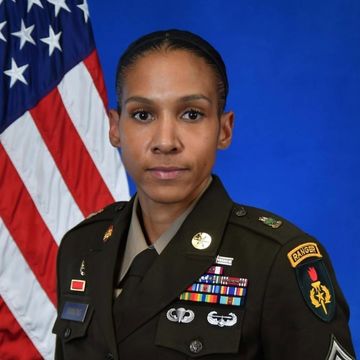
She’s traveled to Okinawa, Japan, Kuwait and Qatar, and served on U.S. bases in Texas, Oklahoma, North and South Carolina. She is a strong, charismatic leader with a clear gaze, an easy smile, a firm but welcoming demeanor and a wicked sense of humor frequently displayed on Instagram, often accompanied by best friend and partner in crime LaToya Greene.
The history part? That came in 2019 when this ultra-marathoner became the first Black woman to successfully complete Army Ranger School, an intensely challenging test of physical and mental toughness. More than half the applicants don’t complete the training.
Why did she do it? That’s who she is. Or, more accurately, who she became.
Simmons was born and raised in Germany where her dad, a former Drill Sergeant, was stationed. The Army was part of her life, but never her goal.
“Everything I am now, I was not as a kid,” she says. “I was a non-athlete. I’d go to school, come home, watch TV. I didn’t have a single conversation with my father about the military. It didn’t appeal to me.”
But after high school she thought a stint in the Army would help her get to college. So, she enlisted, with “no aspirations.”
Basic Training changed that.
“Right place, right time, right uniform,” Simmons said. “I liked the structure, putting the pedal to the metal, seeing what hard work can do. And I kept getting more and more ambitious, realizing that the more work you put in, the more you reap.”
She applied the same ethic to running, a new interest. “I couldn’t run a mile before I joined,” she recalled. With her first half-marathon in 2017 she found she craved the highs… and the lows. “It makes you SO uncomfortable. But after…” she smiled.

She didn’t stop at half-marathons, opting for more and longer races — each one a new chance to get “uncomfortable,” then feel great afterward.
When the opportunity came to attend Ranger School, she seized it. “I had plateaued,” she said. “This was the holy grail, a chance to get really uncomfortable!” Being “first” didn’t matter. “I had no idea, and I was not trying to make history,” she said, adding that it wasn’t until graduation that she found out how unique her achievement had been.
Things were looking up. Simmons was enjoying life with spouse Gabby Ximenez, herself a Sergeant Major candidate. Simmons would rise daily at 3:00AM for a 10-mile run — perhaps a bit over the top for most people, but “not extreme to me.” Life was good.
Then, in December 2023 Simmons noticed some lumps in her groin area. She felt no pain or other symptoms, so she didn’t see a doctor right away. When she did make an appointment in September 2024, she received devastating news: Simmons had neuroendocrine cancer.
Unlike lung, breast or colon cancers, which typically develop in the cells lining the organ, “neuroendocrine cancer is not organ-specific,” explained Gagandeep Brar, M.D., Assistant Clinical Professor, Department of Medical Oncology & Therapeutics Research at City of Hope. These tumors can sprout anywhere, though they frequently appear in the gastrointestinal tract.
Neuroendocrine tumors, or NETs, are rare, affecting approximately 12,000 people a year. Slow-growing NETs caught early can be surgically removed or treated with hormone inhibitors. Later-stage and rapidly growing tumors require more aggressive treatment, including chemotherapy, radiation, and targeted or immunotherapy drugs.
Initially, her doctors believed they could control Simmons’ tumors with hormone-inhibiting injections. When the shots didn’t work, her medical team took a closer look and determined that Simmons’ cancer had reached Stage 4, with tumors spreading to her lungs, bones, abdomen and pelvic area.
The normally stoic Simmons didn’t like the sound of that.
“I was devastated for a week,” she said. “I kept thinking to myself, ‘I’m dying!’ And why? I didn’t smoke, didn’t drink.” Eventually she pulled herself together in typical Janina fashion – by signing up for an ultra-marathon.
With her Stage 4 diagnosis, Tricare — the Army’s health insurance system — referred Simmons to City of Hope where she met Dr. Brar, who was struck by how young her patient was; most people with NETs tend to be in their mid-50’s and 60’s. Why the thirtysomething Simmons was afflicted remains a mystery.
“It hit too close to home, almost like seeing myself,” said Brar, who graduated medical school in 2012 and was doing her fellowship the same year Simmons was breaking barriers in Ranger school. “It was definitely unsettling.”

Dr. Brar brought extensive experience to Simmons’s case, having served at the National Cancer Institute as well as a prestigious New York medical center. Now, working at City of Hope — an institution known for treating unusual and rare cancers.
And she knew exactly what to do.
Brar’s priority was to calm her new patient, and Simmons’ family.
Dr. Brar met with Simmons and her family, recognizing the importance of clear communication and reassurance during such a difficult time. She carefully explained the treatment options, outlining the steps ahead and answering questions with compassion and expertise. Her confidence and empathy helped ease some of the uncertainty Simmons and her loved ones felt.
“I could feel their anxiety, perhaps more from her spouse,” recalled Brar. “[Simmons remained] very ‘put together,’ calling me ma’am... I hope they left with a little less anxiety.”
Because Brar had a plan. “When you can tell a patient, ‘we’re gonna do this…’ they can breathe, as long as you can lead with a plan of action.”
For Simmons the plan involved a relatively new therapy called Lutathera.
Approved in 2018, Lutathera is a type of radioactive “smart bomb,” ideal for patients like Simmons whose NETs have an abundance of receptors for the hormone somatostatin. Lutathera takes advantage of this, wrapping a potent radioactive isotope inside a substance that mimics somatostatin. When infused, this powerful package targets those receptors, releasing radiation that kills cancer cells without harming healthy tissue.
The IV infusion process can take six hours or more, including preparation, dosage, and follow-up drug treatment. The process involves four long treatment days, each occurring every eight weeks, and Simmons spends much of that time in isolation because the radiation can be harmful to others. Simmons coped with the tedium by talking, laughing, singing and praying, with her personal lifeline and guardian angel, radiology nurse Anna Trejo, who spoke Simmons’ language, calling the treatment, “your spiritual boot camp.”
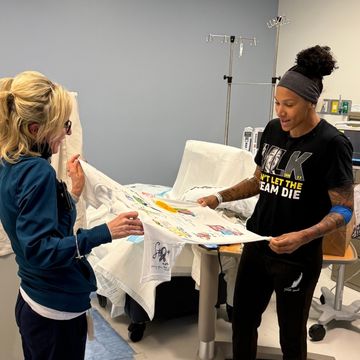
“She was the biggest blessing,” said Simmons.
Trejo felt the same way.
“I love Janina,” she said. “She’s an inspiration. She’s an overcomer. She’s going through this huge life challenge, and I’m watching her on the phone, comforting her mom in Germany!”
Trejo choked up as she described what happened next.
“She gave me a challenge coin,” said Trejo, holding back tears. Military commanders hand out challenge coins to recognize and reward outstanding troops. Simmons felt Trejo deserved one.
“I was so moved,” she continued. “I didn’t deserve it. I was the one who was supposed to be doing the giving. She showed such grace, and she gave me hope for humanity!”
Simmons completed her Lutathera treatment in April 2025 and it worked. In fact, Brar says Simmons’ response was among the best she’s ever seen. Her latest scans show the tumors diminishing. Six months later her life is back to near normal, though she’ll require monthly hormone injections indefinitely, to keep the cancer at bay. This led the Army to classify her as “non-deployable,” so Simmons is now looking beyond the military for her next chapter. She’s writing a book, doing public speaking, considering civilian life — and of course, more running.
“This cancer diagnosis was not for me,” she says. “It’s so I can help other people going through it. We all have ‘something.” But it doesn’t have to hold us back.
“Never lose hope. That’s so important. Because when you really mean it, miracles can happen.”
If you or a loved one is concerned about possible signs or symptoms of cancer and would like an initial appointment or a second opinion, call us 24/7 at (833) 902-5220.