George Green looks remarkably healthy for someone who received last rites not that long ago.
He’s a calm, smiling, 66-year-old former nurse and businessman, enjoying retirement with his wife Elizabeth at their home in Coto de Caza in southeastern Orange County, California.
He moves slowly, but he considers that a major achievement — it’s a long way from the days when he needed a gurney and an ambulance just to get from place to place, the result of an exceedingly rare and crippling disorder that descended on him suddenly and nearly took his life.
What still upsets the Greens to this day is the long cycle of pain, fear, mistrust, bewilderment, misdiagnosis and lack of imagination they endured before George landed in the right hands.
“George’s case was complexity built upon complexity,” explained Scott Goldsmith, M.D., assistant professor in the Division of Multiple Myeloma, Department of Hematology & Hematopoietic Transplantation. “It required much more than a ‘one-size-fits-all’ approach.”
Nothing like this had ever happened to George, not during his youth in Louisville, Kentucky, nor after arriving in California in 1977.
But in late 2020, he began a downhill slide.
Unusual Symptoms, Followed by a Coma
“George is a hands-on person, working on cars. He has lots of tools,” said Elizabeth, also a retired nurse and the voluble ying to her husband’s taciturn yang. “One day he was suddenly just not interested. He slowed down, lost his appetite, his weight dropped. He kept buying new shoes because his feet hurt. I noticed all of it, but George kept saying, ‘I’m OK.’
“His pain got so bad I couldn’t get him down the stairs,” she recalled. Somehow, she managed to get him to a doctor, who detected problems with George’s blood chemistry. Could it be attributed to his type 2 diabetes? Elizabeth bristled. “I knew it wasn’t that!”
More doctors. More tests. An oncologist suspected blood cancer, but also speculated gout might be to blame. “I became unglued,” said Elizabeth, nearly shouting now. “I knew this was not gout!”
Back home, things kept getting worse. “My leg was getting more painful,” said George. “I couldn’t walk. Couldn’t even sit in a chair in a normal way.” Elizabeth called an ambulance, which ended up speeding the Greens from one hospital to another and being turned away because of the COVID-19 lockdown. Meantime, George was deteriorating rapidly. His blood pressure was dropping, his eyes rolling back into his head.
When they finally reached an emergency room that would accept him, George was in a coma. The ER team struggled to raise and maintain his blood pressure. He spent several days in intensive care. It was here that George, a Seventh Day Adventist, was given last rites. The doctors were not at all sure they could save him.
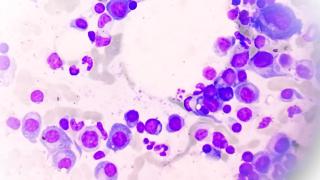
The Greens were told George most likely had multiple myeloma, a blood cancer that develops in plasma cells in the bone marrow. Elizabeth was skeptical. “It wasn’t behaving like regular multiple myeloma. I know because I had dealt with George’s mother,” who died of the disease. When one doctor insisted, Elizabeth exploded. “Hell no!” she screamed. “Y’all are killing my husband!”
Frustrated and losing trust in the medical system, Elizabeth remembered how, working as a nurse decades earlier, she had frequently referred patients to City of Hope. Now she reached out to the City of Hope clinical practice site in nearby Newport Beach.
The Newport team referred George’s case to the full multiple myeloma panel, based in Duarte. This is where Goldsmith learned of George’s case and knew it was not “run-of-the-mill” multiple myeloma. He wanted to meet George. He knew he could treat him.
“I offered to see him,” recalled Goldsmith, “but he was bedridden. Elizabeth had him transported by gurney and ambulance to Duarte. She’s very upset, she’s scared, there’s a lack of trust in institutions. He’s in pain, he’s weak, he has infections and bedsores, he’s dropped 60 pounds.”
In his weakened condition, George could say little during that first meeting. “At this point,” he said, “I’d been to several hospitals, and I just wanted treatment.”
He remembers Elizabeth doing most of the talking. She had plenty to say.
“I knew all about him,” Elizabeth said of Goldsmith — she had looked up his bio ahead of time — “and I said to him, ‘We don’t want any clinical trials and we don’t want any donor transplants.’” Her skepticism and wariness were clearly showing. She went on for quite a while, she admits. George remembers thinking they were going to get thrown out at any moment.
Dr. Goldsmith took it all in.
“I spent a lot of time listening,” he said. “To their story, to all the symptoms, which told me everything I needed to know. I could also see their fear, their concern, their mistrust, how tired they were.
“I made it clear to them that I wanted to help. I told them I know what it’s like to be a patient, how draining it is, to think no one is listening to you. And I promised them, if you trust me, I can treat you.”
Myeloma With POEMS Syndrome
Dr. Goldsmith explained that George’s myeloma was compounded by POEMS syndrome, an extremely rare disorder that creates too many abnormal plasma cells, which can damage multiple organs.
POEMS stands for the symptoms it displays: polyneuropathy: nerve pain in the arms and legs; organomegaly: abnormally large liver, spleen and lymph nodes; edocrinopathy: abnormal hormone levels; m-protein: overproduction can cause blood tumors and skin changes.
George had all the symptoms. “It was all there,” recalled Dr. Goldsmith.
And the doctor had a plan.
“POEMS is known to be very responsive to autologous stem cell transplant,” he said, “but there is often concern about whether patients are healthy enough to go through it.” In an autologous procedure, the patient’s own stem cells are harvested, then reintroduced after high-dose chemotherapy cleans out the diseased bone marrow and with it most of the immune system. The process can be, in Goldsmith’s words, “brutal,” and right now George was in no shape to tolerate it.
He would have to be brought along gradually. Dr. Goldsmith mapped it out.
“I started with daratumumab, an antibody drug that binds to specific proteins on multiple myeloma cells, and low-dose dexamethasone to relieve inflammation for the first four weeks.
“I added bortezomib, an agent that kills cancer cells, in the second month.
“I added cyclophosphamide, a much stronger chemotherapy drug, in the third month.”
Throughout this time, the Greens were making their weekly commute to Duarte by ambulance, with George on a gurney. The logistics — the transportation and the complex drug schedule — were daunting. But Dr. Goldsmith’s care team, led by nurse practitioner Jennifer Bautista and registered nurse Karen Betito, coordinated everything. The Greens also received help from the supportive care team, which provided needed pain management.
After five months, George was finally well enough to go through the harvesting process. He then received high-dose melphalan: the final, crucial step prior to transplant. “Actually,” explained Dr. Goldsmith, “the main purpose of doing an autologous transplant is to get to that high-dose chemo.” The chemo cleans out the system, so the returned stem cells can restore normal blood cell production.
George had his stem cell transplant on Jan. 11, 2023. His post-transplant period was rough at first — he couldn’t keep any food down. After a few weeks, however, he improved, and though he agrees with Dr. Goldsmith’s “brutal” description, he also says, “If I had to do it again, I would.”
Goldsmith never used the word “remission,” but by April he was able to tell the Greens that “things look good.” There is always a small chance of recurrence, and George will be carefully monitored going forward.
For now, though, it’s all good news. In July, George began physical therapy — a painful process after being bedridden for a year — and he has regained his ability to walk.
“I’m grateful for every day,” he said. He occasionally glances at a photo, preserved on his phone, of his former, seriously ill self. “I keep it as a reminder,” he said.
Much of their earlier mistrust has been replaced by profound gratitude, which the Greens plan to express in a tangible way. Elizabeth is collecting funds from family, friends and business associates to make a sizable contribution to help further research and treatment.
“I owe so many people who helped us,” she said. “I got my husband back. Now, I want to help somebody who is where we were and doesn’t have resources. More research needs to be done.”
They offer this advice to others in their situation:
“If you can get here, get here,” said George. “There’s nothing like the feeling that everyone did everything they could to help you.
“I’ve never been in a place like City of Hope.”