
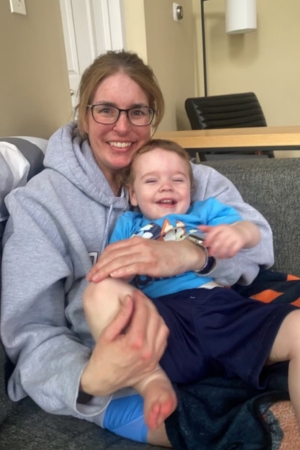
He’s also something of a miracle. That’s because several months before Colin was born, mom Alyssa Kelly’s ultrasound looked suspicious, and it was far from certain if either she or her baby would survive.
Sweethearts for several years, Chris and Alyssa Kelly married in 2018, settled into their Chicago home and looked forward to starting a family. It was an exciting time when Alyssa became pregnant in early 2021. Initially, she dismissed the abdominal discomfort she’d been having.
“We went to our first ultrasound as new parents with excitement and anxiousness,” Chris recalled. “The ultrasound tech brought up baby Colin and then right away said, ‘What is this black spot?’ They made the presumption that it was a giant ovarian cyst and a bowel problem.”
Alyssa had assumed her stomach discomfort came from morning sickness. But now she realized, something else was going on. “I was getting sicker and sicker, and even though I was eating for two, I was losing weight,” she said.
They went for a second ultrasound and this time the technician showed even greater concern, prompting the Kellys to pursue additional imaging with magnetic resonance imaging (MRI).
They received the news by phone: Alyssa had Stage 4 colon cancer. The tumor was the size of a softball and also pressing on her uterus.
“I was in complete shock,” said Alyssa. “Here I was, 38 years old, this young mom-to-be, and this happens.”
The news kept getting worse, as did Alyssa’s steadily increasing physical pain. Doctors attempted a colonoscopy for a better view, but the tumor blocked the scope. They also discovered Alyssa had multiple tumors in her liver and some spots on her lungs.
“Now I was freaking out,” Alyssa said. “All these scary things [were happening] and I kept wondering, what’s next?”
Chemotherapy During Pregnancy
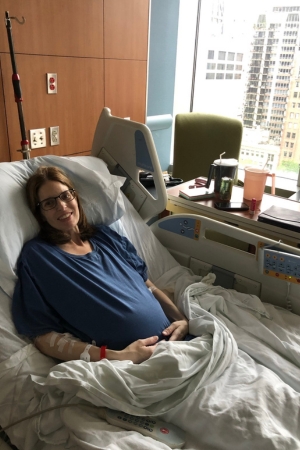
Chemotherapy was next, another scary prospect for Alyssa who was now in her third trimester. In earlier generations doctors might have counseled their pregnant cancer patients to consider an abortion, but today’s chemo drugs pose less risk, though they should not be given until after the first trimester. She began treatment to save her life and the baby’s life.
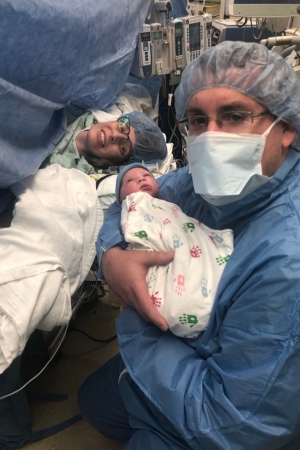
Colin Hugh Kelly was born August 24, 2021. Alyssa’s chemo was briefly halted before she gave birth and resumed four weeks after her delivery. The Kellys were hoping the chemotherapy had shrunk Alyssa’s tumors enough to make surgery possible.
But the chemotherapy hadn’t done its job. On November 1, doctors declared the cancer still too large and “inoperable.” No other hospital would attempt surgery either.
It was heartbreaking news, but the Kellys refused to give up. Through Colontown, Chris learned about City of Hope and surgical oncologist Yuman Fong, M.D. Chris says City of Hope struck him as the most “aggressive” option; a charge Fong does not dispute.
“I am pretty aggressive,” declared Dr. Fong, the Sangiacomo Family Chair in Surgical Oncology and chair and professor in the Department of Surgery. “But that’s what we train all our lives for, to do advanced surgery safely.”
Chris emailed Dr. Fong some of Alyssa’s images, including those taken before Colin’s birth.
“I still remember that first scan,” recalled Dr. Fong. “This huge rectal tumor, tumors on both sides of the liver, and you could see the baby right there.
It’s one of the most frightening things I’d ever seen.”
They all met face-to-face in November, but Dr. Fong said the tumors were still too large for surgery. Despite that disappointment, the Kellys believed they had finally found the right person to take care of them.
“Dr. Fong is the most caring and empathetic doctor I’ve ever met,” said Chris.
“I felt really comfortable and confident with him,” added Alyssa.
FOLFIRI Led to Tumor Shrinkage
They hoped for better news after a course of second-line chemotherapy (in all, Alyssa would endure some 50 rounds of chemotherapy) and that’s exactly what happened. A combination of drugs known as FOLFIRI plus panitumumab dramatically shrank Alyssa’s tumors.
“Just when we felt so hopeless, the scans showed a remarkable response to treatment,” remembered Chris. “I can’t even describe in words what it felt like to read those results.”
Even Dr. Fong was surprised when he saw the new scans. “There was real excitement in his voice,” said Chris.
Surgery was set for May 20, 2022. Three surgeons would work together: Dr. Fong would handle the liver tumors; colorectal surgeon Andreas M. Kaiser, M.D. would excise the rectal cancer and create a temporary ileostomy opening for getting rid of waste; gynecologic oncologist Ernest Han, M.D., Ph.D. would perform a partial hysterectomy (the lung nodules would be dealt with later, through radiation). A complex procedure to be sure, but Fong says it’s not all that unusual.
“Four percent of colon cancers go to the ovaries,” he explained. “Twenty-five percent go to the liver. Drs. Han, Kaiser and I have done this many times. We have it down.”
And they had it done... in 10 hours. Everything went smoothly, Fong said.
All told, the Kellys spent a month at City of Hope and in Southern California. Back home in Chicago, there were follow-up procedures, including the insertion of a Hepatic Artery Infusion pump to deliver chemo directly to the liver, and surgery to reverse Alyssa’s ileostomy. While these steps were taken outside City of Hope, Dr. Fong has remained in touch, regularly examining Alyssa’s latest scans and reports.
“I get kind of attached to my patients,” he said, smiling. “And it’s no big deal to look at a scan or read a report to make sure everything’s done right.”
Celebrating Survival – Years of Survival
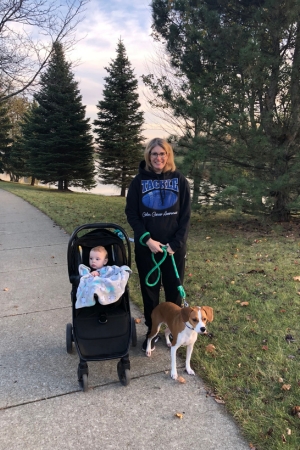
Not long ago, having simultaneous rectal cancer and extensive liver metastases meant having only months to live. Having such disseminated cancer during pregnancy may have meant death for both the patient and the child. For Alyssa, it’s been over four years since diagnosis. Colin has also just celebrated his fourth birthday.
After having been off chemotherapy for over a year, Alyssa has several lung tumors now. She has restarted chemotherapy and is looking into clinical trials.
The Kellys, speaking now from experience, urge folks to “get checked” if they have any unusual stomach or bowel symptoms, noting that the recommended age for colonoscopies is now 45. And they can’t stress enough how important it is to always seek a second or third opinion when faced with a dire cancer diagnosis.
“My body has been through so much,” said Alyssa. She says friends admire her strength. “Frankly, I’ve never seen myself so strong. My Dad calls me The Beast!”
“But I have to be strong,” she continued, with a big smile. “I have to be here for my husband, my son and my friends.”
If you or a loved one is concerned about possible signs or symptoms of cancer and would like an initial appointment or a second opinion, call us 24/7 at (833) 902-5220.