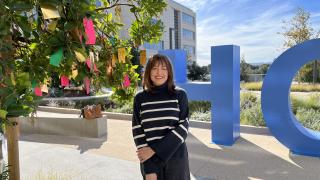
When Michelle Vacca was diagnosed with lung cancer at age 49, her thoracic surgeon had a very specific wish for her.
“He said, ‘My hope for you is that you stay stable for the next five to 10 years, because there are so many treatments coming down the pipeline right now for your kind of lung cancer and I just want you to stay healthy long enough so that you can benefit from them,’” Vacca recalled.
More than eight years later, her disease remains in check thanks to several new treatment advances, including an investigative medication she’s currently taking through a clinical trial at City of Hope.
A Shocking NSCLC Diagnosis

Vacca’s cancer journey began in March 2017 with a trip to the emergency room for an unrelated issue, during which chest scans revealed a spot on her lung. Despite not being a smoker or having any symptoms, she was diagnosed with a type of slow-growing non-small cell lung cancer (NSCLC). In Orange County, California, where Vacca lives, lung cancer is the second most diagnosed cancer in adults, even though only 7% of the population smokes.
“I was really lucky to have found the cancer completely by accident,” said Vacca, who is married and a mom to two adult children. “They caught it early, which also means that it's more treatable, more survivable.”
Her first line of treatment was surgery, which kept her cancer at bay for three years. When the NSCLC returned, genomic testing showed that Vacca had developed a mutation in the epidermal growth factor receptor (EGFR) gene that helps cancer cells multiply. She was prescribed Tagrisso, a once-daily pill that blocks EGFR and slows progression in NSCLC patients.
“I was on that for about a year and a half, and then my cancer mutated again,” Vacca said. “I went on another type of medication, and it was exactly one year before my body just decided the side effects were just too hard to handle.”
At that point, Vacca requested a referral to City of Hope after hearing about innovative clinical trials happening at the cancer center through social media support groups. “My previous oncologist was out of good options for me,” she said. “I’m so lucky that with the help of my stepsister, Brooke, who works for a local nonprofit called Kure It Cancer Research, I quickly got an appointment with Dr. Danny Nguyen.”
While the clinical trial Vacca had in mind wasn’t right for her situation, Dr. Nguyen, who practices at City of Hope Orange County Lennar Foundation Cancer Center, was prepared at her first appointment with an alternative study for which she qualified.
“He must have known that I was going to say yes — he had all the paperwork and a pen in his hand ready to go,” Vacca remembered. “It was an amazing experience, because he sat me down and started from scratch, like, ‘I don't know what you know about your cancer or the mechanisms about what's going on inside your body, but why don't we just start at the beginning, and I'll bring you up to speed.’ My other doctors had never done that.”
Kinase Inhibitor for Lung Cancer Shows Promise
Within weeks of meeting Dr. Nguyen, Vacca started the clinical trial at City of Hope. Investigators for the study had just resumed recruiting participants after COVID-19 shutdowns — a theme that had become common in Vacca’s treatment experiences.
“New treatment opportunities have opened up for me exactly when I’ve needed them,” said Vacca. “Every single medication that I've been on is a new thing that just came down the pipeline like my surgeon predicted they would.”
Vacca is now approaching her third year of the study, which is evaluating a kinase inhibitor medication specifically for NSCLC patients who have the same rare mutation as she does. Her first scans showed a reduction in cancer cells, and she has remained stable since.
“Treatments like these are allowing patients like Michelle to live longer with a good quality of life and allowing them to continue to experience important life milestones,” said Dr. Nguyen.
So far, the only side effect has been a skin rash, which is typical in people taking these types of medications. But with intel from other patients and some trial and error, she’s been able to control flare-ups.
“Michelle has been a great patient,” Dr. Nguyen said. “I think a large part of her success is her motivation to be an active participant in her care and her very positive and optimistic attitude.”
Vacca said she especially appreciates the information shared throughout the clinical trial. “If something works for somebody else, Dr. Nguyen will share it with other patients and vice versa,” she said, noting the quality of care she receives at City of Hope Orange County and the personalized service is like nothing she has ever experienced.
“Everybody there is so kind and you can tell they all love their jobs. From the receptionist to the phlebotomists to the lab techs, all of them are wonderful,” Vacca said.
Advocating for Other Cancer Patients
Although Vacca is happy to share her story now, she was reticent to share her cancer diagnosis for many years. In fact, it wasn’t until recently that she began to open up.
“I think people need to see that you’re doing great. It gives other people hope when they see that cancer is not stopping you,” Vacca said. “When you think about clinical trials, most people think of them as a last option, but that’s not always the case. I am stable, and I'm grateful for that, and I want other people to see that you can live with cancer.”
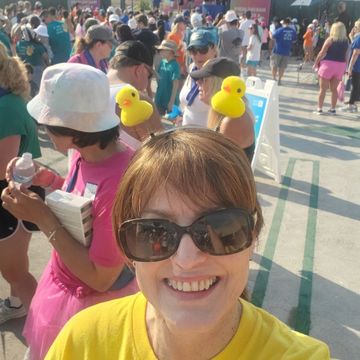
She also advocates for every new patient to get a second or even third opinion — and one of them has to be City of Hope, Vacca insisted. “No one's going to fight for you as hard as you're going to fight for you, and you've got to find a team of doctors and nurses that share the same mindset,” Vacca emphasized. “The good thing about City of Hope is they have the clinical trials, they're cutting-edge, they know what's out there and what's coming, too. And new developments in treatment are happening so fast.”
When she’s not busy spreading awareness by participating in City of Hope’s annual Walk for Hope events or guest starring on the organization’s podcast, Talking Hope, Vacca also gives back to her community as a volunteer for Heritage Hill Historical Park in Lake Forest, California.
In her free time, she attends as many K-pop concerts as she can with a group of friends she met through her musical interests. And now that her clinical trial appointments are spread out to every six weeks, she’s hoping to travel more.
“I’d love to squeeze in a nice, long visit to Scotland between clinic visits,” Vacca said. “I still actively have cancer, but the treatments I’m on keep me healthy and I just feel so lucky and grateful for that.”
If you or a loved one is concerned about possible signs or symptoms of cancer and would like an initial appointment or a second opinion, call us 24/7 at (833) 902-5220.