Prostate cancer survivor Rick Lawley

From ‘Unresectable’ to ‘Undetectable’

When doctors told Rick Lawley his aggressive prostate cancer couldn’t be treated surgically, he turned to City of Hope, where he received a surprising second opinion
Rick Lawley Cycling
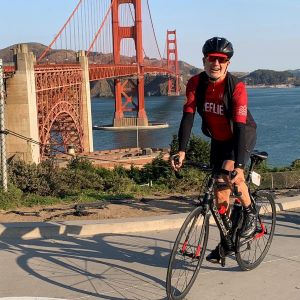
Rick Lawley

At 63, Rick Lawley is in remarkable physical shape, which he regularly puts to good use. In honor of five family members who battled cancer, he rides with the Fireflies, a cycling group that stages an annual 600-mile, weeklong trek across California to raise money for City of Hope. The tour has netted nearly $4 million since 2007.

Born and raised in the U.K., Lawley displayed that “get out there” mentality at an early age. In his teens, he began working as a film and video editor, ultimately creating his own company, which he then brought to Southern California. He became well known in his new home for his work in television and movies, and for corporate clients like Apple, Amazon and General Electric.

In 2021, while he and his wife were  back in the U.K. to care for their elderly parents, Lawley began having some urinary difficulties. His doctors diagnosed benign prostate enlargement. They gave him some medications and sent him on his way.

Toward the end of 2023, his symptoms worsened, and further testing provided disturbing news. Lawley’s prostate-specific antigen (PSA) number was 19 (it’s less than 1 in healthy men; anything above 2.5 is cause for concern). A biopsy determined he had Stage 3 locally advanced prostate cancer. Lawley’s Gleason score — a measure of the aggressiveness of tumor cells — was 9, putting him in the high-risk category (low-grade cancer cells register around 6).

Facing Stage 3 Prostate Cancer

Tanya Dorff, M.D.
Tanya Dorff, M.D.

The bad news kept coming. After an MRI (magnetic resonance imaging) scan, doctors declared Lawley’s cancer “inoperable.”

“I was not prepared for this,” recalled Lawley. “But my wife, who is extra strong, didn’t panic. She just said, ‘Let’s get to work!’”

They went for a second opinion from a physician who promptly earned the nickname “Dr. Gloom and Doom” for his pessimism and dour demeanor. Finally, they just looked at each other and said, “Let’s go to City of Hope.” A friend who’d been treated there had recommended his oncologist, Tanya Dorff, M.D., section chief of the Genitourinary Disease Program and professor in the Department of Medical Oncology & Therapeutics Research. They made the call.

“And we jumped on a plane,” he said.

Thanks to his cycling/fundraising, Lawley knew all about City of Hope. He’d been on the Duarte campus many times as a supporter and advocate. But showing up in April 2024 as a patient felt surreal. And emotional.

“When we drove up,” he recalled, “and I saw that City of Hope logo — the very logo I’d been riding with for 10 years — I just burst into tears. I mean, City of Hope sits at the base of the mountains I used to cycle around. I would often joke that if I ever got cancer, I’d just put on my City of Hope jersey and roll right in!”

Having received little hope from his doctors to date, arriving at City of Hope gave Lawley “an immediate sense of comfort.” Especially when he met Dr. Dorff for the first time.

“He was super anxious,” said Dr. Dorff, recalling their first meeting. “He was stressed and really focused on getting a plan together.”

Lawley appreciated Dr. Dorff’s no-nonsense style.

“She’d be a great poker player,” he said. “She doesn’t give anything away. She’s all about the science and the facts. She’s extraordinarily focused on her work, pragmatic and very professional.

“That’s exactly what I needed.”

Dr. Dorff started Lawley on hormone therapy and sent him to speak with a radiation oncologist and a surgeon. Lawley thought the surgical consult was just pro forma. The words “inoperable” and “unresectable” still echoed in his head.

Then came the surprise. Or, as he puts it, a “deep shock.”

The Option of Prostate Cancer Surgery

Wesley-Yip's-315x415
Wesley Yip, M.D.

Yes, he was told, radiation over a multiweek period could be successful. Nevertheless, in spite of everything he’d been told in the U.K., there was no reason to rule out surgery. Not only that, but going the surgical route would take less time and get him back to his old life faster.

“We’re a little more aggressive here,” said Wesley Yip, M.D., assistant professor in the Division of Urology and Urologic Oncology, Department of Surgery. “And we don’t withhold options from patients.” He explained that while others may look at a high-risk case and automatically see no benefit to surgery, “we personalize our care based on the patient in front of us. He [Lawley] wasn’t a frail 80-year-old. He was a young, fit guy and a great candidate for surgery, even with his high-risk status.”

Lawley recalls that Dr. Yip didn’t press for the surgery. He simply laid out the options, giving Lawley the information he needed to make an informed decision. “He [Dr. Yip] has such a confidence about him. He wasn’t selling the surgery. He is exactly what I’d want in any surgeon. He was someone I could trust.”

Largely on his “gut feeling” about Dr. Yip, Lawley chose surgery over radiation. “You’ve got to go with your instincts,” he said.

The four-hour, robot-assisted procedure took place in June 2024. The pathology report revealed aggressive disease, though Dr. Yip is confident he removed all the cancer, including many lymph nodes. “It went quite well,” he said. “He went from ‘unresectable’ to ‘undetectable.’”

A day later, Lawley was home, albeit moving slowly and wearing a catheter. Little by little he began to feel like himself again, and after about six weeks (“exactly when Dr. Yip said it would happen”), he knew he’d turned the corner.

“Some days I’m tired, so I take a nap,” he explained. “And then there are days like yesterday, when I biked 30 miles.”

The best news was yet to come. An excited Dr. Yip informed Lawley that his PSA — once as high as 19 — was now effectively near zero.

“I just fell to my knees,” Lawley said. “I was stunned. And extraordinarily grateful.”

No one will call him “cured” just yet. Lawley will remain on hormone therapy for two years. But he’s already making plans for a long vacation, which involves loading up a mobile home and biking through the Scottish Highlands.

“City of Hope lived up to my expectations,” he added. “There’s no other place I’d consider getting treatment.”

Subscribe to our
CancerCenter Newsletter

Thank you

Keep an eye on your inbox for the latest City of Hope news and research breakthroughs. If you have previously subscribed to receive email communications, your preferences have been updated.