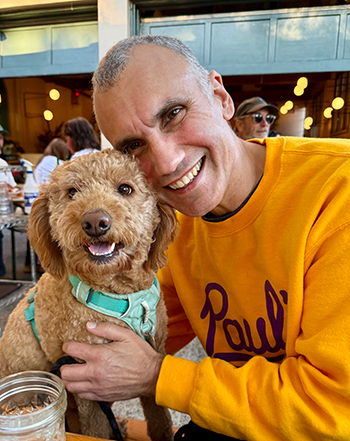
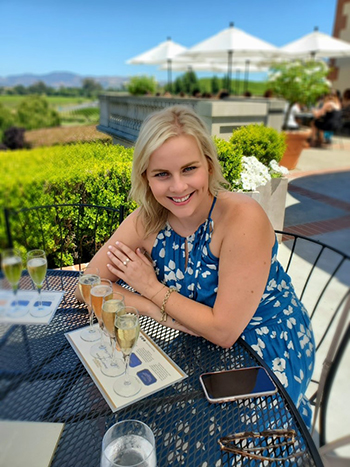
Montone, now 55, is trim, muscular and back to the life he once feared he would lose. Baranowski, 42, is a registered nurse from Tracy, California, who lifts weights before work, does CrossFit, recently took up skiing and returned from a trip to Europe with her mother.
Their cancers were different, but their stories followed a similar and frightening path: rare sarcomas, rapidly worsening disease, discouraging opinions from other hospitals and, eventually, a connection with William Tseng, M.D., a City of Hope sarcoma surgeon willing to take on complex cases others had deemed too risky.
Montone, who lives in Portland, Oregon, was fit, healthy and active in April 2019, running 30 miles a week, when he felt a twisting, tearing sensation in his midsection while moving furniture. He assumed he had pulled a muscle. Instead, the pain worsened until he could barely get out of bed. At the hospital, doctors told him his white blood cell count was “off the charts” and admitted him to the oncology ward.
He was diagnosed with retroperitoneal liposarcoma, a football-sized cancerous tumor formed from fat tissue and buried deep inside his abdomen. The disease is exceedingly rare, and few hospitals have the expertise to treat it. Montone searched for sarcoma specialists and began treatment at a nearby university medical center.
But chemotherapy and radiation caused severe inflammation. When surgeons attempted to remove the tumor, Montone said it “disintegrated and went throughout my entire abdomen.” He underwent multiple surgeries, spent a week in a medically induced coma and developed sepsis. After a brief period of improvement, the cancer returned aggressively. Doctors eventually referred him to hospice care
“An hour later, the hospice team was there,” he said. “It was pretty surreal. And almost a relief.”
Baranowski’s diagnosis came in November 2021, after a hysterectomy to treat symptoms of fibroids and endometriosis. Doctors discovered she had Stage 1 uterine leiomyosarcoma, a rare cancer that develops in an organ’s smooth muscle and can mimic the symptoms of fibroids. About 1,000 cases are diagnosed each year.
When Baranowski returned three months later for another procedure, surgeons found metastatic implants throughout her pelvis. She was now Stage 4.
“I saw stars, like when you’re about to faint,” she remembered. “I felt panic, my heart raced, and later came fear and depression.”
Chemotherapy failed to stop the cancer. A small tumor on her colon grew rapidly, eventually overtaking her bladder and colon. She traveled to Houston for a second opinion at a major cancer center, where doctors tried radiation in hopes of shrinking the tumor enough for surgery. Instead, when she returned for a preoperative scan, the surgeon told her she would not operate.
“I didn’t get out of bed for two days after that,” Baranowski said. “I cried. I was just catatonic. I thought it was the beginning of the end for me.”
For both patients, family and friends helped keep hope alive.
Montone’s brother, Ian, refused to give up. From Montone’s hospice bed, he helped arrange a telehealth visit with William Tseng, M.D., who at the time led a retroperitoneal sarcoma program at a Los Angeles academic medical center. Tseng joined City of Hope in 2022.
“You don’t look like hospice to me!” Tseng told Montone.
Everything changed. Montone said Tseng calmed him and made him reconsider what others had told him.
“I don’t feel like I’m supposed to die,” Montone said.
Baranowski, meanwhile, had been sharing her experience on Instagram. An old friend urged her to contact City of Hope, but Baranowski was so exhausted and discouraged she could not bring herself to make the call. Her friend did it for her. Within days, City of Hope reached out, and her case went before the Tumor Board, where William Tseng, M.D. insisted he could do the surgery.
“I saw nothing on her scans that said I couldn’t,” said Tseng, an internationally recognized sarcoma expert and associate clinical professor in the Division of Surgical Oncology within the Department of Surgery at City of Hope. “There was no technical reason and no cancer-related reason not to do it.”
Tseng’s approach was direct with both patients. He laid out the risks plainly, explaining that surgery could succeed, fail or, given the complexity of the case, dying on the table is also a real possibility. For Montone, those odds were clarifying. For Baranowski, Tseng’s willingness to try restored the hope she thought she had lost.
“I’d been on this huge rollercoaster,” Baranowski said. “I’d reached the lowest of the lows, and now I had hope again. I trusted him immediately.”
Montone’s surgery was scheduled for March 2020, just as the COVID-19 pandemic lockdown began. Family members could no longer accompany patients into the hospital. The procedure took 13 hours. When Montone woke up, he heard someone tell him the surgery had been a success.
“I just started crying, like, oh my God,” Montone said. “It was fantastic. I could not believe it. Such a relief. I’m on the other side!”
On April 12, 2023, Tseng led a team of five surgeons through a complex, 13-hour operation for Baranowski that cleared out her cancer and restored a semblance of normal life. Six months later, doctors spotted a new growth on her lung, which was removed during a shorter surgery. No new cancers have appeared since.
Montone remained cancer-free until 2025, when the sarcoma returned. By then, Tseng had joined City of Hope as associate clinical professor in the Division of Surgical Oncology within the Department of Surgery, and Montone followed him.
“That was a no-brainer,” Montone said. “He’s one of the best.”
Once again, Montone’s surgery was successful. Eighteen months later, he remains cancer-free and matter-of-fact about the future. If the cancer recurs, he is confident he and Tseng will be able to handle it.
Baranowski now gets scans every six months, an emotional experience because she knows sarcoma can recur. She still worries, but she is learning how to live with that uncertainty.
“I was petrified of living my life because I thought the cancer was going to come back,” she said. “I’m finally getting to the point where I’m handling scan day a little bit better. But I still worry.”
For Baranowski, the message is clear: Get a second opinion. Find the right specialist.
“If your doctor has any problem with you getting a second opinion,” she said, “that is not a doctor you have any business seeing anyway.”
“And when it’s sarcoma, those opinions must, non-negotiable, must come from a high-volume sarcoma center,” she said. “They must come from a hospital that is regularly treating sarcoma patients.”
Montone is also learning what it means to live after a diagnosis that nearly took everything. In a cancer support group exercise, he wrote about the gift of survival and how the experience changed him.
“I almost lost it all,” he wrote. “I am still me and no longer the same. Wherever this journey takes me next, I want to live in it as a pilgrim and not a tourist.”
Baranowski sums up her experience more simply.
“I credit Dr. Tseng with saving my life.”