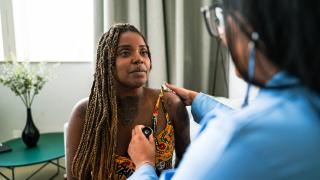
An unfortunate, yet undeniable, fact: Black people experience a higher cancer burden and face more challenges in prevention, detection, treatment and survival. In the United States, they have the highest death rate and shortest survival of any racial/ethnic group for most cancers.
When taking a closer look regionally, the Midwest is no exception, where mortality rates are higher among Black cancer patients compared to white patients in Illinois, Indiana, Iowa, Michigan, Minnesota, Ohio, Wisconsin and other states.
“There’s a pattern of poor outcomes often tied to less access to high-quality care, fewer treatment options, advanced-stage diagnoses and higher rates of comorbidities,” says Ajaz M. Khan, M.D., M.B.A., C.P.E, Chief of Medical Oncology and President of the Medical Staff at City of Hope® Cancer Center Chicago.
In this article, we’ll explore:
- Cancer death among Black Midwesterners
- What’s behind the higher mortality rate?
- Cancer screening, diagnosis and treatment in Chicago
If you or a loved one has been diagnosed with cancer and is looking for an initial appointment or a second opinion, call us 24/7 at (877) 524-4673.
Cancer Deaths Among Black Midwesterners
In May, the American Cancer Society (ACS) released Cancer Treatment and Survivorship Statistics, 2025, a report that estimates the number of people living with cancer will surpass 22 million by 2035.
The same report found that improved outcomes are not equally distributed, and that in cities like Chicago, cancer survival can depend on a person’s ZIP code. The disparities are most stark in Black populations — across the country and within the Midwest.
Research proves that geography matters. For example:
- A county-level investigation revealed cancer hot spots in the Midwest, where cancer death rates decreased by lower amounts than the national average. Black men and women had higher mortality rates than their white counterparts in these areas.
- A study on colorectal cancer in the Journal of Racial and Ethnic Health Disparities noted that Black patients in the Midwest have the lowest five-year overall survival, with a median overall survival of 67 months, compared to 74 months for white patients; this disparity is most pronounced in the Midwest.
- A 2022 analysis of 822 patients in the Chicago area found that, for acute myeloid leukemia (AML), “living in predominantly Black neighborhoods increases the likelihood of late-stage diagnosis and increased mortality from solid tumors.” Black people had a 59% greater chance of dying from AML compared to non-Hispanic whites.
- Published in the Journal of Clinical Oncology, a five-year analysis of stomach cancer trends in the Midwest found that mortality rates were highest among Black individuals.
The Great Lakes at a Glance
While Black Americans overall face disproportionate cancer rates, in the Midwest, the statistics surrounding cancer mortality among Black people are even more glaring.
In the Great Lakes region specifically — Illinois, Indiana, Michigan, Ohio and Wisconsin — the national mortality rate, based on data from 2018 to 2022, is 146 per 100,000 cases, according to the ACS. In these Midwestern states, not only are Black mortality rates higher than the national average, but they are also the highest cancer mortality rates of any race or ethnicity across most cancer types.
Here’s the breakdown, per 100,000 cases:
- Illinois: 185
- Indiana: 177.7
- Michigan: 177.1
- Ohio: 176.8
- Wisconsin: 215
Illinois Snapshot
Data from the Illinois Department of Public Health paints a similar picture — Black cancer patients have a higher cancer burden.
In Illinois:
- Breast cancer mortality rates are highest in Black women.
- Colorectal cancer incidence and mortality rates are highest in Black populations.
- Lung cancer incidence and mortality rates are highest in Black individuals.
- Prostate cancer incidence and mortality rates are highest in Black men.
- Cervical cancer incidence and mortality rates are highest in Black and Hispanic women.
“These disparities hit close to home,” Dr. Khan says. “Take lung cancer. The five-year survival rate is 26.8% among Black people here in Illinois, significantly lower than 29% among whites. We have work to do when it comes to catching the disease earlier, when we have more treatment options.”
What’s Behind the Higher Mortality Rate?
Nationally and regionally in the Midwest, the gap in cancer rates — higher incidence, higher mortality and poorer survival — among the Black community is complex. At the core of these racial disparities is ongoing discrimination, characterized by unfair systems in health care, housing, education, employment, earnings, insurance and more.
Contributing Factors
- Inadequate access to quality cancer care, such as barriers to screening, diagnosis, treatment and clinical trials
- Lower socioeconomic status, which for most cancers, means increased risk of mortality
- Genetic and biological differences, including higher prevalence of more aggressive types of cancer
- Lifestyle and environment — for example, higher rates of smoking and obesity
- Prevalence of other health conditions (comorbidities) like diabetes, which raises the risk of cancer incidence and mortality
- Mistrust in the United States health care system based on a history of racial bias and discrimination
Cancer Screening, Diagnosis and Treatment in Chicago
Prostate, breast, lung and colorectal cancers make up 58% of all new cancers diagnosed among Black people — and all have a screening option.
Dr. Khan encourages patients to be proactive and talk to their doctor about a personalized screening plan, based on age, family history, lifestyle choices and other factors.
“I can’t overstate the importance of catching cancer early,” Dr. Khan says. “It means more options and better outcomes. Screening can save lives.”
Screening recommendations for the Black community include:
- Cervical cancer screening with Pap smear every three years and annual pelvic exams beginning at age 21 for women
- Yearly skin checks by a dermatologist beginning at age 21
- Regular colorectal cancer screenings starting at age 45 (using colonoscopy, Cologuard test, FIT test or Gualac-based fecal occult blood tests, depending on which option and frequency the doctor advises)
- Breast cancer screenings for women with an annual mammogram beginning at age 40, possibly earlier, given increased risk of breast cancer at a younger age
- Prostate cancer screenings beginning at age 40 with a PSA test and/or digital rectal exam
- Lung cancer screening yearly with a low-dose CT scan for those 50 or older, who smoke or quit in the past 15 years, or have a 20-pack year smoking history (number of packs smoked per day multiplied by the number of years smoked)
With locations in Lake County, downtown Chicago and the North Shore, City of Hope Chicago offers screening technologies for breast, colorectal, lung and prostate cancers.
If you or a loved one has been diagnosed with cancer and is looking for an initial appointment or a second opinion, call us 24/7 at (877) 524-4673.