Michelle Kang Article Header

After Cancer at 27, a New Start: Michelle’s Story

Michelle Kang was 27 and thriving when an unexpected breast cancer diagnosis changed everything — forcing her to fight for her life, redefine her future and ultimately discover a renewed purpose at City of Hope.
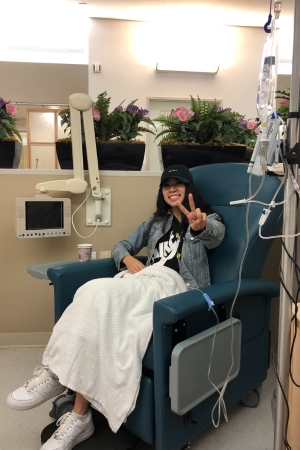
Michelle Kang's Second Round of Chemo
Michelle Kang's second round of chemotherapy.
“I knew in my gut something was wrong.”

Michelle Kang’s “gut” knows more about cancer than many people twice her age.

Kang showed an interest in cancer care and treatment — especially the complex business side — right out of college, where she studied health administration. Her first job put her on the fast track: shadowing C-suite executives at a major New York City medical institution that wanted to create a new cancer center. Before you could say “super achiever,” Kang was running the center she helped build. She was 25.

Living and thriving on New York’s Upper West Side, Kang and her fiancé, Paul Chung, were looking forward to a happy future, including a trip to South Korea (the “Motherland,” as she calls it), the birthplace of their parents.

Then came the unexpected.

While in Korea, Kang, now 27, felt a lump in her right breast.

Her doctors seemed unconcerned. “They brushed me off,” she said. “But because of my job and the patients I’ve met, I saw that my story aligned with theirs. I knew I’d have to advocate for myself.”

Even before returning to the U.S. Kang got busy, setting up appointments in New York, where she knew the atmosphere would be different. “They took me seriously,” she said.

She went through a battery of tests. The radiologist’s demeanor told her everything.

“I saw a shift (in his face). He said, ‘Oh, this is wrong.’”

A Stage 1B Hormone-Positive Breast Cancer Diagnosis

Michelle Kang's First Hormone Therapy Injection
Michelle's first injection of hormone therapy.

Kang had Stage 1B hormone-positive breast cancer. Hearing the words nearly paralyzed her.

“I went cold,” she remembers. “I could see the doctor but barely hear her. Just a few words. Chemotherapy. Double mastectomy. And you better freeze your eggs! I was in shock.”

It made no sense, she thought. She was so young, always healthy, no cancer in the family, no suspicious genetic mutations. “I asked every oncologist why,” she said. “One answered, ‘If I knew, I’d be living in a mansion.’”

“Cancer isn’t anybody’s fault,” said City of Hope® surgical oncologist Katharine Schulz-Costello, D.O., “and there’s no one thing that causes it.” Scientists are investigating environmental factors, but the evidence isn’t definitive. The increase in cancer among young people is still not fully understood, and most cases occur without any known genetic risk factors.

Tears streaming down her face, Kang next went for magnetic resonance imaging (MRI). All alone in that cold, dark room, “I thought my life was over,” she said. “I promised myself that if I came out of this alive, I would chase all my dreams, do all the things I promised myself.

“And I will be fearless!”

But she worried about Paul. She gets emotional thinking about it. It takes a while to say the words. There is pain in her eyes.

“I told him … if you want to leave me … you can ... and I won’t be resentful.”

He stayed.

“I’m so lucky,” gushed Kang. “He went wig shopping with me. He even tried on the wigs himself! He fed me, he cooked for me, told me I was beautiful. We’re getting married in September.”

Some Stage 1B patients may need only a lumpectomy and radiation, but analysis of Kang’s tumor showed it to be especially aggressive. Kang and her doctors chose a more extensive course of action.

Bilateral Mastectomy Followed by Chemotherapy

Michelle Kang Article
Michelle Kang.

With Paul at her side, Kang endured months of grueling treatment: a bilateral mastectomy in the summer of 2019, followed by 14 rounds of aggressive chemotherapy — Adriamycin, Cytoxan and Taxol — and months later, breast reconstructive surgery.

Kang also began a 10-year regimen of monthly leuprolide injections and daily tamoxifen pills. This ensures no estrogen will feed new tumors, but it also puts Kang into menopause temporarily; the effect can be reversed by stopping the drugs, something Kang will do when she and Paul decide the time is right to start a family.

In the meantime, Kang was on the cusp of another life-changing decision: a move to Los Angeles to start a new role.

Having remained cancer-free for nearly two years, Kang nevertheless felt uneasy. She was haunted by the thought of a possible recurrence.

“The emotional struggle with cancer is harder than the physical,” she said. “Chemo was easier than this baggage. I had to find a new normal.”

She realized her priorities had changed. She no longer cared about climbing the corporate ladder, or any of the “FOMO” goals of her early 20s. “I wanted to make a bigger impact, at a big system,” she said. “I wanted to make a difference.”

That’s when she read about a Patient Experience position at City of Hope in Los Angeles, California. Her fearlessness kicked in. Even though she and Paul were very happy on the East Coast, Kang applied. She received an offer, and in 2021 the couple moved to Southern California.

“I went from The City That Never Sleeps to the City of Angels to City of Hope!” she said, smiling. “I only want to be here.”

She loved the job – creating tools and policies to help patients get the most out of their City of Hope experience. She has since moved into Philanthropy, Marketing and Communications, where she gets to be part of the storytelling process — helping shape stories of courage and success, even if she’s not the one writing them. “It was the storytelling that got me through (my cancer). The stories gave me hope.”

Now 33, Kang has a brand-new career and care team who’ve built a survivorship program aimed at keeping her cancer-free for many decades to come.

Leading that team is oncologist Christina Yeon, M.D., M.H.M., who connected with Kang immediately.

Christina Yeon, M.D.

“We hit it off right away,” said Yeon, Regional Director for San Gabriel Valley and Associate Clinical Professor, Department of Medical Oncology & Therapeutics Research. “She is pretty exceptional, very well-informed and super-organized. We’re like two peas in a pod. And it’s nice to share a similar (Korean) heritage.”

Yeon monitors Kang’s hormone therapy, administers Zometa® to counteract possible bone loss caused by chemotherapy, and tests her blood with Signatera®, a form of liquid biopsy that can detect minute cancer cells at their earliest stages.

She also keeps watch for residual effects of Kang’s extensive cancer treatments. Many potent cancer therapies can damage organs, impair a young woman’s ability to conceive, or trigger new cancers years later.

“You have to think about long-term toxicity,” said Yeon. “A 30-year-old has many more years ahead than a 60-year-old. The goal is to minimize the long-term side effects for many years down the line.”

Kang also sees Dr. Schulz-Costello, calling her someone who “has this superstar quality. She really understands young patients.” Schulz-Costello returns the compliment.

“Imagine what she went through in her 20s,” said Schulz-Costello. “She’s incredibly resilient. I’m honored and happy to follow her.”

Once a year Kang checks in with the “amazing” plastic surgeon Antoine Lyonel Carré, M.D., M.P.H., whose services she will likely need more than once in the coming years. Implants don’t last forever: hardening scar tissue around them can cause pain; the risk of rupture goes up with each passing year; and as the body ages, the implants can shift. A young patient like Kang may face one or more follow-up reconstruction procedures.

Like his colleagues, Carré was impressed by Kang’s extensive knowledge, but even more impressed by how she reined it in. “She was smart enough to let herself be a patient,” he said. “But she did understand the big picture.”

Six Years Cancer-Free

Michelle Kang's 6th Cancerversary
Michelle Kang celebrating 6 years cancer-free.

As she looks forward to her wedding, Kang, now six years cancer- free (“At 10 years, we pop the champagne!”) is eager to share her story, “so no one feels alone like I did.” She takes part in the annual Walk For Hope®, and she urges every woman her age to carefully examine themselves, to report anything unusual to their doctor and never allow anyone to dismiss their concerns.

Mostly though, she’s just grateful.

“I thought I had lost so much precious time at my peak,” she says. “But this has been a redirection, a sixth sense. It’s about my soul ... I know who I am now, and I’m grateful for the lessons that cancer taught me.”

If you or a loved one is concerned about possible signs or symptoms of cancer and would like an initial appointment or a second opinion, call us 24/7 at (833) 902-5220.

Subscribe to our
CancerCenter Newsletter

Thank you

Keep an eye on your inbox for the latest City of Hope news and research breakthroughs. If you have previously subscribed to receive email communications, your preferences have been updated.