Retired Chicago police officer Lester “Les” Balaszek spent 31 years walking into situations many people would run from. Although Les has always remained calm under pressure, the former officer didn’t face his toughest challenge walking the beat. Instead, it started in July 2025, when a conversation with his family about a doctor’s appointment set a life-altering diagnosis in motion.
“It was a routine appointment, but my daughter and my sister, who are both nurses, asked about my PSA score,” recalled Balaszek.
PSA is short for prostate-specific antigen, a type of protein produced in the prostate gland. A PSA test measures how much of this antigen is present in the blood and reports it as a score between 0 and 10 nanograms per milliliter of blood. Higher PSA results can indicate health issues with the prostate – so when Balaszek’s results came back elevated, his family encouraged him to follow up. After a series of tests and referrals, Balaszek was diagnosed with an aggressive form of prostate cancer.
The doctors who first saw Balaszek recommended surgery as a first-line treatment and, in October 2025, he underwent a procedure designed to remove the tumor. But in the operating room, his surgeons discovered the tumor had fused to another organ, which made it impossible to remove safely. They aborted the procedure, leaving Balaszek no better off than before.
Post-op recovery also posed significant challenges.
“On the day I was being released from the hospital, the nurse said I needed to urinate before I could be released. I tried for 10 hours—unsuccessfully,” Balaszek said. His medical team inserted a Foley catheter, allowing him to urinate through the catheter into an external bag. He has been self-catheterizing ever since.
Taking Pointers from a Fellow Officer
Around the time Balaszek underwent surgery, his former police department partner was fighting his own battle against colon cancer. Given just 18 months to live by one hospital, Balaszek’s former partner had turned to City of Hope® Chicago for a second opinion and found a personalized approach to care that improved his outcomes drastically: Balaszek’s former partner is now four years into survivorship himself.
Balaszek’s former police partner urged Balaszek to make an appointment with City of Hope. Soon, Balaszek was meeting with radiation oncologist Kevin King, M.D.
When Dr. King opened Balaszek’s original scans, he noticed something the prior team had missed: evidence that the cancer had already spread beyond the prostate to a spot on a bone.
“The imaging reports showed that Les had metastatic disease at the time of diagnosis,” Dr. King said. “If they had been able to avoid the surgery, he might have avoided these urinary complications, including having a catheter put in.”
This piece of information changed Balaszek’s treatment trajectory.
Dr. King recommended a longer course of radiation therapy using an innovative radiation tool called the Ethos™ therapy system. The Ethos system combines real-time imaging with AI-driven software to adjust how the radiation machine delivers radiation, making treatment more targeted and reducing damage to the surrounding tissue and organs.
“Things shift in our bodies from day to day, so adaptive radiation gives us the ability to use artificial intelligence to adapt the treatment plan that very day, when the patient is on the table,” explained Dr. King. “This way, you have a more precise plan and you can reduce the side effects that a patient may have with radiation treatment.”
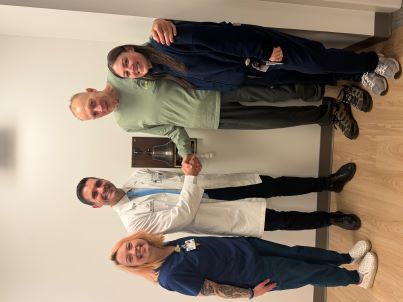
Les began treatment at City of Hope Chicago’s downtown location in February 2026, undergoing 39 sessions in total. During that time, he said, “I called Dr. King my partner on the job.”
Dr. King stressed that this innovative approach to radiation treatment is not available everywhere.
“Adaptive radiation therapy is not offered at many centers, and it’s typically saved for approaches where patients undergo five treatments or less,” he said. “For Les, we were able to give him 39 treatments because of his advanced disease.”
Ringing the Bell
The results of Balaszek’s’ treatment have been encouraging.
“After radiation, his PSA became undetectable,” Dr. King said. On April 7, 2026, surrounded by his family, Balaszek rang the bell to celebrate the end of his initial course of adaptive radiation. While he continues to take the hormone therapy medications Lupron® and Xtandi®, his cancer remains in check as of September 2026. What’s more, his appetite has come back.
“For seven weeks, I walked past a favorite neighborhood restaurant, Egg Harbor, unable to stomach the thought of eating. But that day, my family and I went in and celebrated together,” Balaszek said.
He has also begun to reduce his reliance on self-catheterization after undergoing a procedure to widen the urethra. While it may sound small, Dr. King notes that changes like these can have a big impact on a patient’s quality of life.
“Les is only doing a self-catheterization once a day now, which is a huge change from when he wasn't able to urinate at all, and I’m really happy for him,” said Dr. King.
Walking the Survivorship Beat
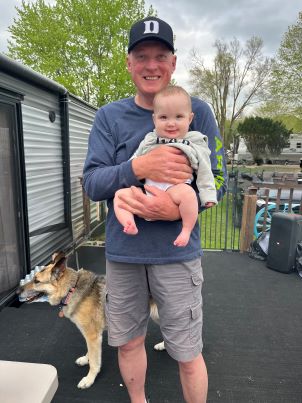
Life is starting to return to a new normal for Balaszek, who has already enjoyed “glamping” trips with his wife and spending time with his three grandchildren. Watching other retired officers face new cancer diagnoses has been sobering, but it has encouraged Balaszek to share his own story whenever he can. His advice is simple.
"Get checked out. Get your tests done. Live each minute to the fullest.”
He also stresses that patients shouldn’t be afraid to seek out a second opinion—and Dr. King agrees.
“City of Hope was really able to change his course of treatment for the better. Even though it was a difficult regimen to get through, Les did it like a rockstar.”
“If you or a loved one is concerned about possible signs or symptoms of cancer and would like an initial consultation or a second opinion, call us 24/7 at (877) 524-4673.”