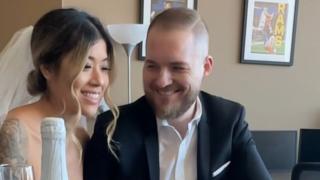
In the fall of 2024, Jeff Henry was busy preparing to marry his fiancée, Kat. He was dieting and his workouts were becoming increasingly difficult, but when fatigue started to hit him, he brushed it off. It wasn’t until Jeff had to stop to catch his breath during a two-block walk that he ended up in the emergency room.
“Everything spiraled from there,” said Jeff, who was only 33 years old when he was diagnosed with Stage 4 diffuse large B-cell lymphoma (DLBCL). “I was getting in shape for the wedding and assuming I was lifting too much or too fast when really, my lungs were filling up with fluid as cancer was growing around my organs.”
Just fourteen months later, Jeff is enjoying a strong recovery after the worst year of his life thanks to an aggressive treatment provided by Tycel Phillips, M.D., a hematologist-oncologist at City of Hope’s National Cancer Center in Duarte, California.
A Shocking DLBCL Diagnosis

When Jeff, now 34, thinks back on the months before his cancer diagnosis, there were a few strange signs that something was off. His feet became swollen after a long day of walking in Spain, but he chalked it up to jetlag. When he started having chronic, post-meal hiccups a few months later, he shrugged those off, too.
“In retrospect, Dr. Phillips said the hiccups were from the lymphoma pressing on my phrenic nerve, and my feet taking on so much fluid was from the cancer that was pressing on a valve in my heart,” said Jeff, who was diagnosed in October 2024. “It was really overwhelming to learn that these were signs of the lymphoma spreading.”
CT scans during his emergency room visit showed a mass suspicious for lymphoma, but the local hospital where Jeff received his initial imagining did not have an oncology department. While they admitted him to drain his lungs and perform a series of tests, including a biopsy, getting results was a slow process. When a family friend offered to help them transfer to City of Hope, Jeff and Kat jumped at the chance, but that process hit some snags, too.
“We wanted to be directly admitted by ambulance, but navigating the insurance system is a nightmare,” remembered Jeff, who was discharged a day before he could be admitted to the cancer center. “I had a panic attack when I left the hospital, but once we got to City of Hope, I felt so much better, like that was the place I needed to be.”
Kat concurred that the level of care was like night and day.
“When we were trying to figure out the best solution for Jeff [at the first hospital], I wouldn't get any answers, and it felt like a big, long waiting game,” Kat said. “At City of Hope, everyone was extremely friendly, very attentive and over explained things in the best way possible.”
Clinical Trial Offers Hope
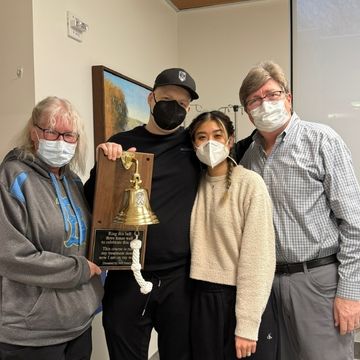
Additional tests at City of Hope® confirmed a diagnosis of DLBCL, an aggressive type of non-Hodgkin lymphoma. Although it’s the most common form of the disease, the median age of diagnosis is roughly 65 years old. His young age made Jeff a good candidate for an investigative treatment in clinical trials that aims to cure the disease.
“It’s never fortunate to have cancer, but at least I was young and Dr. Phillips gave me the confidence that my body could take the stronger treatments,” said Jeff. “I decided not to go down a rabbit hole of Googling everything about the disease; the strategy I felt most comfortable with was keeping my head down and listening to Dr. Phillips.”
In mid-October, he became a participant in a phase 3 trial sponsored by F. Hoffmann-La Roche Ltd. that is studying a bispecific antibody immunotherapy in combination with Pola-R-CHP chemotherapy for previously untreated DLBCL patients. Jeff was enrolled in the control arm group, meaning he only received Pola-R-CHP.
“My outlook was if something good can come from my experience, if I can benefit someone, then we can turn everything I went through into something meaningful,” Jeff said.
Pola-R-CHP is a newer regimen for DLBCL that also uses immunotherapies plus chemotherapy medications and has been shown to improve progression-free survival, especially in patients with advanced disease. Thus far, it’s all Jeff has needed to clear the disease.
“Treatments for patients with Stage 4 disease are now evaluating the role of immune directed therapies and how they might benefit clinical outcomes in combination with standard chemotherapy,” said Dr. Phillips. “Jeff is a great patient who was unfortunately diagnosed with an aggressive cancer. Despite toxicities from treatment, he always maintained a positive mindset.”
Jeff credits his mom, a nurse, and Kat, who is now his wife, for keeping him calm and positive during the six rounds of treatment he faced over four months.
“My wonderful wife basically became a health insurance expert, in addition to becoming a lymphoma expert and a nurse, charting all of my medications, dosages, timing, and side effects in Excel,” said Jeff. “I really couldn't have done it without her. She was amazing.”
A month into the trial, Jeff and Kat wed over Zoom instead of their planned venue in Puerto Vallarta, Mexico.
“We did ask Dr. Phillips if Jeff would be able to go to Mexico with all this and he said absolutely not,” remembered Kat. “We really weren't sure what his prognosis was, so that drove a lot of anxiety.”
To deal with the uncertainty and upheaval of his life, Jeff utilized emotional and social services at City of Hope, including the psychology team. He was grateful support was available for his family, friends, and Kat, too.
“With Kat as the caregiver it took a lot for her to not break down, not show emotion while I'm trying to stay positive, keep my horse blinders on, and stay the path,” said Jeff. “Being a caregiver has its own challenges and we’re grateful City of Hope also provided resources for her.”
The Road to Recovery
In February 2025, Jeff completed treatment and will continue to get check-ups every three to six months as part of the ongoing trial.
“Dr. Phillips said he feels pretty comfortable with where I'm at, and he would only see me every six months if it weren't for the clinical study, so that's great,” said Jeff.

Now, he’s working on the emotional and physical issues that cancer treatment can leave behind. One of the lasting side effects was about 30 pounds of weight gain from steroids that were part of his regimen.
“Jeff pushed to remain active during the treatment with great support from his wife,” said Dr. Phillips. “He is continuing to work toward a return to ‘normal’ and I have no doubt that he will get back to his baseline.”
Jeff said, “I’m coming out from this thing better than when I started.” Through diet, discipline, resistance training, and zone 2 cardio, he lost over 40 pounds since chemotherapy, is getting stronger every day, and now can easily fit back into his original wedding tux, which he’ll soon need for a January vow renewal in Puerto Vallarta.
“We're gonna go back and take all the wedding party pictures and capture the moments that we were supposed to have the first time around,” said Jeff.
The couple looks forward to getting their friends and families together, many of whom they strengthened bonds with during Jeff’s treatments. They also took advantage of City of Hope’s fertility services, including sperm cryopreservation.
“We’ve done IVF retrieval as well, so we have embryos frozen and ready to pop them in when time is right,” said Jeff.
For now, the couple is focused on celebrating. They both recently had makeup bachelor and bachelorette parties and recently went on a cruise to the Bahamas, where their honeymoon was supposed to take place before Jeff got sick.
“We were just about to get started, and then it got taken away from us, so that was hard,” said Kat. “Now I make sure we always have something to look forward to.”
While his outlook is optimistic, Jeff is still looking for the silver-lining of his experience but hopes sharing his story will reach others.
“I have this sense that you either look at this like random things happen to random people, or everything happens for a reason and something good can come from this,” he said. “I don’t know when or what exactly the good is that’s going to come from this, but hopefully I can help someone with their journey to getting back to feeling like who they were.”