
A City of Hope scientific symposium brought together preeminent scientists and federal health officials to discuss the significant and far-reaching role the gut microbiome could play in cancer prevention and treatment.
Trillions of microbes, invisible to the eye and teeming inside the gut, are now having a moment.
Some are calling it a moonshot moment.
A growing body of research suggests this vast ecosystem may be critical to understanding cancer — how it develops, how the immune system reacts, and why some patients respond to therapies while others do not.
That idea drew a rare convergence of federal health leaders, cancer center executives, and leading scientists to City of Hope, one of the largest and most advanced cancer research and treatment organizations in the United States, in May, for a scientific symposium called “The Next Frontier of Cancer Prevention and Care: The Microbiome.”
By the end of the symposium, the microbiome was being discussed not simply as a research topic, but also as one of the next major priorities in cancer prevention, treatment, and care.
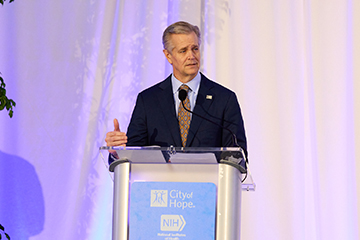
“If we do this well, if we bring the same level of collaboration, focus, and urgency that has defined the greatest achievements in cancer, then the microbiome will represent the next chapter in how we attack cancer and in turn change the world for people,” said Robert Stone, City of Hope CEO and the Helen and Morgan Chu Chief Executive Officer Distinguished Chair.
That sense of urgency extended beyond the scientific community.
“I want to open the door so that we understand much more about the microbiome in three years than we have in all the years leading up to now,” said Robert F. Kennedy, Jr., U.S. Secretary of Health and Human Services (HHS). “I want to make it a moonshot. I think it's so critical for American health.”
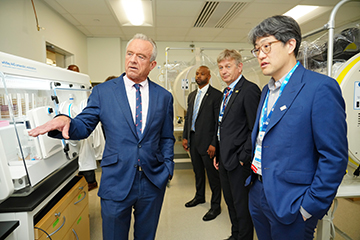
Who attended the microbiome symposium: Leading researchers and executives from City of Hope, the National Cancer Institute, the University of Texas MD Anderson Cancer Center, Memorial Sloan Kettering Cancer Center, Dana-Farber Cancer Institute, University of Pennsylvania’s Perelman School of Medicine, Roswell Park Comprehensive Cancer Center, and Fred Hutch Cancer Center gathered with government officials including HHS Secretary Robert F. Kennedy Jr., and National Institutes of Health Director Jay Bhattacharya, M.D., Ph.D.
Experts who presented in the symposium say the gut microbiome may become a central factor in cancer prevention, treatment response and patient outcomes.
Why the gut: The human body hosts trillions of tiny microbes that, for the most part, live symbiotically in our nose, lungs, digestive tract, and other organs. In recent years, the microbiome, as these communities are collectively called, has gained attention as a potential mediator of a wide range of health conditions.
An emerging consensus among researchers is that the gut microbiome is not just a peripheral community of organisms. In fact, it’s now being reframed as an organ system that should be evaluated alongside other major considerations such as cardiac, pulmonary, and renal function. Many recent studies have shown that the gut microbiome can have a direct impact on cancer treatment efficacy and toxicity.
"The microbiome is a relevant organ that we need to know about if we want to do the best for our patients," said Marcel van den Brink, M.D., Ph.D., president of City of Hope National Medical Center and a nationally recognized leader in microbiome research. "Incorporating that in our way of thinking when we analyze a patient for a therapy or for having cancer – that would be a big step forward.”
How the gut may influence cancer care:
- Shaping the immune system, gut microbes help regulate responses to threats, including cancer cells, infections, and treatment of side effects.
- Being highly modifiable compared to other organ systems, meaning it can be tracked before, during and after treatment and potentially improved as needed through diet, and emerging therapies including probiotics and fecal microbiome transplants.
- Evidence suggests that the microbiome may actively determine responses to some treatments and may explain why patients with similar cancers often have very different responses to the same therapies. For example, research has found that microbiome composition differs meaningfully between responders and non-responders to immunotherapy.
- Medications, radiation, dietary changes, and intensive therapies like stem cell transplants may alter and disrupt the microbiome, affecting treatment tolerance, recovery and more.
Leading-edge research at City of Hope and other prominent institutions who participated in the event have begun critical investigations of the microbiome, finding strong links between it and many aspects related to cancer. Additional topics discussed at the symposium included:
- Food as medicine - Growing evidence shows that diet may influence inflammation, immune function, and other factors in cancer care. For example, an early City of Hope study showed that high fiber intake in stem cell transplant patients was linked to fewer severe complications, fewer infections, and better survival.
- Boosting the microbiome for better outcomes - One small study at MD Anderson investigating the use of fecal microbiome transplants (FMT) from healthy individuals to improve the microbiomes of cancer patients found that one-third of the FMT recipients overcame a previous resistance to immunotherapy.
- Emerging fields of study – Researchers also talked about the potential of using microbes that are naturally drawn to tumors to deliver therapies directly, developing synthetic treatments to modulate the microbiome and reshape immune responses.
"Diet shapes the microbiome and the microbiome produces metabolites and those metabolites circulate systemically to influence tumor development and organized anti-tumor immune response,” said Emese Zsiros M.D., Ph.D., chair of the Department of Gynecologic Oncology at Roswell Park Comprehensive Cancer Center. “That immune response architecture helps to determine who derives the durable benefit from immunotherapy. Five steps, one system.”
Key takeaways:
- The microbiome is emerging as a potentially controllable lever in cancer therapy.
- Understanding how the microbiome works in the context of cancer could lead to more precise treatments that improve outcomes.
- In small studies, a healthy, highly diverse gut microbiome was associated with better overall survival for many cancer patients.
- Cancer centers and clinical trials should formally incorporate microbiome assessment and intervention into their treatment and study plans.
As Nadim Ajami, Ph.D., who co-leads MD Anderson’s Platform for Innovative Microbiome and Translational Research remarked, “Medicine has transformed cancer care, but microbiome health really can help us write a next chapter for cancer prevention and better outcomes."
What's next: Most studies thus far of the microbiome in the context of cancer have been small and preclinical. Sustained federal investment in cancer research is essential to building powerful research programs and transitioning the science from exploratory to life changing. To develop large-scale randomized clinical trials that have the potential to bring scientific breakthroughs to patients beyond academic medical centers, more support is needed.
"I hope we can come together as a national consortium and think along the lines of a moonshot … taking all the knowledge we have so far about cancer, diet and the microbiome into trials," said Dr. van den Brink.
“The moment is now for us to seize in terms of possibilities,” said Robert Jenq, M.D., director of the City of Hope Microbiome Program. “The foundation has been laid, and the tools are now available, so I’m really optimistic about this."
At City of Hope, the microbiome program is already dedicated to revolutionizing cancer care by harnessing the untapped therapeutic potential of the microbiome and establishing itself as a global hub for microbiome research.
“We are studying how the microbiome, diet, immune function, and cancer treatment interact, and we are already putting that understanding into practice through clinical nutrition, transplant care, and supportive therapies designed to help patients tolerate treatment and recover more fully," said Dr. van den Brink.
Learn more about City of Hope's microbiome research program.