Turns out, more than a few cancer patients liken their disease to a dragon as well: the deadly, merciless, relentless beast that must be confronted, fought, and conquered.
What do these two “dragons” have in common?
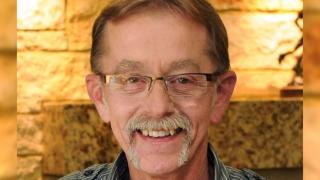
Phil Bosanko.
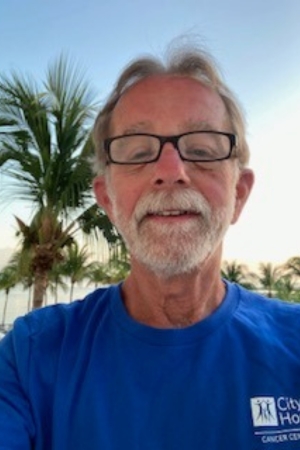
At 68, Bosanko, who lives in Wind Lake, Wisconsin, is a double dragon slayer and a hopeful sign of what’s possible.
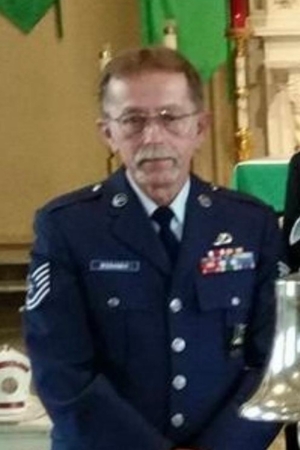
A retired Air Force firefighter, Bosanko battled and defeated stage 4 colon cancer. He sees the parallels.
“[Firefighting is] a brotherhood like no other,” said Bosanko. He means it literally. Three of his brothers are fellow smoke eaters. “Then again, us cancer fighters and survivors, it’s a club you never wanted to join, but also like no other.”
Caught early, colorectal cancer is highly curable, usually through surgery, and five-year survival rates can approach 90%. It’s a much grimmer story for stage 4 when cancer cells have spread to other organs, like the liver and lungs.
20 Years of Stage 4 Colon Cancer Survival
Bosanko is alive and cancer-free nearly 20 years after his stage 4 diagnosis, a feat that is almost unheard of. He marvels at his good fortune, considering how his cancer journey began.
“He was given a death sentence by his local doctors,” recalled Evan Pisick, M.D., chief of medical oncology at City of Hope® Cancer Center Chicago and associate clinical professor with the Department of Medical Oncology & Therapeutics Research.
The diagnosis had come out of nowhere.
Growing up near Milwaukee, Bosanko was a typical, healthy, athletic kid with no family history of colon cancer.
He joined the Air Force after high school, hoping to train as a military police officer, but didn’t meet the height requirement in effect at the time. He switched to firefighting “and I loved it!” he said. Bosanko spent 14 years battling flames for the Air Force, plus another decade of volunteer firefighting in Wisconsin. In civilian life he worked for a software company and, after 9/11, signed up to join the new Transportation Security Administration, where he served another 17 years.
Bosanko’s First Colon Cancer Symptoms
It was during his TSA tenure, in early 2006, when Bosanko, then 48 and still in good shape (“I ran a mile-and-a-half every day,” he said), saw some blood spotting which lasted about a week. His wife Kim, a registered nurse, was concerned. She brought him to their local hospital for his first-ever colonoscopy, as well as a Computed Tomography (CT) scan.
The colonoscopy showed the presence of cancer, and Bosanko was immediately admitted and scheduled for surgery. A few days later, nine inches of his colon would be removed.
Nevertheless, the couple was optimistic. They assumed Phil’s disease was early stage and had been caught in time.
“The oncologist walked in, looked at me and said, ‘Hi, you have one year to live. Your entire liver is covered with cancer.’”
Stage 4.
“It was a knee to the groin,” said Bosanko, matter-of-factly.
It can take a decade or more for colon cancer to reach stage 4, which means the disease likely had been growing inside Bosanko as early as his 30s, far younger than the recommended age (45 now, recently lowered from 50) for beginning regular colonoscopies.
Colorectal Cancer Diagnoses in Younger Patients
When Bosanko was diagnosed, he was considerably younger than typical colon cancer patients of the era, usually in their mid 60s. That is no longer the case today. Doctors are seeing a growing number of younger patients. They attribute this alarming change to several factors.
“Environmental,” asserted Dr. Pisick. “Our food, water, air, the microplastics getting into our bodies. Plus our Western diet, with all that ultra-processed food, plays a role. So does obesity.”
Bosanko did not like his oncologist’s attitude, nor the standard post-surgery chemotherapy regimen being offered. In search of a second opinion and, more importantly, more innovative strategies, he contacted the Zion, Illinois institution that ultimately became City of Hope Chicago. Three weeks later, he was there.
“It was night and day,” said Bosanko. “They treat you like a person, not a number.”
Standard procedure, says Pisick, who’s served at the Zion facility since 2008 — before, during and after the City of Hope transition — and has seen uninterrupted commitment to leading-edge, patient-centered care.
“The culture hasn’t changed,” he said. “Our values and missions were aligned. And joining City of Hope gave us even better technologies and clinical trials.”
Gone now was Bosanko’s “one year to live” prognosis, replaced with optimism. Bosanko, an avid deer hunter, noticed the difference.
“I told (the oncologist), ‘I'm not going to make it to deer camp this year.’ I was bummed. But he assured me I was well on my way to getting better. He said, ‘I think you'll be at deer camp next year.’
“That bumped me up!”
Finding tumors in the liver should no longer mean there is no hope, explained Yuman Fong, M.D., City of Hope’s Sangiacomo Family Chair in Surgical Oncology. The liver is an effective filter, he says, which blocks the cancer from advancing further. Unfortunately many oncologists don’t understand that. “The fact is,” asserted Fong, “today we can clear the liver, help people live longer, and 30 to 40% of them can be cured.”
Not that it would be easy. Bosanko’s liver was riddled with tumors, the largest one, he says, was “the size of a baseball.”
Trying Hepatic Artery Infusion
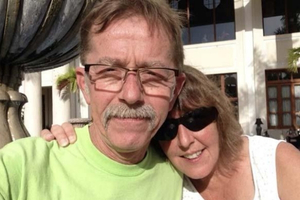
But as it turned out, the tumors were especially receptive to chemotherapy. Bosanko began an intense regimen of 15 cycles of cisplatin and leucovorin infusions, five days a week, four hours a day. To battle the inevitable nausea, he was given Zofran®. And then his doctors deployed a powerful weapon to take the cancer fight right to the source.
First developed in the 1980s, a process called hepatic artery infusion (HAI) pumps super-concentrated chemo drugs directly into the patient’s liver. This allows the chemo to work efficiently without harming the rest of the body. It’s a long, 12-hour procedure and Bosanko had it three times, receiving the drug mitomycin.
HAI was still somewhat experimental at the time, but today it is approved as a standard of cancer care under the guidelines of the National Comprehensive Cancer Network (NCCN). And the process keeps improving.
“Today we have even better pumps and better drugs,” explained Pisick.
Make no mistake, Bosanko experienced some tough moments during his 15 months of chemo. “Did I have bad days? Sure.” He lost a lot of weight, and almost lost his will.
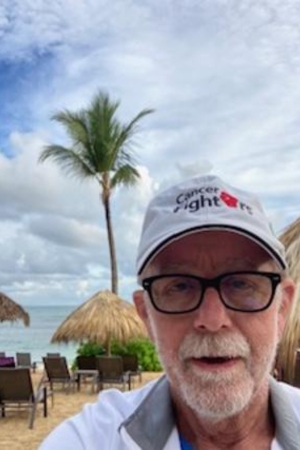
But he got through it. Not long after completing chemo, Bosanko was back at work, and ever since he’s been the “go-to” guy – in his neighborhood, and beyond, as a member of Cancer Fighters, answering questions about cancer, encouraging everyone to fight, to get a second opinion, and most of all, to slay that dragon: never give up.
“I feel both lucky and blessed,” he says. One of his favorite T-shirts reads, “If you think winning isn’t everything, you’ve never had cancer!”
If you or a loved one is concerned about possible signs or symptoms of cancer and would like an initial appointment or a second opinion, call us 24/7 at (877) 516-9365.